You are using an outdated browser and your browsing experience will not be optimal. Please update to the latest version of Microsoft Edge, Google Chrome or Mozilla Firefox. Install Microsoft Edge

September 6, 2024

ASEAN: Big Changes on Vitamin and Mineral Limits for Health Supplements

Addressing technical barriers to trade is a key priority for the Association of Southeast Asian Nations (ASEAN) as part of trade facilitation in achieving the single market and production base under the ASEAN Economic Community directive agreed in 2015. The region has been undertaking positive steps toward standard harmonization in ASEAN priority sectors, integrating and bringing about regulatory convergence by taking into account the diversities that exist in the ten ASEAN member states.

Health supplements in ASEAN are under the responsibility of the Traditional Medicine and Health Supplement Product Working Group (TMHS PWG). One of the TMHS PWG’s outputs is the ASEAN Agreement on a Regulatory Framework for Health Supplements, which includes various technical requirements for health supplements that participating member states must adopt by adjusting their domestic regulations.

The key ingredients of these health supplements are vitamins and minerals. While all ASEAN countries allow the use of vitamins and minerals in health supplements, the amounts allowed for use vary, depending on the nutritional requirements deemed appropriate by each country.

Partly in response to these efforts for regional harmonization, there have been important changes to vitamin and mineral limits in certain ASEAN countries that are worth monitoring. Some of these are outlined below.

Thailand

In January 2024, the Thai Food and Drug Administration (TFDA) updated the Thai Recommended Daily Intake (Thai RDI) guidelines for the Thai population. Subsequently, the TFDA adjusted the vitamin and mineral limits in order to comply with the updated Thai RDI and to follow the ASEAN Agreement on a Regulatory Framework for Health Supplements.

The TFDA’s adjustment of vitamin and mineral limits for use in food supplements came in Notification of the Ministry of Public Health (No. 448) B.E. 2566 (2023) Re: Food Supplements (No. 5), which was published in the Government Gazette on January 4, 2024. It increased the maximum limits for certain vitamins and minerals (see breakdown below) up to the limits that had previously only been allowed in drugs. The minimum limits of vitamins and minerals for use in food supplements should be more than 15% of Thai RDIs, as set out in the Notification of the Ministry of Public Health (No. 445) B.E. 2566 (2023) Re: Nutrition Labels. This notification took effect on July 2, 2024.

Before that date, if a party wished to use more than 60 mg of Vitamin C or more than 2 mcg of Vitamin B12 in a health supplement, they would have needed to register the product as a medicine (not a health supplement) in Thailand. Now, health supplements are allowed to use 1,000 mg of vitamin C and 600 mcg of vitamin B12—a level that previously would have required registration as a medicine.

Health supplements are classified as a type of food in Thailand—this differs from some other countries, which may include health supplements in the medicine group. The registration process for health supplements is straightforward and takes a short time (about one to two months) to receive approval. On the other hand, drug registration is more complex and time-consuming. Health supplement companies widely agree that the time needed to receive license approval is one of the main obstacles for a business getting their products to market.

This change allows products that in the past had to be registered as medicines to now be accepted as health supplements in Thailand. This regulatory change will help promote the health supplement business in Thailand and ASEAN.

Indonesia

In Indonesia, the maximum limits for vitamins and minerals for use in health supplements were first updated by the Indonesian FDA (known as BPOM) with the issuance of BPOM Regulation No. 11 of 2020 concerning the Criteria and Procedure for Health Supplement Registration, which has since been revoked by BPOM Regulation No. 32 of 2022. There is currently a draft amendment to BPOM Regulation No. 32 of 2022 that has not yet been finalized. However, the draft amendment does not propose any changes to the current maximum limits for vitamins and minerals.

This shows how BPOM has been actively updating the regulatory framework on health supplements due to the large presence of health supplement products in Indonesia. Businesses in this sector therefore need to be sure of the latest requirements before registering their health supplement products in Indonesia.

Vietnam

In contrast to the changes seen in recent years in Indonesia and Thailand, Vietnam has not amended or drafted any amendments to domestic regulations related to the maximum levels of vitamins and minerals in health foods since 2014. The current maximum limits for vitamins and minerals in Vietnam are not matched to those in neighboring countries or to those in the ASEAN Agreement on a Regulatory Framework for Health Supplements. Nevertheless, Vietnam may consider revising the maximum limits at some point to comply with the ASEAN standards.

In Vietnam, health supplements are classified as food rather than medicine. Under Vietnam’s current regulations, the vitamin and mineral content in health supplements (calculated according to the manufacturer’s recommended daily dose) must not exceed the maximum intake threshold for vitamins and minerals prescribed in Circular 43/2014/TT-BYT.

If the maximum intake threshold is not specified, the related Codex regulations or those of relevant international organizations apply.

Breakdown

The following table summarizes the current maximum daily limits for vitamins and minerals in health supplements for adults in Thailand, Indonesia, and Vietnam. It also shows how the limits have changed compared to the previous regulations in each country.
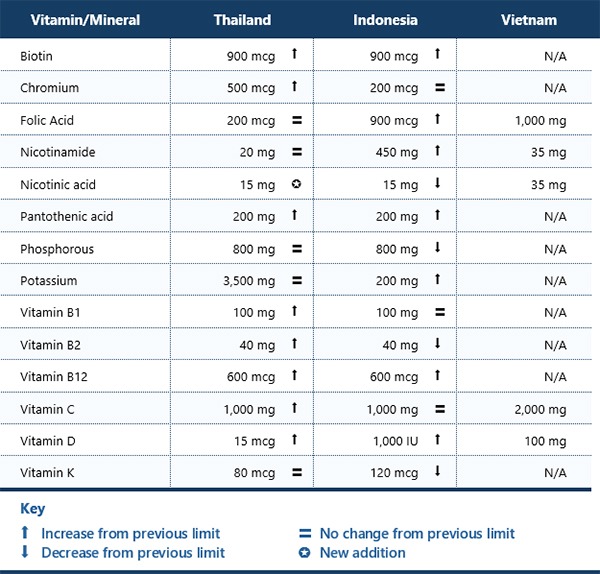
Where the limits are marked as not available, manufacturers may either follow the limitations under the ASEAN Agreement on a Regulatory Framework for Health Supplements or assume vitamins and mineral limits in health supplements based on generally accepted scientific data and taking into consideration, as appropriate, the varying degrees of sensitivity of different consumer groups.


RELATED INSIGHTS​ 

December 13, 2024
Experts from Tilleke & Gibbins have provided updates for the latest edition of The Pharma Legal Handbook: Vietnam, published by Pharma Boardroom. This comprehensive guide to the legal framework regulating the healthcare and life sciences industries in Vietnam was authored by by the Hanoi-based team of Hien Thi Thu Vu, head of regulatory affairs for Vietnam, and Mai Thi Le, regulatory affairs consultant, the handbook is a must-read for healthcare and life sciences companies that are interested in the Vietnam market. The guide includes eight sections on various important aspects of local regulations: Regulatory, Pricing, and Reimbursement Overview Preclinical & Clinical Trial Requirements Marketing, Manufacturing, Packaging & Labeling, and Advertising Traditional Medicines and Over-the-Counter Products Product Liability Patents and Trademarks Regulatory Reforms Orphan Drugs and Rare Diseases Tilleke & Gibbins has also authored The Pharma Legal Handbook: Thailand, which was updated at the same time as the Vietnam guide. The Pharma Legal Handbook: Vietnam, like all of the country guides from Pharma Boardroom, is available for purchase on the Pharma Boardroom website.
December 13, 2024
Attorneys from Tilleke & Gibbins in Bangkok have provided updates for the latest edition of The Pharma Legal Handbook: Thailand, published by Pharma Boardroom. This comprehensive guide to the legal framework regulating the healthcare and life sciences industries in Thailand was authored by Alan Adcock, partner and director, intellectual property, and head of the firm’s life sciences practice; Dr. Atthachai Homhuan, manager of regulatory affairs; and San Chaithiraphant, senior associate. The handbook is a must-read for healthcare and life sciences companies that are interested in exploring expansion into the Thai market.
December 12, 2024
On November 21, 2024, the National Assembly of Vietnam adopted a law amending and supplementing the 2016 Law on Pharmacy (“Amended Law on Pharmacy”). The Amended Law on Pharmacy simplifies some procedures for the pharmaceutical field, and will take effect on July 1, 2025, except for regulations on drug registration and rights and responsibilities of certain types of pharmaceutical business. Some outstanding points in the Amended Law on Pharmacy are presented below. E-commerce Distribution The Amended Law on Pharmacy allows trading in pharmaceutical products by the e-commerce channel, including e-commerce trading floors, e-commerce sales applications, and e-commerce sales websites with online ordering functions. Accordingly, e-commerce retail of non-prescription drugs is permitted if the drugs are neither specially controlled drugs nor drugs included in the list of drugs restricted for retail sale, and e-commerce wholesale of drugs and drug materials is permitted, as long as they are not specially controlled drugs. New Rights for Import FIEs The amendment provides some additional rights to foreign-invested enterprises (“FIEs”) that import drugs, including the rights to: Repurchase drugs and drug materials manufactured through the technology transfer of the FIE itself in Vietnam, and sell such products to wholesalers; Import drug materials to supply to drug manufacturers in Vietnam that are hired by or receive technology transfer from the FIE itself under a processing contract or technology transfer contract; Deliver and transport drugs and drug materials the FIE has imported, outsourced for processing, or transferred technology for in Vietnam, from the FIE’s warehouse to its wholesalers; Deliver and transport drugs used in aid, sponsorship, humanitarian, and disease prevention and control programs to medical facilities receiving funding; and Transport drug materials imported by the FIE from its warehouse to drug manufacturers that are hired by or receive technology transfer from the FIE itself under a
December 9, 2024
Cambodia’s Law on Seed Management and Plant Breeder’s Rights was enacted in 2008, but it was not until recently that new plant varieties could successfully be registered for protection in the country. Although the law has been in place for some time, recent developments confirmed the application process and a schedule of charges for the registration of new plant varieties. With these developments, breeders have been able to register their new plant varieties in Cambodia since March 1, 2024. Applicants for new plant variety protection must be Cambodian nationals, foreign nationals domiciled in Cambodia, or permanent residents of either a country that is a contracting party to the International Union for the Protection of New Varieties of Plants (UPOV) Convention or a country with which Cambodia has signed a memorandum of understanding on plant variety protection. Applicants can also claim a priority date from the first application for the same plant variety filed in any contracting party of the UPOV Convention within 12 months of the earliest application’s filing date. To be eligible for protection, new plant varieties must satisfy the following criteria: Novelty: A variety is considered “new” if, at the date of filing the application for new plant variety protection, it has not been sold, marketed, or otherwise disposed of others—by or with the consent of the breeder—for more than: One year for any plant variety in Cambodia; Six years for trees and vines or four years for all other plant varieties in countries besides Cambodia. Distinctiveness: A variety must be clearly distinguishable from any other existing varieties. Uniformity: A variety must be sufficiently uniform in its relevant characteristics. Stability: A variety must remain unchanged in its essential characteristics at the end of each cycle of propagation and in each generation. The last three criteria are often