
You are using an outdated browser and your browsing experience will not be optimal. Please update to the latest version of Microsoft Edge, Google Chrome or Mozilla Firefox. Install Microsoft Edge

February 3, 2023

A Review of the Japan-Vietnam Patent Prosecution Highway

Overview

Although Vietnam has a number of mechanisms for accelerating the patent examination process, most of them have not lived up to the expectations of applicants. However, a fast-track patent prosecution highway (PPH) program was opened for the first time between the Intellectual Property Office of Vietnam (IP Office) and the Japan Patent Office (JPO) in January 2016, creating opportunities for all applications originating from Japan.

The PPH program has been rolled out in the following stages:
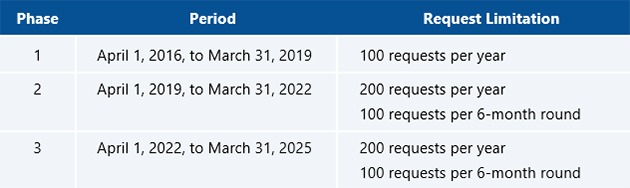
After more than six years of implementation, this program is considered successful and can be extended to support Japanese enterprises in establishing patent rights in Vietnam.

Effectiveness

This program has many advantages, such as:

  • Applications originating from Japan are usually of good quality with clear and coherent specification It is possible that the IP Office’s requirements for specifications are already very consistent with Japanese applicants’ way of drafting specifications thanks to the JPO’s training programs for the IP Office.
  • Patents in Japan usually have a short examination timeline and are granted very quickly, even within the application filing timeline in Vietnam (12 months from the priority date for applications filed under the Paris Convention and 31 months from the priority date for applications filed as PCT national phase applications).
  • The coordination between the JPO and the IP Office has been very good. PPH applications are processed in a quick and efficient manner.
  • Japanese applicants and their representatives also often coordinate well with the IP Office to rectify formality shortcomings and avoid prolongation of the examination period.

Although there are no official statistics from the IP Office, according to independent statistics for applications whose PPH requests were filed by Tilleke & Gibbins’ associate firm (one of the most prolific filers under the PPH), the examination period for applications under the PPH has been significantly shortened, compared to the period for substantive examination as prescribed by law (18 months):

  • The average period for receiving the first office action as from the date of the PPH request is 8.53 months.
  • The average period for receiving a notice of allowance without an office action from the date of requesting PPH is 7.98 months.

Further, the prescribed 18-month time limit for examination is often difficult to achieve for various reasons, and the actual examination period for applications not under the PPH program is typically much longer than 18 months in practice. Obviously, the PPH has been providing a tremendous time benefit to Japanese applicants.

Current Status

Since its inception, the PPH program has attracted the attention of many Japanese enterprises and industrial property representatives in Vietnam. In fact, in the first rounds of this program, the timeline for the number of requests to reach the limit was often very short, and in many cases the limit was reached on the very first day the round was opened.
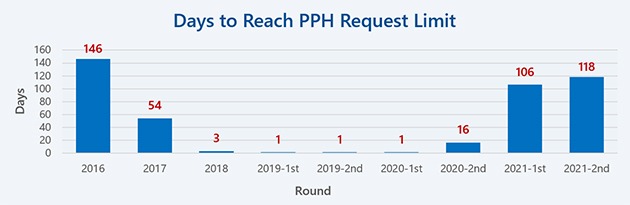
However, despite the PPH’s apparent effectiveness, recent monitoring of the number of applications as well as the time limit for filing PPH requests shows that this program has not been attracting the attention of Japanese applicants as much as before. According to the above figure, the number of days to reach the request limit has increased in every period since 2020. By 2022, the first round, which was opened on April 1, 2022, had not even reached 100 requests after six months, and the 34 remaining spots were moved to the second round, which was opened on October 1, 2022.

It is not clear why Japanese applicants have shown reduced interest in the PPH program after its initial popularity, though it is worth noting that the time period in which the number of PPH requests was slower to reach the limit (from October 2020 to mid-2022), coincided with the period when Japan and Vietnam were most affected by the Covid-19 pandemic. This may have affected the management strategy of Japanese enterprises as well as the budget for promoting IP portfolios.

Upcoming Changes

Article 114 of Vietnam’s amended IP Law, which took effect on January 1, 2023, allows the IP Office to use the results of substantive examination of a patent application claiming the same invention filed with a foreign patent office in the process of assessing the patentability of the corresponding Vietnamese application. The latest draft of a circular to replace Circular 01/2007, which guides the implementation of the IP Law, also includes provisions intended to allow an applicant to proactively request the IP Office to proceed in this manner. Also according to this draft circular, if the IP Office accepts the applicant’s request, a communication on substantive examination results must be issued for the Vietnamese application within 12 months from the date of the request.

As such, Article 114 of the IP Law seems to open a new door for patent applicants in accelerating the examination process in Vietnam. This program is expected to be equally effective and possibly even more effective than existing acceleration programs. The scope of expedited examination is extended to applicants from all countries and is not limited only to applications originating from Japan and South Korea (which has its own PPH with Vietnam) or applications with equivalent applications filed in ASEAN countries under the ASPEC program.

Although on the positive side, the expedited process will give applicants more options, on the other hand, because of the overlap in the results that can serve as basis for examination, this new program will “steal” applications from the PPH program. Thus, once the new program goes into effect, Japanese applicants will no longer have a significant advantage over applicants from other countries that can use foreign results. However, according to the statistics cited above, the average examination period of the PPH program may still be shorter, and the PPH program has been operating in a stable manner; hence, in the early period once the new program is in place, the Japan PPH may still be more attractive.

As Vietnam currently does not have a mechanism for extending the protection term of a patent, the early granting of a protection title is still an advantage. The PPH remains an effective channel for Japanese applicants in expediting the examination and granting of patents in Vietnam.

RELATED INSIGHTS​ 

December 4, 2024
On December 1, 2024, Myanmar’s Intellectual Property Department (IPD) issued the first group of trademark certificates of registration for marks registered under the Trademark Law of 2019. This is the first registration announcement since the start of the IPD’s soft opening period in 2020. With the registration of marks now in place, registered owners will benefit from stronger legal protections. These protections include the exclusive right to prevent unauthorized use of identical or similar marks by third parties and the ability to take enforcement and administrative actions. Myanmar’s implementation of the “first-to-file” system further emphasizes the importance of early registration. Marks registered at an early stage will be in a stronger position when filing oppositions against subsequent applications for identical or confusingly similar marks. The IPD issues certificates of registration in an electronic format to owners who have filed their applications via the IPD’s online filing system. For applicants who submitted their marks via physical applications, the IPD will issue physical certificates of registration. The initial registration term for a mark is 10 years from the filing date and is renewable for additional periods of 10 years each time. The IPD publicly discloses the details of marks registered under Myanmar’s Trademark Law via their official website. The IPD’s issuance of mark registrations under the Trademark Law of 2019 is a decisive step forward in intellectual property protection in Myanmar. It enhances legal safeguards for mark owners and any other authorized persons, and affirms Myanmar’s commitment to aligning its practices with global standards. For more information on protecting intellectual property rights in Myanmar, please contact Tilleke & Gibbins at [email protected].
December 4, 2024
On October 28, 2024, Indonesia officially amended its existing Patent Law when the president ratified Law Number 65 of 2024. This comprehensive update—the third such amendment in the history of Indonesia’s Patent Law—introduces several key changes that will significantly impact patent protection and application processes in Indonesia. Key highlights and changes are outlined below. Definition of Invention The new law broadens the definition of “invention” to explicitly include systems, methods, and uses. Additionally, the law introduces formal definitions for traditional knowledge and genetic resources. Patentability Criteria Notable changes include: Computer programs are now excluded, with an exception for computer-implemented inventions. Theories and methods in science and mathematics are added to the list of excluded inventions. Previous restrictions on new uses of existing products are removed. Grace Periods The grace periods for some patent-related actions have been adjusted: The grace period for disclosures has been extended to 12 months (from 6 months previously), providing inventors with more flexibility in filing patent applications after initial disclosure. A newly introduced item is the grace period for a conventional patent application claiming priority rights, which is 4 months after the 12-month filing deadline under the Paris Convention. The grace period for annuity payments is 6 months (from 12 months previously) with a fine for late payments of 100% of the annual fee payable. Patent Holder Rights and Obligations Patent holders can now grant permissions to enforce patents. There is a new requirement for patent holders to submit annual statements on patent implementation in Indonesia. Compulsory Licensing Significant changes to compulsory licensing include: Establishment of licenses based on the principle of expediency. Limitations on license scope and transferability. Prioritization of domestic market needs. New provisions for technical improvements and economic significance. Government Patent Exploitation The new law contains specific provisions for the government’s implementation
December 4, 2024
Thailand Legal Basics, a valuable primer for foreign investors, explores all aspects of living and doing business in Thailand. Written by specialists at Tilleke & Gibbins in Bangkok, it is the only comprehensive English-language guide to the Thai legal system with a focus on the concerns of foreign business and investment.
November 25, 2024
Trademark registration for marks composed of combinations of Roman letters and/or Arabic numerals has long been challenging in Thailand, particularly for those that are neither stylised nor pronounceable. There have been conflicting perspectives regarding the interpretation of “invented letter(s) and numeral(s)” under Section 7 of the Thai Trademark Act. The Department of Intellectual Property (DIP) has considered that letters and numerals must feature notable visual enhancements to be inherently distinctive, and “invented” must be in the form of stylisation, such as overlapping or interlocking letters, or intricate designs like traditional Thai oral patterns or geometric motifs. Some examples of acceptable letter and numeral marks according to the DIP The courts, however, have consistently recognised that three-letter marks, even when presented without stylisation, can be inherently distinctive. The rationale is that these marks, viewed as random and unusual combinations, can in many cases be distinguishable from common words and sufficient for the public to identify the associated goods/services, and distinguish them from others. Following Supreme Court precedents on registrability, the DIP officially updated its Examination Guidelines in January 2022 to recognise that combinations of three or more letters, even if not stylised or forming pronounceable words, can be deemed inherently distinctive. Challenges persist, however, for two-letter marks, which still face significant obstacles in achieving registrability. The JD case Background Beijing Jing Dong 360 Du E-Commerce, one of China’s largest e-commerce companies, led trademark applications for the marks JD.COM (and device) and JD.CO.TH (and device) for services in Class 35 related to advertising and business management: The registrar rejected the applications, citing insufficient stylisation of ‘JD’ and describing ‘.com’ and ‘.co.th’ as common descriptive terms. The applicant appealed to the Board of Trademarks, which upheld the refusal, echoing the registrar’s reasoning and asserting that the marks were devoid of inherent distinctiveness