
You are using an outdated browser and your browsing experience will not be optimal. Please update to the latest version of Microsoft Edge, Google Chrome or Mozilla Firefox. Install Microsoft Edge

February 3, 2023

A Review of the Japan-Vietnam Patent Prosecution Highway

Overview

Although Vietnam has a number of mechanisms for accelerating the patent examination process, most of them have not lived up to the expectations of applicants. However, a fast-track patent prosecution highway (PPH) program was opened for the first time between the Intellectual Property Office of Vietnam (IP Office) and the Japan Patent Office (JPO) in January 2016, creating opportunities for all applications originating from Japan.

The PPH program has been rolled out in the following stages:
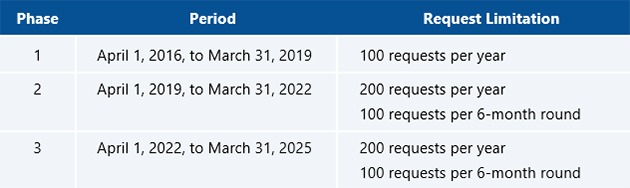
After more than six years of implementation, this program is considered successful and can be extended to support Japanese enterprises in establishing patent rights in Vietnam.

Effectiveness

This program has many advantages, such as:

  • Applications originating from Japan are usually of good quality with clear and coherent specification It is possible that the IP Office’s requirements for specifications are already very consistent with Japanese applicants’ way of drafting specifications thanks to the JPO’s training programs for the IP Office.
  • Patents in Japan usually have a short examination timeline and are granted very quickly, even within the application filing timeline in Vietnam (12 months from the priority date for applications filed under the Paris Convention and 31 months from the priority date for applications filed as PCT national phase applications).
  • The coordination between the JPO and the IP Office has been very good. PPH applications are processed in a quick and efficient manner.
  • Japanese applicants and their representatives also often coordinate well with the IP Office to rectify formality shortcomings and avoid prolongation of the examination period.

Although there are no official statistics from the IP Office, according to independent statistics for applications whose PPH requests were filed by Tilleke & Gibbins’ associate firm (one of the most prolific filers under the PPH), the examination period for applications under the PPH has been significantly shortened, compared to the period for substantive examination as prescribed by law (18 months):

  • The average period for receiving the first office action as from the date of the PPH request is 8.53 months.
  • The average period for receiving a notice of allowance without an office action from the date of requesting PPH is 7.98 months.

Further, the prescribed 18-month time limit for examination is often difficult to achieve for various reasons, and the actual examination period for applications not under the PPH program is typically much longer than 18 months in practice. Obviously, the PPH has been providing a tremendous time benefit to Japanese applicants.

Current Status

Since its inception, the PPH program has attracted the attention of many Japanese enterprises and industrial property representatives in Vietnam. In fact, in the first rounds of this program, the timeline for the number of requests to reach the limit was often very short, and in many cases the limit was reached on the very first day the round was opened.
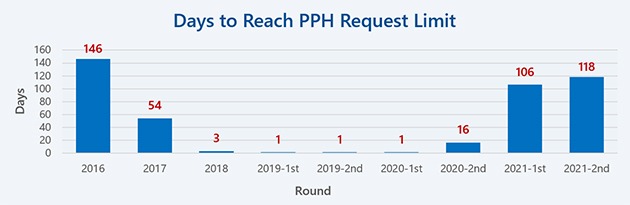
However, despite the PPH’s apparent effectiveness, recent monitoring of the number of applications as well as the time limit for filing PPH requests shows that this program has not been attracting the attention of Japanese applicants as much as before. According to the above figure, the number of days to reach the request limit has increased in every period since 2020. By 2022, the first round, which was opened on April 1, 2022, had not even reached 100 requests after six months, and the 34 remaining spots were moved to the second round, which was opened on October 1, 2022.

It is not clear why Japanese applicants have shown reduced interest in the PPH program after its initial popularity, though it is worth noting that the time period in which the number of PPH requests was slower to reach the limit (from October 2020 to mid-2022), coincided with the period when Japan and Vietnam were most affected by the Covid-19 pandemic. This may have affected the management strategy of Japanese enterprises as well as the budget for promoting IP portfolios.

Upcoming Changes

Article 114 of Vietnam’s amended IP Law, which took effect on January 1, 2023, allows the IP Office to use the results of substantive examination of a patent application claiming the same invention filed with a foreign patent office in the process of assessing the patentability of the corresponding Vietnamese application. The latest draft of a circular to replace Circular 01/2007, which guides the implementation of the IP Law, also includes provisions intended to allow an applicant to proactively request the IP Office to proceed in this manner. Also according to this draft circular, if the IP Office accepts the applicant’s request, a communication on substantive examination results must be issued for the Vietnamese application within 12 months from the date of the request.

As such, Article 114 of the IP Law seems to open a new door for patent applicants in accelerating the examination process in Vietnam. This program is expected to be equally effective and possibly even more effective than existing acceleration programs. The scope of expedited examination is extended to applicants from all countries and is not limited only to applications originating from Japan and South Korea (which has its own PPH with Vietnam) or applications with equivalent applications filed in ASEAN countries under the ASPEC program.

Although on the positive side, the expedited process will give applicants more options, on the other hand, because of the overlap in the results that can serve as basis for examination, this new program will “steal” applications from the PPH program. Thus, once the new program goes into effect, Japanese applicants will no longer have a significant advantage over applicants from other countries that can use foreign results. However, according to the statistics cited above, the average examination period of the PPH program may still be shorter, and the PPH program has been operating in a stable manner; hence, in the early period once the new program is in place, the Japan PPH may still be more attractive.

As Vietnam currently does not have a mechanism for extending the protection term of a patent, the early granting of a protection title is still an advantage. The PPH remains an effective channel for Japanese applicants in expediting the examination and granting of patents in Vietnam.

RELATED INSIGHTS​ 

November 15, 2024
Vietnam’s new Decree No. 147/2024/ND-CP on the management, provision, and use of internet services and online information (“Decree 147”), which will come into effect on December 25, 2024, replacing Decree No. 72/2013/ND-CP (“Decree 72”), introduces several changes to the regime for domain name dispute resolution. The new decree aims to clarify the legal framework and address some longstanding inconsistencies between Vietnam’s laws on intellectual property and information technology. The main changes related to domain name dispute resolution under Decree 147 are summarized below. Removal of Prescriptive Actions Decree 147 no longer lists specific actions for resolving domain name disputes. Decree 72 had outlined three methods: negotiation/mediation, arbitration, and court. However, IP practitioners had long criticized this approach, arguing it conflicted with the IP Law, which additionally allows administrative action. By omitting these methods, the new decree implies an acceptance of administrative action as provided in the IP Law. However, Decree 147 remains silent on establishing a dispute resolution forum aligned with the CPTPP’s requirement for a UDRP-like model. Currently, Vietnam’s available forums do not fully conform to the UDRP framework. An anticipated circular may provide further guidance on this aspect. Deactivation of Domain Names Decree 72 does not have any provision on the deactivation of a domain name. However, Decree 147 has stipulated some situations where domain names will be deactivated, such as when there is a request from an authority, or when it is discovered that incorrect information was used for registration. Clearer Criteria for Dispute Resolution Article 16 of Decree 147 sets out three clear criteria that must be met for domain name dispute resolution to proceed: (i) confusing similarity with the plaintiff’s trademark, trade name, or personal name; (ii) the defendant’s lack of legitimate rights or interests in the domain name; and (iii) bad faith. Previously,
November 4, 2024
On October 31, 2024, Myanmar’s Intellectual Property Department (IPD) announced that it would officially start accepting applications for patent and utility model registration under the Patent Law, effective immediately. Contained in IPD Announcement No. 14/2024, this significant development opens new avenues for securing patent and utility model rights in the country. Myanmar’s Patent Law (Pyidaungsu Hluttaw Law No. 7/2019) was enacted on March 11, 2019, providing a framework for the protection of inventions related to products and processes. This is the first legislation specifically addressing the protection of patents in Myanmar’s history. The Patent Law took effect on May 31, 2024, under State Administration Council Notification No. 106/2024. To implement this new framework, the Ministry of Commerce (MOC) promulgated the Patent Rules under Notification No. 43/2024 on June 4, 2024, detailing the requirements and procedures for patent- and utility model-related matters. Subsequently, the MOC specified the official forms to be used for filing of patent- and utility model-related matters under Notification No. 54/2024 on July 19, 2024. On October 22, 2024, the Intellectual Property Agency announced the official fees, including annuity fees, for patents and utility models under Notification No. 2/2024. Applicants (both individuals and legal entities) can now file to register new patents and utility models with the IPD electronically, in person (directly or through a local representative), or by post. To be patented, an invention must: Not have been disclosed to the public anywhere by any means before the filing date or priority date (if claimed); Involve an inventive step; and Be capable of use in any industry. As for utility model registration, the requirements are the same, except an inventive step is not necessary. This milestone marks a pivotal moment for innovators and investors looking to protect their inventions in Myanmar. All stakeholders are encouraged to
November 4, 2024
On September 30, 2024, Vietnam’s Ministry of Science and Technology (MOST) issued Circular No. 06/2024/TT-BKHCN (“Circular 06”), amending and supplementing certain articles of Circular No. 11/2015/TT-BKHCN dated 26 June 2015. These two circulars are the primary guidance on Decree No. 99/2013/ND-CP and Decree No. 46/2024/ND-CP on administrative sanctions in industrial property. Circular 06, which will come into force on November 15, 2024, will improve the alignment between the recently amended IP Law and its subordinate legal instruments. Some of the notable amendments of Circular 06 are set out below. Clarification of Additional Sanctions: Circular 06 clarifies the application of the additional sanction of “full or partial suspension of production, trading, or service activities for 1 to 3 months”, which was recently amended in Decree No. 46/2024/ND-CP. It specifies that only activities directly related to the violating goods or services will be partially suspended. Preventive Measures for Domain Name Disputes: Circular 06 specifies the required documents for brand owners to request the preventive security measure of placing a temporary hold on the registration of domain names during enforcement action against cybersquatters. The introduction of this regime under Circular 06 is expected to enhance cooperation between the Vietnam Internet Network Information Center, domain name registrars, and enforcement authorities to place the temporary hold on infringing domain names. Unfair Competition Relating to Domain Names: Circular 06 outlines specific requirements to prove unfair competition involving the possession and use of Vietnamese domain names that are identical or confusingly similar to another person’s registered trademark, trade name, or geographical indication. However, the regime established by Circular 06 does not fully align with the Uniform Domain Name Dispute Resolution Policy (UDRP) mechanism, a standard procedure for the settlement of domain name disputes that Vietnam is obligated to adhere to under the Comprehensive and Progressive Agreement
November 1, 2024
Tilleke & Gibbins has contributed the Thailand chapter to Franchise 2025 from the International Comparative Legal Guides (ICLG) series published by Global Legal Group. This comprehensive guide provides detailed analysis of franchise laws and regulations across multiple jurisdictions worldwide. Each chapter of the guide follows a Q&A format, organized into key sections covering critical aspects of franchise law and operations, including: Relevant legislation and rules governing franchise transactions Business organization options for franchised operations Competition law considerations Protection of intellectual property and brands Liability issues and risk mitigation Governing law and dispute resolution Real estate matters Online trading regulations Termination requirements Joint employer risks and vicarious liability Currency controls and taxation Commercial agency considerations Good faith obligations and fair dealing requirements Ongoing relationship management Franchise renewal processes Franchise migration procedures Electronic signatures and document retention The Thailand chapter, authored by Alan Adcock and Kasama Sriwatanakul, examines these topics in detail, with particular attention to recent developments like the Trade Competition Commission’s Franchising Guidelines which introduced new disclosure requirements and protections for franchisees. The complete Thailand chapter is available as a PDF below. The Thailand chapter—and the full Franchise 2025 guide—are also freely available on the ICLG website.