
You are using an outdated browser and your browsing experience will not be optimal. Please update to the latest version of Microsoft Edge, Google Chrome or Mozilla Firefox. Install Microsoft Edge

February 3, 2023

A Review of the Japan-Vietnam Patent Prosecution Highway

Overview

Although Vietnam has a number of mechanisms for accelerating the patent examination process, most of them have not lived up to the expectations of applicants. However, a fast-track patent prosecution highway (PPH) program was opened for the first time between the Intellectual Property Office of Vietnam (IP Office) and the Japan Patent Office (JPO) in January 2016, creating opportunities for all applications originating from Japan.

The PPH program has been rolled out in the following stages:
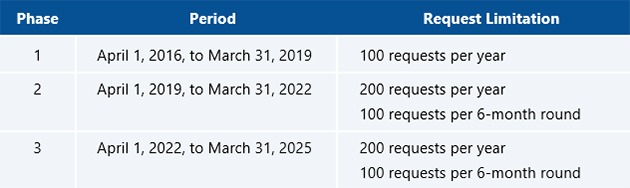
After more than six years of implementation, this program is considered successful and can be extended to support Japanese enterprises in establishing patent rights in Vietnam.

Effectiveness

This program has many advantages, such as:

  • Applications originating from Japan are usually of good quality with clear and coherent specification It is possible that the IP Office’s requirements for specifications are already very consistent with Japanese applicants’ way of drafting specifications thanks to the JPO’s training programs for the IP Office.
  • Patents in Japan usually have a short examination timeline and are granted very quickly, even within the application filing timeline in Vietnam (12 months from the priority date for applications filed under the Paris Convention and 31 months from the priority date for applications filed as PCT national phase applications).
  • The coordination between the JPO and the IP Office has been very good. PPH applications are processed in a quick and efficient manner.
  • Japanese applicants and their representatives also often coordinate well with the IP Office to rectify formality shortcomings and avoid prolongation of the examination period.

Although there are no official statistics from the IP Office, according to independent statistics for applications whose PPH requests were filed by Tilleke & Gibbins’ associate firm (one of the most prolific filers under the PPH), the examination period for applications under the PPH has been significantly shortened, compared to the period for substantive examination as prescribed by law (18 months):

  • The average period for receiving the first office action as from the date of the PPH request is 8.53 months.
  • The average period for receiving a notice of allowance without an office action from the date of requesting PPH is 7.98 months.

Further, the prescribed 18-month time limit for examination is often difficult to achieve for various reasons, and the actual examination period for applications not under the PPH program is typically much longer than 18 months in practice. Obviously, the PPH has been providing a tremendous time benefit to Japanese applicants.

Current Status

Since its inception, the PPH program has attracted the attention of many Japanese enterprises and industrial property representatives in Vietnam. In fact, in the first rounds of this program, the timeline for the number of requests to reach the limit was often very short, and in many cases the limit was reached on the very first day the round was opened.
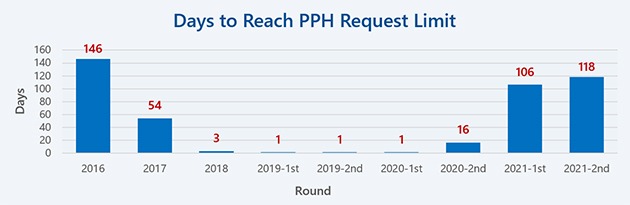
However, despite the PPH’s apparent effectiveness, recent monitoring of the number of applications as well as the time limit for filing PPH requests shows that this program has not been attracting the attention of Japanese applicants as much as before. According to the above figure, the number of days to reach the request limit has increased in every period since 2020. By 2022, the first round, which was opened on April 1, 2022, had not even reached 100 requests after six months, and the 34 remaining spots were moved to the second round, which was opened on October 1, 2022.

It is not clear why Japanese applicants have shown reduced interest in the PPH program after its initial popularity, though it is worth noting that the time period in which the number of PPH requests was slower to reach the limit (from October 2020 to mid-2022), coincided with the period when Japan and Vietnam were most affected by the Covid-19 pandemic. This may have affected the management strategy of Japanese enterprises as well as the budget for promoting IP portfolios.

Upcoming Changes

Article 114 of Vietnam’s amended IP Law, which took effect on January 1, 2023, allows the IP Office to use the results of substantive examination of a patent application claiming the same invention filed with a foreign patent office in the process of assessing the patentability of the corresponding Vietnamese application. The latest draft of a circular to replace Circular 01/2007, which guides the implementation of the IP Law, also includes provisions intended to allow an applicant to proactively request the IP Office to proceed in this manner. Also according to this draft circular, if the IP Office accepts the applicant’s request, a communication on substantive examination results must be issued for the Vietnamese application within 12 months from the date of the request.

As such, Article 114 of the IP Law seems to open a new door for patent applicants in accelerating the examination process in Vietnam. This program is expected to be equally effective and possibly even more effective than existing acceleration programs. The scope of expedited examination is extended to applicants from all countries and is not limited only to applications originating from Japan and South Korea (which has its own PPH with Vietnam) or applications with equivalent applications filed in ASEAN countries under the ASPEC program.

Although on the positive side, the expedited process will give applicants more options, on the other hand, because of the overlap in the results that can serve as basis for examination, this new program will “steal” applications from the PPH program. Thus, once the new program goes into effect, Japanese applicants will no longer have a significant advantage over applicants from other countries that can use foreign results. However, according to the statistics cited above, the average examination period of the PPH program may still be shorter, and the PPH program has been operating in a stable manner; hence, in the early period once the new program is in place, the Japan PPH may still be more attractive.

As Vietnam currently does not have a mechanism for extending the protection term of a patent, the early granting of a protection title is still an advantage. The PPH remains an effective channel for Japanese applicants in expediting the examination and granting of patents in Vietnam.

RELATED INSIGHTS​ 

April 20, 2026
Myanmar’s industrial design registration regime has been steadily gaining momentum since the country officially began accepting applications under the Industrial Design Law of 2019. The Industrial Design Division of Myanmar’s Intellectual Property Department (IPD) has actively advanced examination and registration procedures, and as of March 2026, approximately 300 industrial design applications have been published in the IPD’s publicly accessible database—a meaningful milestone in the development of Myanmar’s emerging intellectual property framework. This figure reflects only published applications; additional filings remain pending and will be published after the conclusion of ongoing examination. Filing Requirements in Practice Compliance with a defined set of mandatory requirements is the foundation for filing a valid design application. These mandatory particulars must be provided at the time of filing in order to establish a filing date. These include the applicant’s and creator’s identifying details, a notarized appointment of representative form, the Locarno Classification of the associated product, and a set of graphic representations of the design across multiple standard views. Applicants must also provide a written description of the design and, where applicable, information relating to any priority claim or request for deferred publication. Filing fees are payable at the time of submission. Beyond these core requirements, applicants typically need to provide supplementary documentation, either at the time of filing or in response to a formality examination. This may include evidence of the applicant’s legal entitlement to the design—particularly where the applicant and creator are different parties—as well as supporting corporate and authorization documents. Where priority rights are claimed, the relevant documents must generally be submitted within three months of the Myanmar filing date, with certified English translations required for any non-English priority applications. The supplementary requirements may vary depending on the nature of the application and the examiner’s requests during the formality examination process.
April 3, 2026
On March 16, 2026, Vietnam’s Ministry of Public Security released a draft version of a new Decree on the Prevention and Combating of Cybercrime and High-Tech Crime to replace the currently effective Decree 25/2014/ND-CP. In the draft, the ministry has proposed a comprehensive regulatory framework aimed at addressing violations occurring within the cybersecurity domain, including measures related to intellectual property. Acts of Online IP Infringement Article 9 of the draft decree notably introduces specific provisions addressing online intellectual property infringement, with detailed lists of acts considered to constitute infringement in the online environment. Copyright and related rights infringement includes: Uploading or sharing works, performances, sound recordings, video recordings, broadcasts, computer programs, software, research, documents, theses, or other intellectual creations on digital platforms without the consent of the rights holder. Unauthorized livestreaming of copyrighted television programs, sporting events, or artistic performances. Uploading, sharing, storing, transmitting, or providing links to infringing works or digital content via websites, social networks, applications, or digital platforms. Providing or using software, tools, devices, or access codes to circumvent technological protection measures or evade lawful control mechanisms implemented by rights holders. Using artificial intelligence (AI) tools to replicate the ideas or structure of another person’s work without significant new creativity or without proper attribution, thereby causing damage to the original author. Industrial property infringement includes: Manufacturing, trading, advertising, or distributing counterfeit goods bearing counterfeit trademarks, geographical indications, or industrial designs, as well as goods infringing industrial property rights through online platforms. Unauthorized registration, appropriation, or use of domain names, account names, or digital identifiers that create confusion regarding the rights holder or the origin of goods or services. Producing, using, or offering for sale products containing all or part of a patented invention via online platforms. Advertising or introducing products with technical features or characteristics identical
March 31, 2026
Vietnam’s most recent amendment of the Law on Intellectual Property (amended IP Law), passed by the National Assembly on December 10, 2025, and effective from April 1, 2026, represents one of the most significant updates to the IP Law in recent years. This amendment modernizes the IP framework, moving a step closer to international standards, while addressing the realities of Vietnam’s booming digital economy, e-commerce growth, and increasing foreign investment, which is crucial for Vietnam’s objective of complete economic transformation. For trademark practitioners, brand owners, and businesses, the changes are largely positive, as they promise faster processes, stronger enforcement tools—especially for online actions—and better commercialization options. However, they also introduce stricter requirements and a need for proactive preparation. Below are some of the most noteworthy changes in the amended IP Law related to trademarks. Significantly Shortened Timelines and Introduction of Fast-Track Examination The statutory timelines under the amended IP Law have been notably reduced: Substantive examination for trademarks is shortened from 9 months to 5 months (from the publication date). The publication period is shortened from 2 months to 1 month. A new fast-track mechanism allows substantive examination in as little as 3 months for qualifying applications (e.g., marks in actual use, facing infringement threats, or meeting government-specified criteria; details to be clarified in implementing regulations). The opposition period is shortened from 5 months to 3 months from publication. This is arguably the most welcome change. Vietnam’s IP Office has long faced criticism for lengthy backlogs, often stretching the trademark registration process to 18–24 months or more. The new timelines bring Vietnam closer to efficient systems. The fast-track option is particularly smart for high-value or urgent cases such as counterfeit threats on e-commerce platforms. However, careful preparation is mandatory for flawless applications from the start to maximize fast-track eligibility.
March 16, 2026
Indonesia’s Ministry of Law has introduced a new framework for patent applications that tightens filing requirements and introduces formal mechanisms for accelerated examination. Minister of Law Regulation No. 6 of 2026 on Patent Applications, which was issued on January 13, 2026, and took effect on February 23, 2026, serves as the implementing regulation for Law No. 65 of 2024 on Patents. It replaces the previous patent application framework (under Minister of Law and Human Rights Regulation No. 38 of 2018, as amended by Regulation No. 13 of 2021), which was considered no longer aligned with current legal, institutional, and technological developments. The regulation also reflects the institutional restructuring of the Ministry of Law and Human Rights into the Ministry of Law. Patent applications filed on or after February 23, 2026, must fully comply with the new regulation. Applications that were filed before this date will continue to be examined and processed under the previous regulation, pursuant to transitional provisions. Substantive Changes Definition of Invention The definition of “Invention” now explicitly includes systems, methods, and uses, in addition to products and processes. This expansion creates broader protection opportunities, particularly for software-enabled, digital, and method-based technologies, although it may also result in closer scrutiny during substantive examination. Excess Claims Fee Excess claims fees must now be paid at the time of filing. Failure to pay excess claims fees at filing results in the application being deemed withdrawn. There is no longer an option to defer payment to the substantive examination stage. This amendment forces applicants to face higher upfront costs. Patent claim strategy must be finalized prior to filing, reducing flexibility at later stages. Procedural and System Changes Fully Electronic Filing Patent applications must be filed electronically via the Directorate General of Intellectual Property (DGIP) online filing system. Assisted filings to