
You are using an outdated browser and your browsing experience will not be optimal. Please update to the latest version of Microsoft Edge, Google Chrome or Mozilla Firefox. Install Microsoft Edge

February 3, 2023

A Review of the Japan-Vietnam Patent Prosecution Highway

Overview

Although Vietnam has a number of mechanisms for accelerating the patent examination process, most of them have not lived up to the expectations of applicants. However, a fast-track patent prosecution highway (PPH) program was opened for the first time between the Intellectual Property Office of Vietnam (IP Office) and the Japan Patent Office (JPO) in January 2016, creating opportunities for all applications originating from Japan.

The PPH program has been rolled out in the following stages:
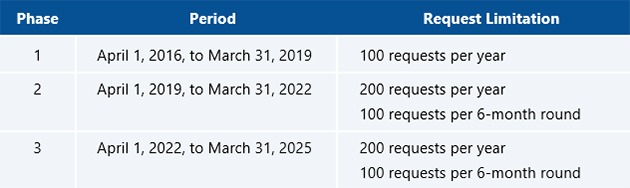
After more than six years of implementation, this program is considered successful and can be extended to support Japanese enterprises in establishing patent rights in Vietnam.

Effectiveness

This program has many advantages, such as:

  • Applications originating from Japan are usually of good quality with clear and coherent specification It is possible that the IP Office’s requirements for specifications are already very consistent with Japanese applicants’ way of drafting specifications thanks to the JPO’s training programs for the IP Office.
  • Patents in Japan usually have a short examination timeline and are granted very quickly, even within the application filing timeline in Vietnam (12 months from the priority date for applications filed under the Paris Convention and 31 months from the priority date for applications filed as PCT national phase applications).
  • The coordination between the JPO and the IP Office has been very good. PPH applications are processed in a quick and efficient manner.
  • Japanese applicants and their representatives also often coordinate well with the IP Office to rectify formality shortcomings and avoid prolongation of the examination period.

Although there are no official statistics from the IP Office, according to independent statistics for applications whose PPH requests were filed by Tilleke & Gibbins’ associate firm (one of the most prolific filers under the PPH), the examination period for applications under the PPH has been significantly shortened, compared to the period for substantive examination as prescribed by law (18 months):

  • The average period for receiving the first office action as from the date of the PPH request is 8.53 months.
  • The average period for receiving a notice of allowance without an office action from the date of requesting PPH is 7.98 months.

Further, the prescribed 18-month time limit for examination is often difficult to achieve for various reasons, and the actual examination period for applications not under the PPH program is typically much longer than 18 months in practice. Obviously, the PPH has been providing a tremendous time benefit to Japanese applicants.

Current Status

Since its inception, the PPH program has attracted the attention of many Japanese enterprises and industrial property representatives in Vietnam. In fact, in the first rounds of this program, the timeline for the number of requests to reach the limit was often very short, and in many cases the limit was reached on the very first day the round was opened.
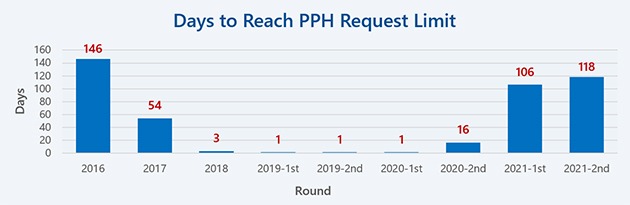
However, despite the PPH’s apparent effectiveness, recent monitoring of the number of applications as well as the time limit for filing PPH requests shows that this program has not been attracting the attention of Japanese applicants as much as before. According to the above figure, the number of days to reach the request limit has increased in every period since 2020. By 2022, the first round, which was opened on April 1, 2022, had not even reached 100 requests after six months, and the 34 remaining spots were moved to the second round, which was opened on October 1, 2022.

It is not clear why Japanese applicants have shown reduced interest in the PPH program after its initial popularity, though it is worth noting that the time period in which the number of PPH requests was slower to reach the limit (from October 2020 to mid-2022), coincided with the period when Japan and Vietnam were most affected by the Covid-19 pandemic. This may have affected the management strategy of Japanese enterprises as well as the budget for promoting IP portfolios.

Upcoming Changes

Article 114 of Vietnam’s amended IP Law, which took effect on January 1, 2023, allows the IP Office to use the results of substantive examination of a patent application claiming the same invention filed with a foreign patent office in the process of assessing the patentability of the corresponding Vietnamese application. The latest draft of a circular to replace Circular 01/2007, which guides the implementation of the IP Law, also includes provisions intended to allow an applicant to proactively request the IP Office to proceed in this manner. Also according to this draft circular, if the IP Office accepts the applicant’s request, a communication on substantive examination results must be issued for the Vietnamese application within 12 months from the date of the request.

As such, Article 114 of the IP Law seems to open a new door for patent applicants in accelerating the examination process in Vietnam. This program is expected to be equally effective and possibly even more effective than existing acceleration programs. The scope of expedited examination is extended to applicants from all countries and is not limited only to applications originating from Japan and South Korea (which has its own PPH with Vietnam) or applications with equivalent applications filed in ASEAN countries under the ASPEC program.

Although on the positive side, the expedited process will give applicants more options, on the other hand, because of the overlap in the results that can serve as basis for examination, this new program will “steal” applications from the PPH program. Thus, once the new program goes into effect, Japanese applicants will no longer have a significant advantage over applicants from other countries that can use foreign results. However, according to the statistics cited above, the average examination period of the PPH program may still be shorter, and the PPH program has been operating in a stable manner; hence, in the early period once the new program is in place, the Japan PPH may still be more attractive.

As Vietnam currently does not have a mechanism for extending the protection term of a patent, the early granting of a protection title is still an advantage. The PPH remains an effective channel for Japanese applicants in expediting the examination and granting of patents in Vietnam.

RELATED INSIGHTS​ 

March 13, 2026
For decades, intellectual property rights holders seeking to eliminate counterfeit goods from the Thai market have relied primarily on criminal raid actions to seize infringing products and hold infringers accountable. The deterrent value of this approach is typically threefold: imposing criminal liability on infringers, removing counterfeit goods from circulation, and subjecting violators to imprisonment and fines. However, these outcomes often fall short of fulfilling brand owners’ broader objectives. In many cases, those prosecuted are merely staff or intermediaries rather than the principals orchestrating the infringing operations. Moreover, any fines imposed are remitted to the Thai government—not to the rights holders who have suffered commercial harm and invested substantial resources in investigation and coordination with law enforcement authorities. As in other jurisdictions worldwide, rights holders seeking monetary compensation for IP infringement in Thailand have traditionally pursued separate civil litigation. Before initiating such proceedings, a brand owner must gather sufficient evidence to establish both the infringement and the resulting damages. Notably, Thai law does not recognize punitive damages; courts award only actual damages proven by the claimant. In the absence of seized infringing goods, the damages awarded in such cases are typically minimal. This all leaves rights holders with limited recourse despite possibly having suffered significant commercial injury. In 2005, Thailand amended its Criminal Procedure Code to introduce Section 44/1, which enables rights holders to claim damages within criminal proceedings at the Intellectual Property and International Trade Court prior to the evidentiary hearing. In practice, this mechanism allows an injured party to submit a petition for civil damages directly within the criminal case initiated by the public prosecutor. Historically, rights holders in Thailand have been reluctant to use Section 44/1 because the compensation awarded by courts was often insufficient to justify the effort. However, recent years have seen a notable shift
March 13, 2026
Vietnam’s Law on Intellectual Property (IP Law) has undergone continuous amendment in recent years, with the latest amendment issued at the end of 2025. Among the amended and supplemented provisions, the regulation that has perhaps attracted the most attention is a provision relating to the use of protected IP objects by artificial intelligence (AI) systems. Specifically, Article 7 of the 2025 IP Law introduces a completely new Clause 5, which reads in full as follows: “Organizations and individuals are permitted to use texts and data relating to intellectual property objects that have been lawfully published, and which the public is allowed to access, for the purposes of scientific research, experimentation, and training of artificial intelligence systems, provided that such use will not unreasonably affect the legitimate rights and interests of the authors and intellectual property rights holders in accordance with this Law. With respect to texts and data that are objects protected by copyright and related rights, the use of the texts and data as set forth herein must also be in accordance with the regulations of the Government.” Analyzing this newly added provision in the context of how it was conceived, as well as the challenges that still lie ahead, can provide some interesting insights. From Aspirations to Flight in Science and Technology From the end of 2024 and throughout 2025—the 50th anniversary of the country’s reunification—Vietnam witnessed numerous sweeping changes in many areas, including legislative development. It could be said that no sessions of the National Assembly have ever adopted as many laws, resolutions, and major policies as this one. The aspirations of the highest-level leadership have been concretized into major law and policy projects, which were drafted, developed, and passed at record speed. All of this was aimed at building a foundation for Vietnam to achieve
March 10, 2026
Indonesia’s trademark prosecution process has been significantly streamlined with Ministry of Law Regulation No. 5 of 2026 (MOLR 5/2026) coming into effect on February 23, 2026. In straightforward cases without opposition, applicants may now see their trademarks proceed to registration within three months from filing—a substantial improvement over previous practice. The regulation also introduces detailed procedures for recording changes of name and address and for transferring rights over pending applications. It enhances the role of the Ministry of Law’s regional offices in assisting local individuals and SMEs, adds provisions governing force majeure situations, implements new requirements for collective trademarks, and formalizes several practices already in place. Substantive Examination Acceleration The most significant change under MOLR 5/2026 concerns substantive examination. The regulation now explicitly requires that applications be published within 15 days of filing, followed by a two-month publication period. Oppositions must be filed only within this window; late submissions will not be processed, even if the system accepts payment. The new regulation requires the Trademark Office (TMO) to forward copies of any opposition to applicants within 14 days of receipt. If no opposition is filed, substantive examination begins immediately after the publication period ends and will be completed within 30 days. If an opposition is filed, the examination is to be finalized within 90 days of the counterstatement filing date. These timelines enable unopposed applications to move from close of publication to final decision in roughly one month. If an application is provisionally refused during ex officio examination, the applicant has 30 working days from the date of notification to file a response. However, the regulation does not specify the timeline for subsequent reexamination after the response is filed. In recent practice, the TMO has been completing reexamination within approximately two to three months. Ownership Recordals May Pause Substantive
March 6, 2026
Myanmar’s Trademark Law 2019 introduced a modern framework for the registration, enforcement, and protection of trademarks. However, due to the high volume of applications filed during the soft-opening period of the Intellectual Property Department (IPD), marks submitted from 2022 onward remain pending as the IPD works its way through the applications filed in 2021, which it has been publishing on a monthly basis since May 1, 2024. During this period, businesses should adopt proactive strategies to protect their brands, monitor conflicting marks, and ensure a smooth registration process. Practical Steps for Safeguarding Pending Marks While a pending application does not confer full trademark rights, brand owners can take several practical steps to strengthen their position: Monitor IPD publications. Businesses should regularly review the IPD’s monthly gazette to identify any identical or confusingly similar marks at an early stage and prepare timely oppositions in accordance with the Trademark Law’s provisions allowing “any interested party” to file an objection to a trademark application. Monitor market activity. Early detection of potential infringement enables swift action, such as cease-and-desist letters and opposition proceedings. Businesses should monitor competitors, distributors, and retailers for unauthorized use of their marks. Collect evidence of use. Maintaining evidence of use strengthens claims of distinctiveness and supports enforcement efforts. Businesses should keep records of commercial activities, distribution, brand promotion and development, marketing communications, product packaging and labeling, and sales demonstrating brand recognition in Myanmar and internationally, particularly in Southeast Asian markets. Although the Trademark Law 2019 establishes a first-to-file system, evidence of use provides considerable practical support for distinctiveness claims and enforcement actions. Pursue Interim Enforcement Options. A pending trademark application can be relied upon to oppose or refuse other marks on absolute and/or relative grounds of refusal. In addition, marks with established reputations may be protected under passing-off principles