
You are using an outdated browser and your browsing experience will not be optimal. Please update to the latest version of Microsoft Edge, Google Chrome or Mozilla Firefox. Install Microsoft Edge

February 3, 2023

A Review of the Japan-Vietnam Patent Prosecution Highway

Overview

Although Vietnam has a number of mechanisms for accelerating the patent examination process, most of them have not lived up to the expectations of applicants. However, a fast-track patent prosecution highway (PPH) program was opened for the first time between the Intellectual Property Office of Vietnam (IP Office) and the Japan Patent Office (JPO) in January 2016, creating opportunities for all applications originating from Japan.

The PPH program has been rolled out in the following stages:
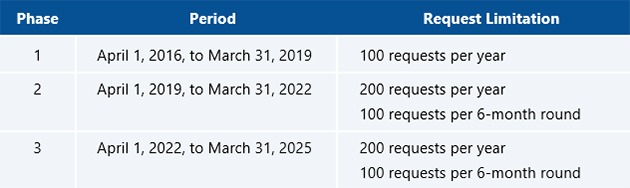
After more than six years of implementation, this program is considered successful and can be extended to support Japanese enterprises in establishing patent rights in Vietnam.

Effectiveness

This program has many advantages, such as:

  • Applications originating from Japan are usually of good quality with clear and coherent specification It is possible that the IP Office’s requirements for specifications are already very consistent with Japanese applicants’ way of drafting specifications thanks to the JPO’s training programs for the IP Office.
  • Patents in Japan usually have a short examination timeline and are granted very quickly, even within the application filing timeline in Vietnam (12 months from the priority date for applications filed under the Paris Convention and 31 months from the priority date for applications filed as PCT national phase applications).
  • The coordination between the JPO and the IP Office has been very good. PPH applications are processed in a quick and efficient manner.
  • Japanese applicants and their representatives also often coordinate well with the IP Office to rectify formality shortcomings and avoid prolongation of the examination period.

Although there are no official statistics from the IP Office, according to independent statistics for applications whose PPH requests were filed by Tilleke & Gibbins’ associate firm (one of the most prolific filers under the PPH), the examination period for applications under the PPH has been significantly shortened, compared to the period for substantive examination as prescribed by law (18 months):

  • The average period for receiving the first office action as from the date of the PPH request is 8.53 months.
  • The average period for receiving a notice of allowance without an office action from the date of requesting PPH is 7.98 months.

Further, the prescribed 18-month time limit for examination is often difficult to achieve for various reasons, and the actual examination period for applications not under the PPH program is typically much longer than 18 months in practice. Obviously, the PPH has been providing a tremendous time benefit to Japanese applicants.

Current Status

Since its inception, the PPH program has attracted the attention of many Japanese enterprises and industrial property representatives in Vietnam. In fact, in the first rounds of this program, the timeline for the number of requests to reach the limit was often very short, and in many cases the limit was reached on the very first day the round was opened.
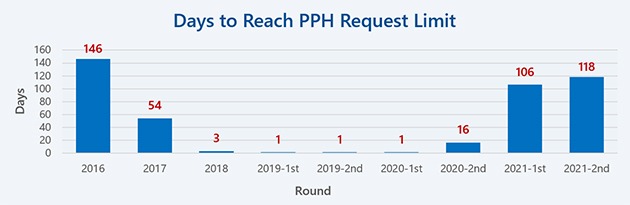
However, despite the PPH’s apparent effectiveness, recent monitoring of the number of applications as well as the time limit for filing PPH requests shows that this program has not been attracting the attention of Japanese applicants as much as before. According to the above figure, the number of days to reach the request limit has increased in every period since 2020. By 2022, the first round, which was opened on April 1, 2022, had not even reached 100 requests after six months, and the 34 remaining spots were moved to the second round, which was opened on October 1, 2022.

It is not clear why Japanese applicants have shown reduced interest in the PPH program after its initial popularity, though it is worth noting that the time period in which the number of PPH requests was slower to reach the limit (from October 2020 to mid-2022), coincided with the period when Japan and Vietnam were most affected by the Covid-19 pandemic. This may have affected the management strategy of Japanese enterprises as well as the budget for promoting IP portfolios.

Upcoming Changes

Article 114 of Vietnam’s amended IP Law, which took effect on January 1, 2023, allows the IP Office to use the results of substantive examination of a patent application claiming the same invention filed with a foreign patent office in the process of assessing the patentability of the corresponding Vietnamese application. The latest draft of a circular to replace Circular 01/2007, which guides the implementation of the IP Law, also includes provisions intended to allow an applicant to proactively request the IP Office to proceed in this manner. Also according to this draft circular, if the IP Office accepts the applicant’s request, a communication on substantive examination results must be issued for the Vietnamese application within 12 months from the date of the request.

As such, Article 114 of the IP Law seems to open a new door for patent applicants in accelerating the examination process in Vietnam. This program is expected to be equally effective and possibly even more effective than existing acceleration programs. The scope of expedited examination is extended to applicants from all countries and is not limited only to applications originating from Japan and South Korea (which has its own PPH with Vietnam) or applications with equivalent applications filed in ASEAN countries under the ASPEC program.

Although on the positive side, the expedited process will give applicants more options, on the other hand, because of the overlap in the results that can serve as basis for examination, this new program will “steal” applications from the PPH program. Thus, once the new program goes into effect, Japanese applicants will no longer have a significant advantage over applicants from other countries that can use foreign results. However, according to the statistics cited above, the average examination period of the PPH program may still be shorter, and the PPH program has been operating in a stable manner; hence, in the early period once the new program is in place, the Japan PPH may still be more attractive.

As Vietnam currently does not have a mechanism for extending the protection term of a patent, the early granting of a protection title is still an advantage. The PPH remains an effective channel for Japanese applicants in expediting the examination and granting of patents in Vietnam.

RELATED INSIGHTS​ 

October 1, 2024
Background Since Thailand’s accession to the Madrid Protocol in November 2017, the trademark registration landscape in the country has undergone significant transformation. Brand owners can seek trademark protection in Thailand through a streamlined international process in addition to the national route. This alignment with global practices has somewhat simplified the registration process, offering businesses a valuable pathway to safeguard their brands in this key Southeast Asian market. However, despite the streamlined process, a technical glitch at the Trademark Office in Thailand’s Department of Intellectual Property has caused delays in issuing local certificates and statements of grant following provisional refusals — commonly referred to as ‘Model Form 5’. These documents are crucial for finalising trademark registrations and confirming their validity within Thailand. It is important to note, however, that this technical issue did not affect the issuance of statements of grant for international registrations (IRs) that had not been provisionally refused. Recent developments The good news is that, as of 19 August 2024, the Trademark Office has successfully resolved the technical issues impacting the issuance of these essential documents. With the glitch now fixed, the office has begun to process the backlog of local certificates of registration and statements of grant for IRs designating Thailand following provisional refusals. What this means for brand owners The resolution of this technical issue represents a significant milestone for brand owners who have been waiting for their local certificates. As the Trademark Office works to clear the backlog, the issuance of certificates and statements of grant is likely to proceed more promptly. For those affected by the delay, the end is in sight. The issuance of these documents will enable brand owners to officially complete their trademark registration in Thailand and benefit from the protections offered under Thai law. In the meantime, brand owners
September 26, 2024
Indonesia enacted a new franchise regulation, Government Regulation No. 35 of 2024 on Franchising (“GR 35/2024”), on September 2, 2024. Franchising in Indonesia was previously governed by Government Regulation No. 42 of 2007 on Franchising (“GR 42/2007”), along with an implementing regulation, Ministry of Trade Regulation No. 71 of 2019 regarding Implementation of Franchising (“MOT Regulation 71/2019”). This new regulation repeals GR 42/2007. However, MOT Regulation No. 71/2019 remains in effect until a new MOT regulation can be enacted. The new franchise regulation contains several amendments and provides more detailed requirements to complement MOT Regulation No. 71/2019. Comparison of GR 35/2024 to GR 42/2007 Minimum years of business operation. The new regulation reduces the minimum duration that a franchise registration applicant must have been operating from five years to three years. Intellectual property (IP) status. Any relevant IP must now be registered before a franchise registration application can be submitted. This is a change from the previous regulations, under which it was possible to obtain a franchise registration (STPW) while an IP application was still pending, and if the IP application could not be registered, the STPW would be canceled. Registration requirements for foreign franchisors. Under the new regulation, foreign franchisors must provide a legalized or apostilled business permit document from the country of origin in addition to the previously required franchise offering prospectus and statement letter from the relevant Indonesian authority. Administrative sanctions. The new regulation has adjusted the three escalating stages of administrative sanctions to (1) two warning letters, (2) a 14-day suspension from business activities, and (3) STPW revocation. This varies from the three stages under the previous regulation (three warning letters, fine, and STPW revocation). The new regulation also expands the list of noncompliant actions that are subject to these administrative sanctions. In addition to
September 23, 2024
The General Department of Customs and Excise (GDCE) in Cambodia’s Ministry of Economy and Finance launched a trial phase of its Intellectual Property Rights Recordation System (IPRRS) on September 1, 2024. The system compiles necessary information and documents related to intellectual property rights in the country, enabling customs authorities to swiftly access these documents and enhance their ability to identify and intercept potential parallel imports and infringing goods at the border. This will also better facilitate ex-officio actions by customs authorities. The system is currently referred to as being in a “trial phase” to support further amendments or updates to address any potential technical errors that may arise from public use. However, the IPRRS is already fully operational. Types of Recordation Currently, the IPRRS allows two types of recordation: Intellectual property recordation is available for trademarks, geographical indications, copyrights, and related rights that are protected in Cambodia. It allows IP owners, authorized representatives, and legal representatives to record information and documents relating to such rights, including information on possible or potential counterfeit goods, with the GDCE. Recordation will give customs authorities quicker access to the information and enable them to promptly take action against potential counterfeit or infringing goods. Exclusive distributorship recordation is meant to streamline the process that takes place after the Ministry of Commerce issues a notice of the recordation of exclusive rights. Under the current practice, after receiving a copy of a notice of the recordal of an exclusive distributorship issued by the Ministry of Commerce (MOC), the GDCE needs to enter the information into their system manually to enable them to promptly identify or stop potential parallel importation at the border. This reportedly causes delays in border officers’ access to the necessary information. Recordation through the IPRRS, on the other hand, allows local exclusive distributors
September 9, 2024
The popularity of the franchise business model has been growing rapidly in Southeast Asia in recent years, with some of the world’s top brands becoming common sights in the commercial districts and shopping malls of major regional cities in Cambodia, Indonesia, Laos, Myanmar, Thailand, and Vietnam. While for most countries in this part of the world, franchising has not been explicitly mentioned in legislation, well prepared franchise business operations can comfortably adapt to each country’s regulatory framework, and the growth is poised to continue even as the global retail sector redesigns and redoubles its efforts in the wake of the COVID-19 outbreak. In fact, the franchise business model, which is both global and hyper-local at once, is one of the most promising solutions that entrepreneurs are turning to in their quest to overcome the challenges of the new economic reality. The Regional Guide to Franchising Law in Southeast Asia provides key, up-to-date insights into the legal frameworks regulating franchise operations in these Southeast Asian countries, and helps brand owners understand the most relevant laws, authorities, and procedures for their business. Some of the essential topics covered for each jurisdiction include considerations in negotiating and designing franchise agreements, protecting intellectual property rights, and important information on judicial and arbitral procedures should a dispute arise between franchisor and franchisee. Practitioners from Tilleke & Gibbins’ offices in Cambodia, Indonesia, Laos, Myanmar, Thailand, and Vietnam contributed to guide—not only by providing legal expertise on the laws and mechanisms applicable in each jurisdiction, but also by examining strategies for establishing and running resilient franchise operations in Southeast Asia. The full guide can be accessed as a PDF through the button below.