
You are using an outdated browser and your browsing experience will not be optimal. Please update to the latest version of Microsoft Edge, Google Chrome or Mozilla Firefox. Install Microsoft Edge

February 3, 2023

A Review of the Japan-Vietnam Patent Prosecution Highway

Overview

Although Vietnam has a number of mechanisms for accelerating the patent examination process, most of them have not lived up to the expectations of applicants. However, a fast-track patent prosecution highway (PPH) program was opened for the first time between the Intellectual Property Office of Vietnam (IP Office) and the Japan Patent Office (JPO) in January 2016, creating opportunities for all applications originating from Japan.

The PPH program has been rolled out in the following stages:
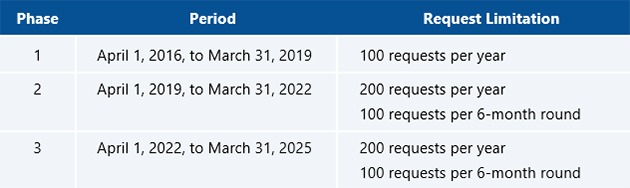
After more than six years of implementation, this program is considered successful and can be extended to support Japanese enterprises in establishing patent rights in Vietnam.

Effectiveness

This program has many advantages, such as:

  • Applications originating from Japan are usually of good quality with clear and coherent specification It is possible that the IP Office’s requirements for specifications are already very consistent with Japanese applicants’ way of drafting specifications thanks to the JPO’s training programs for the IP Office.
  • Patents in Japan usually have a short examination timeline and are granted very quickly, even within the application filing timeline in Vietnam (12 months from the priority date for applications filed under the Paris Convention and 31 months from the priority date for applications filed as PCT national phase applications).
  • The coordination between the JPO and the IP Office has been very good. PPH applications are processed in a quick and efficient manner.
  • Japanese applicants and their representatives also often coordinate well with the IP Office to rectify formality shortcomings and avoid prolongation of the examination period.

Although there are no official statistics from the IP Office, according to independent statistics for applications whose PPH requests were filed by Tilleke & Gibbins’ associate firm (one of the most prolific filers under the PPH), the examination period for applications under the PPH has been significantly shortened, compared to the period for substantive examination as prescribed by law (18 months):

  • The average period for receiving the first office action as from the date of the PPH request is 8.53 months.
  • The average period for receiving a notice of allowance without an office action from the date of requesting PPH is 7.98 months.

Further, the prescribed 18-month time limit for examination is often difficult to achieve for various reasons, and the actual examination period for applications not under the PPH program is typically much longer than 18 months in practice. Obviously, the PPH has been providing a tremendous time benefit to Japanese applicants.

Current Status

Since its inception, the PPH program has attracted the attention of many Japanese enterprises and industrial property representatives in Vietnam. In fact, in the first rounds of this program, the timeline for the number of requests to reach the limit was often very short, and in many cases the limit was reached on the very first day the round was opened.
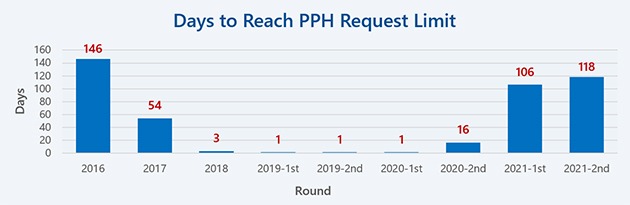
However, despite the PPH’s apparent effectiveness, recent monitoring of the number of applications as well as the time limit for filing PPH requests shows that this program has not been attracting the attention of Japanese applicants as much as before. According to the above figure, the number of days to reach the request limit has increased in every period since 2020. By 2022, the first round, which was opened on April 1, 2022, had not even reached 100 requests after six months, and the 34 remaining spots were moved to the second round, which was opened on October 1, 2022.

It is not clear why Japanese applicants have shown reduced interest in the PPH program after its initial popularity, though it is worth noting that the time period in which the number of PPH requests was slower to reach the limit (from October 2020 to mid-2022), coincided with the period when Japan and Vietnam were most affected by the Covid-19 pandemic. This may have affected the management strategy of Japanese enterprises as well as the budget for promoting IP portfolios.

Upcoming Changes

Article 114 of Vietnam’s amended IP Law, which took effect on January 1, 2023, allows the IP Office to use the results of substantive examination of a patent application claiming the same invention filed with a foreign patent office in the process of assessing the patentability of the corresponding Vietnamese application. The latest draft of a circular to replace Circular 01/2007, which guides the implementation of the IP Law, also includes provisions intended to allow an applicant to proactively request the IP Office to proceed in this manner. Also according to this draft circular, if the IP Office accepts the applicant’s request, a communication on substantive examination results must be issued for the Vietnamese application within 12 months from the date of the request.

As such, Article 114 of the IP Law seems to open a new door for patent applicants in accelerating the examination process in Vietnam. This program is expected to be equally effective and possibly even more effective than existing acceleration programs. The scope of expedited examination is extended to applicants from all countries and is not limited only to applications originating from Japan and South Korea (which has its own PPH with Vietnam) or applications with equivalent applications filed in ASEAN countries under the ASPEC program.

Although on the positive side, the expedited process will give applicants more options, on the other hand, because of the overlap in the results that can serve as basis for examination, this new program will “steal” applications from the PPH program. Thus, once the new program goes into effect, Japanese applicants will no longer have a significant advantage over applicants from other countries that can use foreign results. However, according to the statistics cited above, the average examination period of the PPH program may still be shorter, and the PPH program has been operating in a stable manner; hence, in the early period once the new program is in place, the Japan PPH may still be more attractive.

As Vietnam currently does not have a mechanism for extending the protection term of a patent, the early granting of a protection title is still an advantage. The PPH remains an effective channel for Japanese applicants in expediting the examination and granting of patents in Vietnam.

RELATED INSIGHTS​ 

August 30, 2024
As in many other countries, registered trademarks in Indonesia that are not used for a given period of time can be canceled. A recent decision (Decision No. 144/PUU-XXI/2023) from the country’s Constitutional Court has extended the non-use cancellation period from three years to five years, applicable from July 30, 2024. This ruling could have a major impact on trademark holders in the country. Background of the Case Article 74 of Indonesia’s Trademark Law of 2016 specifies that trademarks can be canceled if they go unused in the trade of goods or services for three consecutive years from the date of registration or last use. This provision is aligned with the Paris Convention and the TRIPs Agreement. On October 27, 2023, an Indonesian individual named Ricky Thio asked the Constitutional Court to examine the constitutionality of Article 74, arguing that it opened a pathway for third parties to eliminate trademarks owned by small and medium-sized enterprises (SMEs), and did not provide certainty to his registered trademark in terms of the period of protection. Additionally, he argued that the period of three consecutive years was burdensome for SMEs, and asked the court to void Article 74 and add force majeure circumstances—such as Covid-19—as an exemption to non-use cancellation. Mr. Thio submitted this request while he was defending his trademark registration from a non-use cancellation request filed by Zhejiang Dahua Technology Co., Ltd. In his defense to that cancellation request, Mr. Thio explained that the non-use of the trademark was due to the Covid-19 pandemic. The cancellation case followed a different judicial pathway, and was under appeal before the Supreme Court at the time Mr. Thio filed his request for judicial review with the Constitutional Court. Mr. Thio’s case also attracted the submission of an amicus brief—a relatively new trend in Indonesia—from
August 30, 2024
In 2023, Vietnam’s Intellectual Property Rights Infringement Prevention Cooperation Program reported that 776 cases of IPR infringement were resolved nationwide. Of these, 546 were addressed through administrative measures, while criminal proceedings were initiated in just five cases. These statistics clearly show that administrative measures overwhelmingly dominate the response to counterfeit goods, with criminal actions being relatively rare. This raises an intriguing question: Why do IPR holders prefer administrative routes over criminal measures in Vietnam? And what challenges and obstacles make criminal enforcement less commonly pursued in these cases? Overlapping legal provisions Under Vietnam’s Penal Code, two key offenses address counterfeit goods: Manufacturing and trading in counterfeit goods under Article 192. Manufacturing and trading in industrial property rights-infringing goods under Article 226. Both provisions regulate counterfeit goods, yet they suffer from a lack of clear definitions and guidelines for application. Article 192 does not explicitly define “counterfeit goods”. Instead, authorities refer to Article 3.7 of Decree No. 98/2020/ND-CP, as amended, which outlines several categories of counterfeit goods, including: (i) utility counterfeits (goods not meeting normal expectations of usage or function), (ii) substandard goods, (iii) counterfeit goods based on misrepresentation, and (iv) counterfeit stamps, labels, and packaging. Meanwhile, Article 226 specifically deals with counterfeit goods that infringe trademark rights. These “trademark-counterfeit goods” are defined under Article 213.2 of the IP Law as goods or packaging bearing trademarks or signs that are identical or confusingly similar to protected trademarks for the same goods, used without the trademark owner’s permission. In this regard, “counterfeit goods” and “trademark-counterfeit goods” are treated as distinct, non-overlapping concepts, each corresponding to a separate offense. However, in practice, there is often a gray area where the two overlap. Many cases involve infringing goods that meet the criteria for both categories, allowing authorities to apply both regulations simultaneously. For
August 30, 2024
With the emergence of online marketplaces and e-commerce platforms, consumers have transformed their ways of engaging in transactions, gaining unprecedented convenience and access to a vast array of products. These platforms allow small businesses and individual entrepreneurs to reach a wider audience in an increasingly competitive market. Challenges in Tracing Online Infringers The growth of these online marketplaces and e-commerce platforms has also given rise to challenges, particularly in locating the actual identity of online infringers and combating intellectual property infringement activities. Online infringers often take advantage of anonymity to offer counterfeit products for sale on their platforms. Not only do these online infringing activities violate the rights of IP owners, but they also involve the sale of counterfeit products that are often manufactured with inferior quality and may pose significant risks to consumers’ health and safety. In today’s modern world, tracing the actual identity of online infringers proves challenging, as infringers adopt numerous methods to conceal their identity. The most frequently used method is using a fake name and address when dispatching parcels to consumers, making it difficult to verify the seller’s identity and the location of the sender on the parcel package. Some infringers exploit cash-on-delivery logistics services to prevent the disclosure of their identity, such as bank account numbers and bank account owner names, which would typically be required for direct payments. Instead, the shipping company collects the payment on their behalf, allowing the infringers to remain anonymous and making it more difficult to find their actual identity. Thailand’s New Regulations on Cash-on-Delivery Logistics Services Recently, the Committee on Contracts of Thailand’s Consumer Protection Board announced the Notification regarding Stipulation of Cash-on-Delivery Logistics Services as a Controlled-Receipt Business B.E. 2567 (2024) under the Consumer Protection Act B.E. 2522 (1979) in the Thai Royal Gazette dated July
August 7, 2024
A recent case at the Myanmar Competition Commission has set a significant precedent in the country’s approach to unfair competition practices. The case, involving a Thai manufacturer of cement grout and tile adhesive products and a local Myanmar producer, highlighted the Commission’s willingness to address issues of deceptive marketing and unfair competition. Background The case centered around a Thai manufacturer who has been distributing their cement grout and tile adhesive products in Myanmar for many years through local distribution agents. The company had established a well-known brand and a strong reputation for quality in the Myanmar market. In recent years, the Thai company discovered that a local individual in Myanmar was manufacturing and selling similar products with packaging nearly identical to their own. The local producer was using the same mark device, color, and packaging design themes, and the products contained deceptive information. Legal Proceedings After an initial cease-and-desist letter failed to resolve the issue, a complaint was submitted to the Myanmar Competition Commission. The case was notable because the Commission typically does not address issues of copying designs, marks, colors, or packaging themes. However, the complaint emphasized that the local individual was misleading customers and competing unfairly by using deceptive information and copying distinctive designs and themes. Lawyers from Tilleke & Gibbins, representing the Thai manufacturer, provided extensive documentation proving their client’s long-standing presence in the Myanmar market and the local individual’s deceptive practices. The Commission’s Investigation Committee conducted a thorough investigation, including market surveys and hearings involving both parties. Commission’s Decision After nearly a year of deliberation, on July 4, 2024, the Decision-Making Committee of the Myanmar Competition Commission ruled in favor of the Thai manufacturer. The decision required the local individual to: Immediately cease the production and distribution of cement grout and tile adhesive products bearing