
You are using an outdated browser and your browsing experience will not be optimal. Please update to the latest version of Microsoft Edge, Google Chrome or Mozilla Firefox. Install Microsoft Edge

May 25, 2018

Myanmar Opens Retail and Wholesale Business to 100% Foreign-Owned Companies

Informed Counsel

On May 9, 2018, Myanmar’s Ministry of Commerce (MoC) issued Directive 25/2018 (the Directive) permitting 100% foreign-owned companies, and joint venture companies established between Myanmar citizens and non-Myanmar citizens, to conduct retail or wholesale business in Myanmar, provided that they meet minimum initial investment requirements, register with the MoC, and comply with certain operational restrictions.

Initial Investment Capital

To qualify under the Directive, companies must meet certain minimum initial investment requirements. Foreign-owned companies, and joint ventures in which Myanmar citizens own less than 20% of the direct share equity, require more initial investment capital than companies with 20% or more direct share equity owned by Myanmar citizens, as detailed below.

Minimum Initial Investment for Retail and Wholesale Business in Myanmar
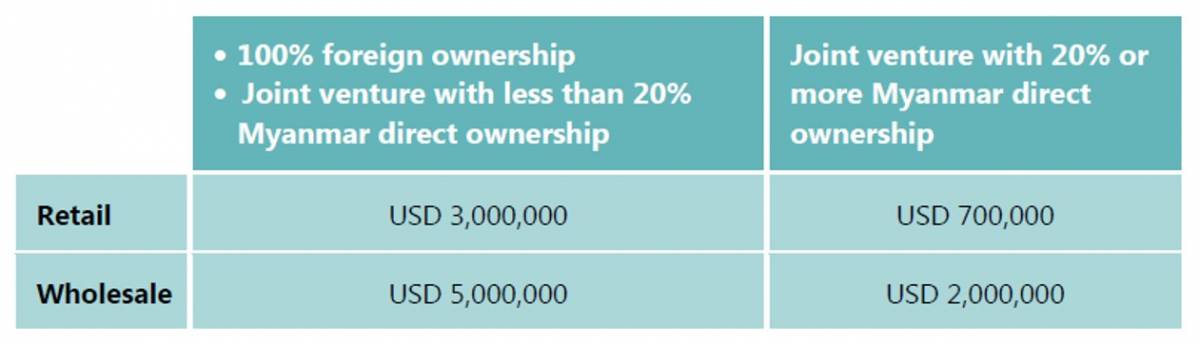
For the purposes of the Directive, initial investment capital does not include the cost of leasing land.

MoC Registration

Any company intending to operate a retail or wholesale business under the Directive must register with the MoC by supplying the following documents:

  • Certificate of company registration
  • Copy of the company’s Myanmar Investment Commission (MIC) endorsement, (or MIC permit if the company falls under the MIC permit requirement scheme)
  • Recommendation letter from the relevant City Development Committee or Township Development Committee of the region or state
  • Lists of group of goods to be sold retail or wholesale
  • Detailed descriptions of the business plan prescribing the amount of initial capital investment, the location, and the area to be occupied in square meters

Any existing company registered under the Directive that wishes to open a new branch or outlet must provide 90-days’ notice to the MoC.

In addition, the Directive expressly entitles Myanmar citizens to operate retail or wholesale businesses with any amount of initial investment capital. However, if these businesses are already in operation, and their initial investment capital was equivalent to USD 700,000 or more, they must register with the MoC within 150 days of the issuance of the Directive.

Operational Restrictions

Companies established under the Directive must not:

  • operate a retail or wholesale premises, including minimarkets and convenience stores, with a floor area of less than 929 square meters;
  • operate a business outside the times, days, and location prescribed by the development committee of the relevant region, state, city, or other local authorities;
  • distribute unsafe or substandard goods in breach of relevant laws; or
  • sell goods prohibited under the law.

In addition, companies have a duty to cooperate with the MoC to support their efficient supervision and enforcement of the law.

This represents a major relaxation of business operational requirements in the Myanmar retail sector, and opens the door for large-scale foreign investment in this burgeoning economy.

RELATED INSIGHTS​ 

August 20, 2026
Vietnam’s Law on Bankruptcy and Rehabilitation No. 142/2025/QH15, passed by the National Assembly on December 11, 2025, does something many regional counterparts do not yet attempt: it instructs parties and arbitral tribunals on exactly what happens to an arbitration once a debtor becomes insolvent. Together with the Law on Commercial Arbitration No. 54/2010/QH12, the new law improves upon what used to be an uncertain area of practice, now providing an explicit, mandatory sequence of procedures. Suspension and Termination of Arbitration Proceedings Under article 40(2) of the law, once a Vietnamese court accepts a bankruptcy petition, any arbitration that concerns the debtor’s financial obligations must be temporarily suspended as soon as the tribunal receives the court’s notification. If the court subsequently issues a decision commencing bankruptcy proceedings, article 59(2) takes a further step: the suspended arbitration is terminated outright, and the underlying case file is transferred to the court handling the insolvency for resolution. The two provisions work as a sequence: first suspension, then termination and transfer, rather than as independent triggers. Meanwhile, article 60(4) reinforces this effect by vesting the bankruptcy court with exclusive jurisdiction over all claims against the debtor from the date the petition is accepted. Notably, this mechanism operates automatically, without the need for the insolvency court to issue a separate anti-arbitration order. The tribunal simply suspends or terminates the proceeding by operation of law once notified; however, Vietnamese law currently provides no procedure by which a party can apply to the insolvency court for permission to continue the arbitration despite the statutory effect. Practitioners with a Vietnamese counterparty in arbitration should treat notification of a bankruptcy filing as something to flag to the tribunal immediately since continuing to arbitrate a claim that has become subject to article 40(2) or 59(2) risks producing an award vulnerable
August 20, 2026
Thai law contains no provision that speaks directly to what happens to an arbitration when one of the parties becomes insolvent. The interaction between arbitration and insolvency is derived instead from the general operation of two separately drafted laws: the Bankruptcy Act B.E. 2483 (1940) and the Arbitration Act B.E. 2545 (2002). Because Thai courts have had few opportunities to interpret how these two statutes apply together, the practical answer to many questions, such as who represents an insolvent party in arbitration, whether an award will be enforced, and what happens to a foreign proceeding, depends on inference from general principles of insolvency, arbitration, and procedural law rather than on settled rules. Liquidation and Restructuring The Bankruptcy Act governs both liquidation, which winds up a debtor’s affairs, and restructuring (rehabilitation), which aims to preserve a business. The consequences for arbitration differ accordingly. In liquidation, the debtor’s assets vest in the official receiver, who alone can conduct or continue any arbitration affecting the estate; the debtor loses the authority to act on its own behalf. In restructuring, the plan preparer or administrator takes over that role, but there is more room for the debtor to remain involved, since the objective of rehabilitation is to keep the business operational. Restructuring carries an automatic stay that takes effect once the Bankruptcy Court accepts the restructuring petition. This stay can halt an arbitration regardless of where it is seated. In contrast, liquidation does not work through a stay; instead, the debtor’s loss of authority over its own assets and disputes is what constrains the arbitration. Neither proceeding provides a party a formal route to apply for permission to continue arbitrating—the Bankruptcy Act contains no such mechanism—though in restructuring cases the Bankruptcy Court may allow proceedings to continue where doing so will not prejudice
August 20, 2026
As part of its membership in Lex Mundi, Tilleke & Gibbins has released the latest edition of its Guide to Doing Business in Thailand, providing an overview of the legal, regulatory, and commercial considerations for companies establishing or expanding operations in Thailand. The 2026 edition offers practical insight into the country’s business environment, investment framework, and operational requirements. The guide covers a wide range of topics relevant to foreign and domestic investors, including: Investment incentives and promotion schemes Financial facilities and banking regulations Exchange controls and money transfers Import and export regulations Business structures and incorporation options Requirements for establishing a business Operational and compliance considerations Business cessation and insolvency procedures Employment and labor laws Taxation Immigration and visa requirements Prepared by Tilleke & Gibbins lawyers across multiple practice areas, the publication outlines key aspects of doing business in Thailand, including foreign investment restrictions, regulatory compliance obligations, corporate structures, employment requirements, and recent legal and economic developments affecting investors. The publication forms part of Lex Mundi’s Country Guides series, a global collection of jurisdiction-specific reference materials prepared by member firms around the world. Together, these guides help companies evaluate opportunities, compare regulatory environments, and plan international business activities across multiple markets. The full Guide to Doing Business in Thailand 2026 is available through the button below.
August 18, 2026
The Bank of Thailand (BOT) is seeking public comment on proposed amendments that would significantly expand know-your-customer (KYC) and customer due diligence (CDD) requirements for cash-related transactions at financial institutions (FIs) and specialized financial institutions (SFIs). Released on August 5, 2026, the proposed regulation would supersede BOT Notification No. 16/2569, which focused primarily on cash withdrawal transactions. The public comment period is open through September 3, 2026. The amendments reflect concerns that FIs and SFIs may be used to facilitate the movement, concealment, and conversion of criminal proceeds, potentially damaging institutional operations and public confidence in the financial system. Expanded Scope of Covered Transactions The most significant change is the broadening of the definition of “cash-related transactions.” Previously, the regulation covered only cash withdrawals and uncrossed check withdrawals. The amended regulation extends coverage to include: Cash deposits, check deposits, or receipt of funds from the public not in the form of deposit accounts; Thai baht (THB) banknote exchange (different denominations); Receipt of cash for issuing checks and drafts; and Purchase, sale, or exchange of foreign banknotes. Mandatory Identity Verification and Risk Management For all cash-related transactions, FIs and SFIs must require customers, or authorized or delegated persons, to present identification or verify their identity before every transaction, including one-time (walk-in) transactions. Specific identification requirements vary by transaction type, customer nationality, and channel (branch vs. electronic). FIs and SFIs must also establish comprehensive risk management processes and procedures for cash-related transactions. These requirements include identifying customers or authorized representatives in accordance with transaction-specific verification standards, analyzing customer behavior, implementing risk-management measures proportionate to the customer’s risk profile, and recording abnormal behavior in relevant systems. The BOT also encourages institutions to proactively guide customers toward transaction channels that offer greater traceability than cash. For corporate customers in high-risk business sectors—including foreign