
You are using an outdated browser and your browsing experience will not be optimal. Please update to the latest version of Microsoft Edge, Google Chrome or Mozilla Firefox. Install Microsoft Edge

July 13, 2018

Vietnam Considers Revising Key Aviation Industry Decree

The Vietnamese government has recently published draft amendments to Decree No. 92/2016/ND-CP which governs the conditions for investment and business in the aviation industry (Decree 92). The new amendments will open up expanded opportunities for foreign investors in the burgeoning aviation industry, but will make it more difficult for new domestic entrants, due to increased capitalization requirements. It is expected that the government will continue reviewing and refining the draft for issuance in the coming time.

According to the draft, the investment ceiling for foreign investment in an air carriage business enterprise will be raised to 49% from the previous limitation in which foreign investors were limited to 30% of the share capital. The largest shareholder will be required to be a Vietnamese company or individual.

It is also proposed that there will be no longer be a distinction between international and domestic-only carriers in determining minimum capital requirements. In comparison with Decree 92, the changes to minimum capital requirements can be summarized as follows:
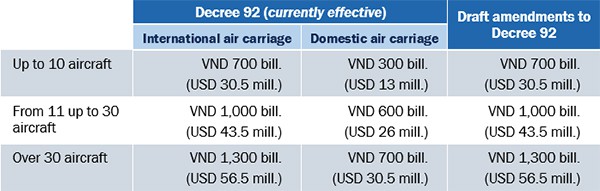
In addition, under the draft, an airport enterprise, whether establishing and maintaining a domestic or international airport, is only required to have minimum capital of VND 200 billion (about USD 8.7 million).

The draft amendments to Decree 92 are indicative of Vietnam’s overall revamping of its aviation regulatory framework. In addition to Decree 92, the Vietnamese Government has been considering amendments to Decree 68/2015/ND-CP governing aircraft registration and rights over aircraft. Decree 68 provides domestic enforcement of the Convention on International Interests in Mobile Equipment (known as the Cape Town Convention), providing aircraft lessors and financiers greater security rights over their assets. The new draft amendments to Vietnam’s aviation regulations show the government is seeking to encourage more foreign investment to meet the country’s rapidly growing air transportation demands.


RELATED INSIGHTS​ 

August 20, 2026
As part of its membership in Lex Mundi, Tilleke & Gibbins has released the latest edition of its Guide to Doing Business in Thailand, providing an overview of the legal, regulatory, and commercial considerations for companies establishing or expanding operations in Thailand. The 2026 edition offers practical insight into the country’s business environment, investment framework, and operational requirements. The guide covers a wide range of topics relevant to foreign and domestic investors, including: Investment incentives and promotion schemes Financial facilities and banking regulations Exchange controls and money transfers Import and export regulations Business structures and incorporation options Requirements for establishing a business Operational and compliance considerations Business cessation and insolvency procedures Employment and labor laws Taxation Immigration and visa requirements Prepared by Tilleke & Gibbins lawyers across multiple practice areas, the publication outlines key aspects of doing business in Thailand, including foreign investment restrictions, regulatory compliance obligations, corporate structures, employment requirements, and recent legal and economic developments affecting investors. The publication forms part of Lex Mundi’s Country Guides series, a global collection of jurisdiction-specific reference materials prepared by member firms around the world. Together, these guides help companies evaluate opportunities, compare regulatory environments, and plan international business activities across multiple markets. The full Guide to Doing Business in Thailand 2026 is available through the button below.
July 23, 2026
Tilleke & Gibbins’ Bangkok-based aviation specialists have authored the Thailand chapter of Aviation Finance & Leasing 2026 from Chambers and Partners. This annual guide examines the key legal issues impacting aircraft lessors, lessees, and financiers in nearly 40 jurisdictions worldwide. In addition to the Thailand chapter, Tilleke & Gibbins also contributed the Vietnam chapter to this year’s edition. The Thailand chapter offers a comprehensive overview of the country’s legal framework governing all aspects of aircraft sale and purchase, aircraft and engine leasing, and aircraft debt finance. Some topics covered include: sale and lease agreement terms taxation lease registration and enforcement lease assignment/novation insurance and reinsurance debt structuring securities liens The guide also examines other matters with practical implications for the aviation industry’s day-to-day operations. Chambers and Partners’ Global Practice Guides provide in-house counsel with authoritative commentary on practical legal issues affecting business, enabling readers to compare legislation and procedures across multiple jurisdictions. The Thailand chapter of Aviation Finance & Leasing 2026 is available as a PDF through the button below. The full guide can be accessed for free on the Chambers and Partners website.
July 23, 2026
Aviation law experts from Tilleke & Gibbins’ Vietnam offices have prepared the Vietnam chapter of Aviation Finance & Leasing 2026 from Chambers and Partners. Covering nearly 40 jurisdictions worldwide, the guide addresses key legal considerations for aircraft lessors, lessees, and financiers. Alongside the Vietnam chapter, Tilleke & Gibbins also provided the Thailand chapter for this year’s edition. The Vietnam chapter delivers detailed insights into the legal environment affecting aircraft sale and purchase, aircraft and engine leasing, and aircraft debt finance. Some of the topics it examines include: sale and lease agreement terms taxation lease registration and enforcement lease assignment/novation insurance and reinsurance debt structuring securities liens The guide also covers other issues influencing the day-to-day activities of aviation industry participants in Vietnam. Chambers and Partners’ Global Practice Guides provide in-house counsel with authoritative analysis of practical legal matters impacting business, enabling readers to compare legislation and relevant procedures across leading jurisdictions. The Vietnam chapter of Aviation Finance & Leasing 2026 is available as a PDF through the button below. The full guide can be accessed for free on the Chambers and Partners website.
February 20, 2026
Thailand’s Supreme Administrative Court has issued a decisive ruling annulling the Ministry of Labor’s notification that had granted an exemption for foreign pilots to fly domestic routes under wet‑lease arrangements. A wet lease is a leasing arrangement in which the aircraft is provided together with its foreign flight crew, including pilots, and related operational support, rather than the airline supplying its own pilots. The judgment, delivered on November 17, 2025, and published in the Government Gazette on January 30, 2026, follows a legal challenge brought by the Thai Pilots Association, which argued that the exemption unlawfully enabled foreign workers to assume a role traditionally reserved for Thai nationals. The notification in question, dated December 13, 2024, authorized foreign pilots who came as part of wet‑leased aircraft to fly domestic routes. The Thai Pilots Association disputed the legality of this rationale, asserting that the exemption was triggered by a private airline’s request rather than by any statutory necessity. The Ministry of Labor justified this measure by relying on aircraft‑specific approvals issued by the Ministry of Transport and by enabling the Department of Employment to issue corresponding work permits. Arguments Presented in the Case The Thai Pilots Association argued that the exemption undermined the interests of domestic pilots and conflicted with the policy intent of Thailand’s foreign‑worker regulatory framework. The lawsuit emphasized that the notification arose directly from a private airline company’s request to operate two A320 aircraft under a wet lease and that the measure had the practical effect of displacing Thai pilots who remained unemployed. Meanwhile, the Ministry of Labor defended the exemption as a temporary and necessary response to industry shortages and part of national efforts to support tourism and restore aviation capacity. Legal Framework Thai law establishes a general prohibition against foreign nationals piloting domestic aircraft. Section