
You are using an outdated browser and your browsing experience will not be optimal. Please update to the latest version of Microsoft Edge, Google Chrome or Mozilla Firefox. Install Microsoft Edge

August 29, 2018

Panasonic Wins Passing Off Case for Packaging and Product Designs

Informed Counsel

Although the Thai Trademark Act provides protection for passing off, filing a lawsuit to defend an IP owner’s unregistered rights can still pose certain challenges. This is especially true where two registered trademarks are different, but the product packaging designs of both marks are confusingly similar. In these circumstances, the court occasionally decides upon a mere comparison of the two marks and may determine that the similarities of their packaging designs are not likely to cause confusion among public consumers due to their dissimilarity.

Recently, the Supreme Court rendered a remarkable and highly significant judgment on the grounds of passing off, which should serve as a landmark trademark infringement case in Thailand. Panasonic, the plaintiff, owns various trademark registrations worldwide. Among those registered marks, the most eye-catching mark is the PANASONIC mark itself. Panasonic registered this mark for use with manganese and alkaline batteries in Class 9 in Thailand in 1985. Panasonic exerted huge efforts and much research in designing the unique colors used with its batteries and the labeling on the packaging to let consumers recognize its products immediately as belonging to Panasonic.

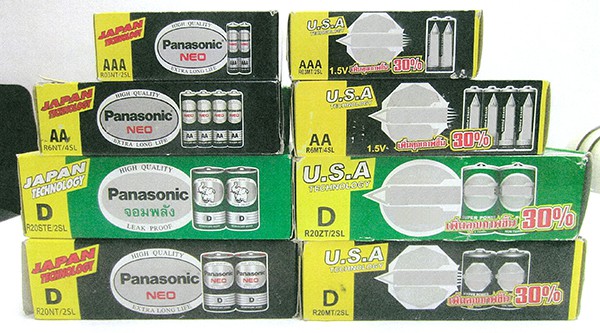
Approximately five years ago, a Thai manufacturing company (defendants) was discovered to be manufacturing different types of batteries that were found to be similar to those manufactured by Panasonic under its own trademark. The defendants’ batteries were closely similar to Panasonic’s battery colors and the text was positioned almost identically to Panasonic’s packaging.

After trying unsuccessfully to reach an amicable settlement, Panasonic decided to bring a civil lawsuit against the defendants on the grounds of trademark infringement and passing off.
IP&IT Court Decision   

At the Intellectual Property and International Trade (IP&IT) Court, Panasonic argued that the appearance of its packaging was immediately recognizable among Thai public consumers and distinguishable from the packaging of other battery manufacturers. To support its claim, Panasonic conducted a public survey opinion poll comparing the overall appearances of its packaging and that of other battery manufacturers’ packaging. The survey results revealed that the average consumer readily recognizes Panasonic’s packaging without seeing the PANASONIC mark, and that there is a likelihood of confusion when consumers see the defendant’s packaging. Unfortunately, these survey results were not convincing evidence to the court. Without considering the defendant’s bad faith in imitating the color, size, and word arrangement of its battery packaging, the court instead took into consideration the trademark itself, and therefore considered that the defendant’s batteries were distinguishable when considering pronunciation and overall appearance.    

Panasonic disagreed with the court’s opinion and decided to appeal the case to the Supreme Court, arguing that the IP&IT Court failed to elaborate on the legal point of the defendants’ bad faith, as it was using similar packaging, labeling, and colors to its own product designs and benefiting from Panasonic’s widespread reputation.

The Supreme Court Decision   

The Supreme Court confirmed the IP&IT Court decision with regard to the dissimilarity of the registered marks, when considering pronunciation and the shape of the Roman characters of the marks. However, the Supreme Court disagreed with most other aspects of the IP&IT Court’s reasoning, especially in its failure to determine whether the defendants, by using a similar packaging, label, and product design to that of Panasonic’s, acted in bad faith and thereby infringed Panasonic’s unregistered trademark rights.    

The Supreme Court emphasized the importance of the bad faith intention of the defendants by determining the manner in which the trademark is used on goods and packages. The court found that even though the registered mark in dispute was not confusingly similar to the PANASONIC trademark in either appearance or pronunciation, the court must compare the characteristics of the batteries and the packaging of the defendants with those aspects of Panasonic’s batteries to determine whether the two companies’ products are similar.    

With regard to the color scheme, the Supreme Court took an approach contrary to the IP&IT Court’s reasoning. Even though color is a common feature that anyone can freely use, a certain color combination (e.g., green and silver; black and silver; or red, white, black and yellow), together with the placement of the colors, text, and images, creates a visual design and pattern indicating that Panasonic’s goods are different from others’ goods.   

The Supreme Court further elaborated that the appearance of the defendants’ batteries and packaging, which appear to be closely similar to Panasonic’s, clearly reflect the bad-faith intention of the defendants to use their registered mark with batteries in order to deceive the relevant consumers into believing that the batteries belong to Panasonic. The court held that such tortious conduct can only have the result of causing injury to Panasonic and is thus unlawful.    

The Supreme Court ruled that the defendants must cease using their product designs and packaging designs of similar coloring and patterns to those of Panasonic, and must not pass off their products as those of Panasonic. Moreover, the court awarded Panasonic compensatory damages, together with its attorneys’ fees and court fees.

Conclusion   

The trademark owner’s victory in this case offers a valuable lesson in determining that trademark infringement should not only consider the mark itself but also the manner in which an alleged infringer uses its mark to imitate a brand owner’s unique product designs and packaging, which can now be considered to be unregistered trademarks. This Supreme Court judgment establishes an exemplary guideline for brand owners facing similar issues, whereby brand owners can protect themselves from others imitating their unique product designs and packaging.

RELATED INSIGHTS​ 

September 17, 2026
Thailand’s Office of the Consumer Protection Board (OCPB) has released for public comment a draft bill to amend the Consumer Protection Act B.E. 2522 (1979), the country’s foundational consumer protection legislation. The draft amendment aims to modernize the nearly five-decade-old framework to address the rapid growth of digital commerce, online advertising, influencer marketing, and new business models. The public consultation period is open until October 10, 2026. Expanded Definitions Covering Digital Commerce The draft significantly broadens several core definitions to capture modern commercial activities: “Consumer” is expanded to include natural persons and nonprofit juristic persons who purchase or receive services, including those solicited by businesses and end users who do not directly pay for the goods or services. “Business operator” now explicitly covers advertising business operators and hired advertising persons, such as influencers and content creators. “Advertising media” is expanded to include digital platforms, social media, and social media user accounts. “Label” now encompasses electronic labels—symbols, codes, or other electronic formats displaying product information. Influencer and Advertising Disclosure Requirements In addition to these expanded definitions, “hired advertising person for selling goods or services” is a new definition covering influencers, content creators, live streamers, affiliate marketers, and virtual online media operators who receive monetary compensation or other benefits for advertising goods or services. Hired advertising persons—including influencers and content creators—must disclose to consumers that content is advertising and reveal their relationship with the business owner. Disclosure is required when the business owner employs the advertiser, pays or provides other benefits for the advertisement, or provides free or discounted products or services. These requirements apply where consumers would not otherwise know that the business has a connection to the person presenting the content. Labeling Requirements for Importers The draft introduces a clearer labeling obligation for importers of label-controlled goods, who must
August 27, 2026
Franchising in Thailand has matured into a sizeable commercial sector, but the rules governing franchisor–franchisee relationships remain scattered across general legislation rather than consolidated in a dedicated franchise statute. In this environment, the decisions of the Trade Competition Commission of Thailand (TCCT) have emerged as valuable practical guidance. Thailand follows a civil-law system in which judicial and administrative decisions do not create binding precedent; however, past rulings are nonetheless influential. This article examines the most instructive recent TCCT decisions and distills the practical compliance considerations for franchisors and franchisees operating in Thailand. Postcontract Changes: Justified or Unfair? A recurring issue is whether a franchisor may alter the terms of engagement after contract execution. The TCCT has established that midterm modifications are not inherently unfair; the determinative factors are whether there was a reasonable business justification, adequate advance notice, and a transparent process. In a 2023 coffee franchise matter, for instance, the TCCT declined to find a violation where a franchisor increased raw material prices, noting the increase had been communicated in advance and supported by demonstrable cost pressures. A bubble tea franchise matter reinforces this principle. The TCCT found that postcontract mandatory purchases of branded syrup and flavorings were justified, as the agreement reserved the franchisor’s right to modify product requirements, the materials were sold at or below market prices, and the branded ingredients possessed distinctive qualities deemed essential to franchise quality. The complaint was dismissed, with the additional requirements characterized as a legitimate measure to preserve brand consistency. Considered together, these decisions indicate that post‑contract modifications will be evaluated against three criteria: (1) whether there is a legitimate business rationale, (2) whether adequate advance notice was provided, and (3) whether franchisees were treated equitably throughout the transition. Discriminatory Treatment: Are Renewals and Information Equal? A 2024 automotive dealership
August 20, 2026
As part of its membership in Lex Mundi, Tilleke & Gibbins has released the latest edition of its Guide to Doing Business in Thailand, providing an overview of the legal, regulatory, and commercial considerations for companies establishing or expanding operations in Thailand. The 2026 edition offers practical insight into the country’s business environment, investment framework, and operational requirements. The guide covers a wide range of topics relevant to foreign and domestic investors, including: Investment incentives and promotion schemes Financial facilities and banking regulations Exchange controls and money transfers Import and export regulations Business structures and incorporation options Requirements for establishing a business Operational and compliance considerations Business cessation and insolvency procedures Employment and labor laws Taxation Immigration and visa requirements Prepared by Tilleke & Gibbins lawyers across multiple practice areas, the publication outlines key aspects of doing business in Thailand, including foreign investment restrictions, regulatory compliance obligations, corporate structures, employment requirements, and recent legal and economic developments affecting investors. The publication forms part of Lex Mundi’s Country Guides series, a global collection of jurisdiction-specific reference materials prepared by member firms around the world. Together, these guides help companies evaluate opportunities, compare regulatory environments, and plan international business activities across multiple markets. The full Guide to Doing Business in Thailand 2026 is available through the button below.
August 13, 2026
On August 6, 2026, the National Bank of Cambodia (NBC) issued a notice calling on business owners that issue electronic money, such as e-wallet accounts and stored-value membership cards, to notify the central bank within 90 days. The notice targets businesses that are not licensed banking or financial institutions or payment service providers, but have been issuing e-money to facilitate payments within their own networks. Failure to notify the NBC may result in legal action. Background and Regulatory Basis The NBC has observed that certain businesses, including cafes, restaurants, transportation companies, entertainment centers, and gas stations, have been issuing e-money through e-wallet accounts in mobile apps or membership cards to facilitate customer payments for products or services within their own networks. Customers create e-wallet accounts and load balances to pay for goods or services at the issuing business. The NBC describes this as “single-purpose e-money.” Under the 1999 Law on Banking and Financial Institutions, providing payment facilities to customers forms part of the operations of banking and financial institutions and requires an NBC license. In addition, article 20 of the 2017 Prakas on the Management of Payment Service Institutions further prohibits legal entities other than banking and financial institutions and payment service institutions from issuing e-money. However, article 20 also provides that issuing e-money in certain limited cases does not require a license, but the NBC must be notified in advance in writing. A business may issue single-purpose e-money without a payment service institution license provided it meets all the following conditions and submits written notice to the NBC: The maximum balance per account is KHR 200,000 (approximately USD 50) or equivalent. The total aggregate balance across all accounts does not exceed KHR 800 million (approximately USD 200,000) or equivalent. The e-money is used to pay for products or