
You are using an outdated browser and your browsing experience will not be optimal. Please update to the latest version of Microsoft Edge, Google Chrome or Mozilla Firefox. Install Microsoft Edge

June 5, 2019

Updates on Thailand’s Trademark Registration Practices

Informed Counsel

The current version of Thailand’s Trademark Act came into force on July 28, 2016. The most recent amendments to the trademark laws introduced multiple-class filings, registration of international trademarks, new methods to calculate official fees, and the acceptance of sound marks. What did not change were the formality requirements and the general examination practices of the Thai Trademark Office. Nevertheless, we have recently come across certain issues that require increased scrutiny from trademark owners.

Priority Claiming   

As Thailand is a party to the Paris Convention, a trademark owner’s right to claim the priority date of a trademark application in a foreign country and then file an application for the same trademark in Thailand within six months of that date has remained unchanged. However, we recently learned that a number of priority claim requests have been rejected by the Trademark Office, which was not an issue we had encountered in the past.    

It would be no surprise if the rejection of the priority claim was the result of a failure to submit the required documents, or if it was due to the material differences in the applied marks in the priority applications. This issue caught our attention because the rejections seemed to target word marks filed in plain block letters. It appears that the Trademark Office has been rejecting priority claim requests for all word marks that were filed using even slightly different fonts from those used by the trademarks appearing in the priority applications.   

Examples of such marks that would be rejected in a priority claim might be as follows.
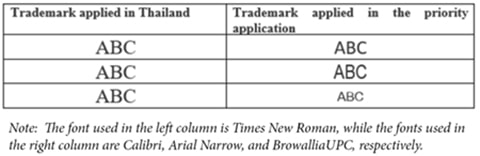
We disagree with this type of rejection and approached the Trademark Office to explain that the marks, as claimed, consist of standard characters, without claiming any particular font style, size, or color. Thus, minor differences between font styles should not be cited as the main reason for rejecting priority claim requests.   

However, we later found that the cause of rejection stems from the Trademark Office’s Internal Guidelines dated 2016, which require that the marks, as claimed, must be identical to the marks in the Thai applications. In particular, for word marks the fonts must be identical. The Internal Guidelines state the criteria for claiming a priority date from a foreign application as follows:

  • Priority application must be stated in the Kor 10 form.
  • The trademark must be the same as set out in the foreign priority application. In this respect, the Registrars are required to examine the primary visual similarities of the marks; e.g., word marks must be in identical fonts.
  • In cases where the trademarks in the foreign applications are in color and the Thai applications contain different colors, the marks are deemed to be the same, except in case of a “group of colors” type of mark.
  • If trademarks applied in foreign applications are Series Marks, and one of the marks in the Series is identical to the trademark applied in Thailand, the two marks are deemed to be the same.
  • The descriptions of goods or services in foreign applications must cover the goods or services listed in the Thai applications.
  • A copy of the priority application must be submitted.
  • Statements certifying that the priority application has never been rejected, withdrawn, or abandoned must be submitted. Such statements must be certified by the trademark owners or their authorized representatives, either within or outside of Thailand.

The Trademark Office’s Internal Guidelines have not been publicly announced, but these Internal Guidelines seem to be used as the basis for rejection of priority claim requests in many cases. Therefore, trademark owners are urged to be aware of this issue and to ensure that when a priority claim is requested, the applicant must strictly comply with these Internal Guidelines.

Multiple-Class Filings   

Since the enactment of the new Trademark Act in 2016, we have always advised our clients who prefer to file multiple-class trademark applications that a problem in one class would delay the whole application, as divisional applications are not allowed in Thailand. This advice remains valid, and we would now like to emphasize that not only will a problem in one class delay the whole application, but it could also result in the rejection of the whole application.   

When a multiple-class trademark application is rejected, the application is rejected in its entirety. The applicant has to appeal with respect to the whole application, even though arguments for some classes may be stronger than other classes, and the Board of Trademarks will issue its decision with respect to the whole application rather than rejecting certain classes and allowing other classes to remain.    

In other words, even if a trademark is descriptive only of certain classes of goods or services, when the Registrar rejects the mark, they usually reject the whole application. Additionally, when the Board of Trademarks issues its decision in an appeal, such decision will target the whole application. We have not yet received a decision by the Board whereby the Board allows only some of the non-affected classes in a multiple-class application to proceed to registration. The Board tends to either accept or reject the application in its entirety, despite there being no official objections targeting some of the classes.    

With this trend of rejecting whole multiple-class applications without allowing divisional applications, trademark owners should consider their risks and may opt to file single-class trademark applications if they anticipate that there might be problem in some but not all classes. On the other hand, if trademark owners anticipate rejection in all classes, filing multiple-class applications would save costs since the appeal for all classes could be filed at the same time.    

We will be closely monitoring these slight and sometimes undisclosed changes in the Trademark Office’s practices, which can have substantial effects on applicants, and will continue to provide timely updates on the trademark registration process in Thailand.

RELATED INSIGHTS​ 

September 24, 2026
Vietnam is implementing and developing a broad package of regulatory reforms that could reshape how IP, data, digital platforms, and product authenticity are regulated and enforced. Several of the key measures have been led by the Ministry of Public Security in its legislative and administrative capacity, as part of a broader government effort. The core reform package consists of four key legal instruments: proposed amendments to the Criminal Code, a proposed new Data Security Law, a draft Decree on Product Identification, Authentication and Traceability, and the newly enacted Decree No. 330/2026/ND-CP. These instruments include rules on criminal enforcement, data security, electronic identification, product identification and traceability, administrative violations, and cybersecurity sanctions. Combined, these measures will affect copyright enforcement, industrial property rights, trade secrets, AI training data, product provenance, online takedowns, valuation of counterfeit goods and electronic evidence. It is worth noting that, in addition to strengthening criminal penalties for IP crimes, Vietnam’s emerging regulatory framework increasingly treats infringement, data misuse, product authentication, and platform-enabled violations as interconnected regulatory and enforcement challenges. For rights holders and foreign investors, this could mean stronger tools against counterfeiting and online infringement, but also more compliance obligations around data, traceability, AI, platform controls and government-facing reporting. Expansion of Criminal IP Enforcement Proposed amendments to Article 225 of the Criminal Code would expand criminal copyright exposure beyond reproduction and distribution to cover large-scale commercial public performance and online communication of works, phonograms and video recordings. This is important because piracy is increasingly about streaming, unauthorized communication, and platform access models rather than physical copying. Aggravated copyright infringement could be subject to up to 10 years in prison for individuals and fines of up to VND 6 billion (about USD 228,300) for commercial legal entities. The amended Article 226 would expand criminal industrial property liability beyond
September 21, 2026
Thailand’s first-to-file trademark system has a serious vulnerability: it lacks both an explicit mechanism for refusing bad-faith registrations and any means of invalidating them in court after the five-year limitation period has expired. While brand owners worldwide confront trademark squatting, Thailand’s statutory silence stands out, particularly in light of AIPPI’s 2017 Resolution Q249, which recommended that every jurisdiction provide clear tools to address bad faith at all stages of the trademark lifecycle. Nearly a decade later, Thailand has yet to act. This article proposes a concrete reform blueprint, drawing on the legislative models of China, the United Kingdom, and the European Union. The Statutory Gap Under the Thai Trademark Act B.E. 2534, no provision expressly authorizes examiners to reject an application on grounds of bad faith. Section 8(10) addresses well-known marks but offers no relief where the targeted mark lacks well-known status. Practitioners have resorted to Section 8(9)—which bars marks “contrary to public order, morality, or public policy”—as a workaround. However, this provision was designed to address the characteristics of the mark itself, not the applicant’s intent. Thai Supreme Court decisions have split on whether it can reach bad-faith conduct, creating persistent legal uncertainty. The gap extends beyond examination. Civil actions to cancel a bad-faith registration must be brought within five years—a deadline that frequently expires before foreign brand owners discover the squatted mark. Cancellation through the Board of Trademarks remains available but is slow, costly, and subject to court appeal, leaving bad-faith registrations in force during protracted proceedings. The system effectively rewards squatters and penalizes legitimate owners. Lessons from International Best Practices Several major jurisdictions have already closed this gap. China’s 2019 amendment to Article 4 of the Trademark Law introduced an absolute ground for refusal: “bad faith trademark applications without intent to use shall be rejected.” Bad
September 14, 2026
Myanmar’s first-to-file trademark registration regime under the Trademark Law 2019—which became fully operational in April 2023—provides mark owners with enhanced legal protection compared with the country’s former system. Correspondingly, the current system imposes more rigorous statutory requirements for obtaining, maintaining, and enforcing rights in marks. In this first-to-file trademark registration system, however, evidence of use remains particularly significant, as it may establish acquired distinctiveness, support a claim that a mark is well-known, and strengthen the owner’s position in both registration and enforcement proceedings. Accordingly, it can be said that this framework is underpinned by three key concepts: distinctiveness, well-known status, and, importantly, use of the trademark. Trademark Distinctiveness Under the Trademark Law, signs that lack distinctiveness are generally ineligible for mark protection. These signs include generic terms, basic shapes, unstylized single letters or numerals, and signs that merely describe the kind, quality, quantity, intended purpose, value, geographical origin, production time, or other characteristics of the relevant goods or services. However, a mark that would otherwise be refused on distinctiveness or descriptiveness grounds may be registrable if it has acquired distinctiveness through its use prior to the filing date. To show this, the applicant must demonstrate that the mark became distinctive to relevant consumers through continuous, exclusive, and good-faith use in trade within Myanmar. The burden of proving acquired distinctiveness rests with the mark owner. Accordingly, sufficient evidence demonstrating both use of the mark and the level of consumer recognition attained should be prepared in advance. Well-Known Mark Criteria Myanmar’s Trademark Rules, which govern the substantive examination of mark registration applications, establish criteria for determining well-known marks, aligned with international standards. Where an applicant claims well-known status—whether to overcome a refusal on relative grounds or to oppose a third party’s registration—the registrar will assess the claim based on the following
September 14, 2026
On August 23, 2026, Vietnam’s National Assembly passed Law No. 11/2026/QH16, amending the country’s Customs Law with effect from March 1, 2027. The amendments represent a substantial reform of Vietnam’s customs-based intellectual property enforcement regime. The reforms come amid considerable external pressure. In its 2026 Special 301 review, the US Trade Representative (USTR) designated Vietnam a “priority foreign country,” citing widespread counterfeiting, weak border enforcement, limited ex officio customs powers, and the absence of controls over goods in transit. Vietnam’s legislative response signals a commitment to bringing its border enforcement practices into line with international expectations. For IP rights holders operating in or through Vietnam, the amended law introduces several tools that substantially strengthen enforcement options at the border. Closing the Transit Gap One of the most consequential amendments is the extension of IP-related customs enforcement to goods in transit. Previously, Vietnam’s customs regime applied IP controls only to goods being imported or exported, a gap the USTR had specifically identified as enabling infringing goods to pass through Vietnamese ports with impunity. Vietnam’s geographic position as a logistics hub for Southeast Asia means that substantial volumes of goods transit its ports and free-trade zones. Extending enforcement to cover these shipments brings Vietnam closer to the standard set by the EU’s customs enforcement regulation and addresses a longstanding concern of multinational brand owners whose goods are frequently counterfeited in the region. Strengthened Suspension and Ex Officio Powers The amended law introduces a dual-track suspension mechanism (Article 73(2)). Customs authorities will suspend clearance upon request by an IP rights holder (or authorized representative) who provides evidence of IP ownership, evidence of infringement, and a financial guarantee. Customs can now proactively suspend clearance on an ex officio basis if, during inspection and monitoring, they discover “clear grounds” to suspect that imported, exported,