
You are using an outdated browser and your browsing experience will not be optimal. Please update to the latest version of Microsoft Edge, Google Chrome or Mozilla Firefox. Install Microsoft Edge

December 24, 2019

Vietnam’s Regional Minimum Wages to Increase

Taylor Vinters – International Employment Law Update

On January 1, 2020, region-based minimum wages for non-state employees in Vietnam will increase by an average of 5.5%. The increase was passed by Vietnam’s National Wage Council on July 11, 2019, and approved by the prime minister on November 17 of the same year.

As the cost of living varies dramatically throughout Vietnam, the government divides the country into four salary regions for the purpose of issuing minimum wages, reflecting the economic realities of the urban/rural divide and other developmental factors. The increase in the minimum wage for 2020 is summarised in the table below.

Monthly minimum wage by region:
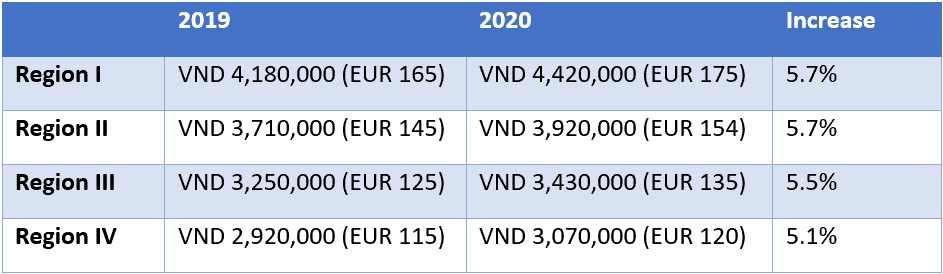
  • Companies are not permitted to pay unskilled employees monthly wages which are lower than the relevant minimum wage. Wages paid to employees who have undergone vocational training should be at least 7% higher than the minimum salary, according to the country’s Ministry of Labor, Invalids and Social Affairs.Region I includes the urban and suburban districts of Hanoi and Hai Phong in the north, and the urban and suburban districts of Ho Chi Minh City and its neighboring provinces of Dong Nai, Binh Duong, and Ba Ria – Vung Tau in the south.
  • Region II includes the outskirts of Hanoi and Ho Chi Minh City, as well as other large and medium-sized cities throughout Vietnam, such as Da Nang, Nha Trang, and Can Tho.
  • Region III includes smaller provincial cities and suburban districts.
  • Region IV includes all remaining areas, including the least developed and sparsely populated rural and mountainous regions of Vietnam.

Comment

Employers with employees in each of the four regions mentioned above should be aware of these changes and ensure that they are complying with them by paying their employees the minimum wage for that region. Contract and payroll reviews are therefore recommended to ensure compliance.

RELATED INSIGHTS​ 

August 20, 2025
On August 7, 2025, the government of Vietnam promulgated Decree No. 219/2025/ND-CP on foreign workers working in Vietnam (Decree 219), introducing substantial reforms to the management of foreign employees. Taking immediate effect upon issuance, and superseding earlier regulations on foreign employees under Decree No. 152/2020/ND-CP as amended by Decree No. 70/2023/ND-CP (collectively referred to as “Decree 152”), Decree 219 sets out clear timeframes and application requirements for work permit issuance, while adopting more flexible policies to support business operations. The key new provisions are as follows: 1. Relaxed Requirements Regarding Job-Posting Under Decree 152, employers were required to follow a complex process to apply for work permits or work permit exemption certificates for foreign employees. This included posting an advertisement for any position the employer wished to fill with a foreign employee on a designated online portal for a given amount of time, to demonstrate that the company tried, but failed, to find a suitable Vietnamese candidate for the position. This job-posting step now only applies when the foreigner will work in Vietnam under a local labor contract. Foreigners coming to Vietnam as intra-corporate transferees (i.e., as secondees) or working under service contracts are exempt. The job-posting period is also reduced from 15 calendar days to five business days. Employers may also now post the advertisements on multiple websites instead of only the online portal of the Ministry of Labor, Invalids and Social Affairs (now the Ministry of Home Affairs after government restructuring) or the provincial-level employment service center. 2. Work Permit Application Dossier Previously, employers were required to complete a preapproval step, whereby they had to submit a dossier explaining their foreign labor demand that required approval from the labor authority. Once approval for the foreign labor demand was granted, the approval dossier was an integral part of
August 20, 2025
With the shift in US policy to discourage DEI programs among government and private-sector employers, some companies have been cutting back. But US companies should be cautious in eliminating their DEI programs globally, as some elements of these programs are obligations under local laws in Vietnam, Thailand, and Cambodia.
July 7, 2025
On June 20, 2025, Cambodia’s Ministry of Economy and Finance issued Instruction No. 19116 to clarify when board members and company directors must receive salaries and pay payroll taxes. Board members and company directors who are not considered employees are subject to a withholding tax. This category consists of people who complete services for a nonresident individual and people who perform independent work for a company in Cambodia. Board members and company directors who are considered employees, including those appointed by a foreign head office to temporarily manage a company in Cambodia, must pay payroll taxes on any salary they receive, regardless of whether they are paid by a local or foreign branch of the company. The above obligations apply regardless of whether the person has a work permit. Board members and company directors are exempt from paying payroll tax if they: Are not present and not performing a regular management role at the company despite being registered on the company’s statutes or patent tax card; Participate only in board meetings and occasional shareholder meetings; and Do not receive a salary from a company in Cambodia. Overall, this instruction provides an important clarification regarding the tax obligations of board members and company directors. Companies should pay attention to the classification of their board members and directors and be mindful of the exemption.   This article was written with the assistance of Tilleke & Gibbins interns Amelia Gemma Erickson and Amrin Keat.
July 7, 2025
On June 27, 2025, Thailand issued the new Ministerial Regulation Prescribing the Criteria and Rates for Receiving Unemployment Benefits (No. 2) B.E. 2568 (2025), which amended a similarly named ministerial regulation by boosting the rate of social security benefits to alleviate hardships for employees who are terminated. The new ministerial regulation took effect the following day. Under this new ministerial regulation, eligible terminated employees are entitled to receive unemployment benefits under the Social Security Fund (SSF) for a maximum of 180 days per year, at the rate of 60% of the employee’s monthly wages at the time of termination, up from 50% previously. However, the maximum wage used as the basis for calculating the benefit remains capped at THB 15,000 per month. Therefore, the maximum unemployment benefit that an employee can receive from the SSF is now THB 9,000 (up from THB 7,500) per month for a period of up to six months. To qualify for the unemployment benefits from the SSF, employees must be registered with the Social Security Office and must have contributed to the SSF for at least six months within the 15 months prior to the start date of the relevant unemployment period. This new ministerial regulation was enacted to increase the amount of financial support provided to insured persons in the case of termination, as part of the government’s objective of alleviating economic hardship under current economic and social conditions in Thailand. For more details on unemployment benefits in Thailand, or on any aspect of employment law in the country, please contact Pimvimol (June) Vipamaneerut at [email protected], Dusita Khanijou at [email protected], Ketnut Pukahuta at [email protected], or Chomanut Arif at [email protected].