
You are using an outdated browser and your browsing experience will not be optimal. Please update to the latest version of Microsoft Edge, Google Chrome or Mozilla Firefox. Install Microsoft Edge

December 24, 2019

Vietnam’s Regional Minimum Wages to Increase

Taylor Vinters – International Employment Law Update

On January 1, 2020, region-based minimum wages for non-state employees in Vietnam will increase by an average of 5.5%. The increase was passed by Vietnam’s National Wage Council on July 11, 2019, and approved by the prime minister on November 17 of the same year.

As the cost of living varies dramatically throughout Vietnam, the government divides the country into four salary regions for the purpose of issuing minimum wages, reflecting the economic realities of the urban/rural divide and other developmental factors. The increase in the minimum wage for 2020 is summarised in the table below.

Monthly minimum wage by region:
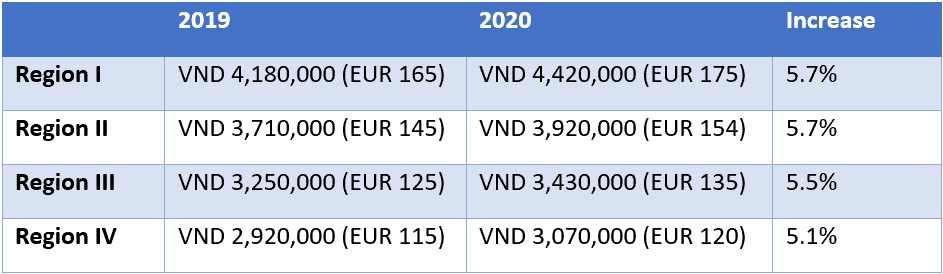
  • Companies are not permitted to pay unskilled employees monthly wages which are lower than the relevant minimum wage. Wages paid to employees who have undergone vocational training should be at least 7% higher than the minimum salary, according to the country’s Ministry of Labor, Invalids and Social Affairs.Region I includes the urban and suburban districts of Hanoi and Hai Phong in the north, and the urban and suburban districts of Ho Chi Minh City and its neighboring provinces of Dong Nai, Binh Duong, and Ba Ria – Vung Tau in the south.
  • Region II includes the outskirts of Hanoi and Ho Chi Minh City, as well as other large and medium-sized cities throughout Vietnam, such as Da Nang, Nha Trang, and Can Tho.
  • Region III includes smaller provincial cities and suburban districts.
  • Region IV includes all remaining areas, including the least developed and sparsely populated rural and mountainous regions of Vietnam.

Comment

Employers with employees in each of the four regions mentioned above should be aware of these changes and ensure that they are complying with them by paying their employees the minimum wage for that region. Contract and payroll reviews are therefore recommended to ensure compliance.

RELATED INSIGHTS​ 

January 12, 2021
Due to the resurgence of the COVID-19 pandemic in Thailand since December, 2020, Thailand’s Ministry of Labor recently published two regulations under the Social Security Act (SSA) in the Government Gazette: The Regulation on Entitlement to Compensatory Benefits in the Event of Unemployment Due to Force Majeure from the Pandemic of Dangerous Communicable Disease Under Relevant Law Relating to Communicable Diseases B.E. 2563 (2020) (the Force Majeure Regulation); and The Regulation on Determination of the Amount of Contributions to the Social Security Funds B.E. 2563 (2020) (the SSF Contribution Regulation). Details of the two regulations are provided below. The Force Majeure Regulation This regulation is similar to a previous regulation from April, 2020, during the first wave of the pandemic, stating that the definition of force majeure under the Social Security Act B.E. 2533 (1990) (the SSA) includes hazards from pandemics of dangerous communicable diseases (including COVID-19). This definition therefore affords protection to insured persons (i.e., employees) in the event that the COVID-19 pandemic results in their being unable to work, or their employers being unable to operate their business normally. This regulation allows the Social Security Office (SSO) to pay compensation to employees who: are insured persons who qualify to receive compensatory benefit in case of unemployment in accordance with the SSA; have to cease working temporarily during the period from December 19, 2020 onwards; and do not receive wages from their employer during the temporary cessation. This applies only if the circumstances above result from the following force majeure events related to hazards from COVID-19 (or other pandemics of dangerous communicable diseases that affect the public under the Communicable Diseases Act B.E. 2558 (2015)): The employee cannot work, or the employer does not allow the employee to work, because of quarantine or to comply with a COVID-19
November 3, 2020
Many Thai and international companies have expanded rapidly into Myanmar in recent years, in what had seemed to be an unstoppable expansion of cross-border trade resulting from the country’s emergence back onto the global stage. For those companies, the COVID-19 situation in Myanmar has been a cause for much concern and uncertainty—doubly so for those who had hired staff in the jurisdiction, as a lack of clarity regarding their obligations as employers was compounded by a lack of information on the situation on the ground.
October 7, 2020
Amendments to Thailand’s Labour Protection Act (LPA) on May 5, 2019, ushered in significant changes to a variety of labour laws, resulting in increased statutory severance pay, increased maternity leave benefits, implementation of paid necessary business leave, changes in wage payments during temporary suspension of business, interest payments for non-payment of wages in certain situations, and new workplace relocation procedures. These changes to the LPA also enhanced employee protections by setting out key amendments to the law governing transfer of employment.
September 17, 2020
After the COVID-19 outbreak, a number of business operators were forced to react to the situation by reducing the number of workers or staff they employed. For the labour courts and labour officers, one important point related to such reductions is whether employers have paid the correct amount of severance, remuneration in lieu of advance notice, and overtime payments to their employees.