
You are using an outdated browser and your browsing experience will not be optimal. Please update to the latest version of Microsoft Edge, Google Chrome or Mozilla Firefox. Install Microsoft Edge

December 24, 2019

Vietnam’s Regional Minimum Wages to Increase

Taylor Vinters – International Employment Law Update

On January 1, 2020, region-based minimum wages for non-state employees in Vietnam will increase by an average of 5.5%. The increase was passed by Vietnam’s National Wage Council on July 11, 2019, and approved by the prime minister on November 17 of the same year.

As the cost of living varies dramatically throughout Vietnam, the government divides the country into four salary regions for the purpose of issuing minimum wages, reflecting the economic realities of the urban/rural divide and other developmental factors. The increase in the minimum wage for 2020 is summarised in the table below.

Monthly minimum wage by region:
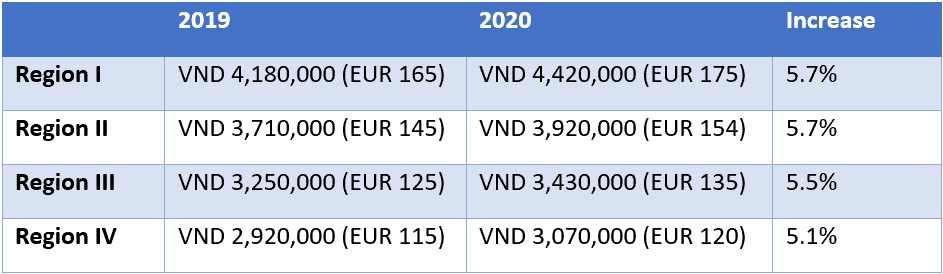
  • Companies are not permitted to pay unskilled employees monthly wages which are lower than the relevant minimum wage. Wages paid to employees who have undergone vocational training should be at least 7% higher than the minimum salary, according to the country’s Ministry of Labor, Invalids and Social Affairs.Region I includes the urban and suburban districts of Hanoi and Hai Phong in the north, and the urban and suburban districts of Ho Chi Minh City and its neighboring provinces of Dong Nai, Binh Duong, and Ba Ria – Vung Tau in the south.
  • Region II includes the outskirts of Hanoi and Ho Chi Minh City, as well as other large and medium-sized cities throughout Vietnam, such as Da Nang, Nha Trang, and Can Tho.
  • Region III includes smaller provincial cities and suburban districts.
  • Region IV includes all remaining areas, including the least developed and sparsely populated rural and mountainous regions of Vietnam.

Comment

Employers with employees in each of the four regions mentioned above should be aware of these changes and ensure that they are complying with them by paying their employees the minimum wage for that region. Contract and payroll reviews are therefore recommended to ensure compliance.

RELATED INSIGHTS​ 

October 14, 2021
As part of its membership in Lex Mundi, Tilleke & Gibbins has published an updated edition of its Guide to Doing Business in Thailand for 2021. This guide outlines all of the key factors for starting and operating a business in the Thai market. Issues covered include: Investment incentives Financial facilities Exchange controls Import and export regulations Structures for doing business Requirements for the Establishment of a Business Operation of the Business Cessation or Termination of the Business Labor legislation, relations, and supply Tax Immigration requirements This publication is part of Lex Mundi’s Guides to Doing Business series prepared by member firms in more than 100 jurisdictions worldwide. The guides serve as a useful resource when planning an international business strategy or researching a new market.
September 13, 2021
Businesses in Vietnam recognize the need to vaccinate their workers in order to keep their factories and workplaces open. In this article, we explore whether employers may require their employees to be vaccinated, as well as associated disclosure and privacy issues under Vietnamese law.
September 13, 2021
With COVID-19 cases continuing to pose a significant threat throughout Thailand, many employers have ordered their employees to work exclusively from home in order to minimize their chances of contracting the virus. However, this luxury is not afforded to all employees—some are unable to work from home due to the nature of their work, and consequently they are placed in the precarious position of being exposed to possible infection. Thailand’s Social Security Office (SSO) understood these risks early in the pandemic and, in March 2020, issued guidelines through the Workmen’s Compensation Fund Office on employees’ entitlement to claim benefits from the workers’ compensation fund (WCF) if they contract the virus as a result of their work. The WCF provides medical-related assistance and compensation to employees who directly suffer from a work-related injury or sickness (subject to certain conditions). Falling ill with COVID-19 during the performance of work duties may constitute suffering work-related sickness, thereby allowing employees to claim compensation from the WCF by submitting the Kor Thor 16 form, a medical certificate, treatment records, records of the employee’s working hours, and other relevant documentation. Upon receiving a claim, the SSO will investigate by collecting facts and evidence from the employer, the infected employee and his or her colleagues, and any witnesses. The official will examine the employee’s duties and working conditions in detail, taking into consideration any relevant information, such as evidence regarding the employee’s travel or movements prior to falling sick. Once all the facts and evidence are gathered, the matter will be submitted to a medical subcommittee responsible for determining whether the employee’s onset of COVID-19 is due to his or her work. If the subcommittee finds that the employee’s contraction of the virus did indeed result from the performance of his or her work duties, the