
You are using an outdated browser and your browsing experience will not be optimal. Please update to the latest version of Microsoft Edge, Google Chrome or Mozilla Firefox. Install Microsoft Edge

December 24, 2019

Vietnam’s Regional Minimum Wages to Increase

Taylor Vinters – International Employment Law Update

On January 1, 2020, region-based minimum wages for non-state employees in Vietnam will increase by an average of 5.5%. The increase was passed by Vietnam’s National Wage Council on July 11, 2019, and approved by the prime minister on November 17 of the same year.

As the cost of living varies dramatically throughout Vietnam, the government divides the country into four salary regions for the purpose of issuing minimum wages, reflecting the economic realities of the urban/rural divide and other developmental factors. The increase in the minimum wage for 2020 is summarised in the table below.

Monthly minimum wage by region:
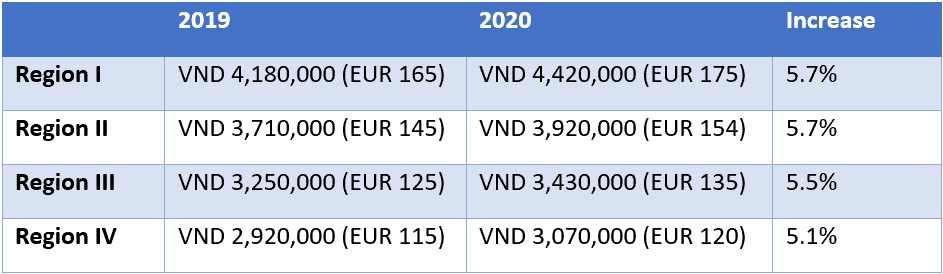
  • Companies are not permitted to pay unskilled employees monthly wages which are lower than the relevant minimum wage. Wages paid to employees who have undergone vocational training should be at least 7% higher than the minimum salary, according to the country’s Ministry of Labor, Invalids and Social Affairs.Region I includes the urban and suburban districts of Hanoi and Hai Phong in the north, and the urban and suburban districts of Ho Chi Minh City and its neighboring provinces of Dong Nai, Binh Duong, and Ba Ria – Vung Tau in the south.
  • Region II includes the outskirts of Hanoi and Ho Chi Minh City, as well as other large and medium-sized cities throughout Vietnam, such as Da Nang, Nha Trang, and Can Tho.
  • Region III includes smaller provincial cities and suburban districts.
  • Region IV includes all remaining areas, including the least developed and sparsely populated rural and mountainous regions of Vietnam.

Comment

Employers with employees in each of the four regions mentioned above should be aware of these changes and ensure that they are complying with them by paying their employees the minimum wage for that region. Contract and payroll reviews are therefore recommended to ensure compliance.

RELATED INSIGHTS​ 

January 14, 2026
Employers operating in Thailand can enforce post-employment noncompete covenants, but success depends on precise drafting and strong evidentiary support. Thai courts will uphold restraints that protect legitimate employer interests and are fair and reasonable in duration, geographic reach, and substantive scope. Overbroad covenants, however, draw judicial skepticism and may fail unless they are drafted in severable, defensible components tied to the employee’s actual role. This article synthesizes recent trends in Thai case practice, explains how Thai courts assess reasonableness in employment restraints, and provides a practical litigation-focused framework for drafting enforceable covenants, preparing evidence, and pursuing relief through the Labor Court. The Legal Framework and Its Practical Implications Thai courts evaluate noncompete covenants under general principles of contract enforceability and public policy, with particular focus on whether a restraint is necessary to protect a legitimate employer interest and proportionate to that objective. In employment matters, this analysis is shaped by the employee-protective tenor of Thai labor law and by the Labor Court’s equitable discretion in determining appropriate remedies. The practical takeaway is that standardized or broadly drafted covenants rarely survive scrutiny. Courts look for a demonstrable nexus between the employee’s actual exposure to confidential information, trade secrets, or customer relationships and the scope of the restraint. Where that nexus is weak or the restraint operates as a blanket prohibition, courts are inclined to decline enforcement or limit relief to a narrowly tailored prohibition. The employer interests most commonly recognized as legitimate in Thai practice include the protection of trade secrets, confidential business information, and goodwill tied to identifiable customer segments or territories. Courts are more likely to enforce restraints where employers can clearly document what information is at risk, why particular customer relationships matter, and how the employee was involved with those assets. Judges also look closely at the
December 19, 2025
On December 12, 2025, Thailand’s Ministry of Labor published a ministerial regulation prescribing the minimum and maximum wages used as a base for calculating social security contributions. The regulation, which takes effect on January 1, 2026, sets a flat minimum base wage of THB 1,650 per month and a phased increase of the maximum base wage over the following six years, as outlined in the table below. Impact on Social Security Benefits Not only will monthly contributions increase as a result of the adjustment to the maximum wages used as a base for calculating social security contributions, but the maximum benefits available to insured persons will also be enhanced, as shown in the next table. Employer Obligations From January 1, 2026, employers must correctly withhold wages and remit social security contributions for both the employer’s and employees’ portions in compliance with the revised thresholds. Failure to comply may expose employers to penalties under the Social Security Act B.E. 2533 (1990). Employers should ensure that payroll systems are updated as necessary to reflect these changes to the wage ceiling used for social security contribution calculations.
December 8, 2025
As Thailand transitions into an aged society, retirement policy and workplace protections for older workers have come into sharper focus. With public sentiment increasingly open to working beyond the traditional retirement age, questions about employee rights and employer obligations are more relevant than ever. In October 2025, Prime Minister Anutin Charnvirakul proposed increasing the statutory retirement age to 65 for government officers, citing Thailand’s aged-society status and the potential social and economic benefits of longer working lives. While academics and stakeholders have raised concerns about systemic impacts, public opinion remains divided, with many workers signaling a willingness to continue working beyond the current norm. Against this backdrop, it’s worth revisiting what the Labor Protection Act B.E. 2541 (1998) (LPA) requires in regard to retirement and severance pay. This article explains the current legal landscape under the LPA, with a focus on retirement and severance pay for employees over 60, recent judicial developments, and practical options for structuring postretirement engagements. Retirement as Termination Under the LPA Under the LPA, retirement—whether set by agreement between employer and employee or unilaterally stipulated by the employer—is deemed a termination of employment. As a result, employees who retire under such terms are entitled to severance pay. The law also adds a default rule: if there is no agreed or prescribed retirement age, or if the prescribed retirement age exceeds 60, an employee aged 60 or older may declare an intention to retire. The declaration takes effect 30 days after notice, and the employer must pay severance accordingly. In short, retirement triggered by agreement, the employer’s work rules, or an employee’s valid notice is treated as a termination, and statutory severance pay is owed. Hiring or Rehiring Employees Over 60 Practical issues arise when an employer’s work rules set a retirement age that does not
December 2, 2025
Investing in Mainland Southeast Asia is Tilleke & Gibbins’ essential guide for investors looking to do business in this vibrant region, whether it’s starting operations as a newly established entity or expanding into new territories or business models.