
You are using an outdated browser and your browsing experience will not be optimal. Please update to the latest version of Microsoft Edge, Google Chrome or Mozilla Firefox. Install Microsoft Edge

December 24, 2019

Vietnam’s Regional Minimum Wages to Increase

Taylor Vinters – International Employment Law Update

On January 1, 2020, region-based minimum wages for non-state employees in Vietnam will increase by an average of 5.5%. The increase was passed by Vietnam’s National Wage Council on July 11, 2019, and approved by the prime minister on November 17 of the same year.

As the cost of living varies dramatically throughout Vietnam, the government divides the country into four salary regions for the purpose of issuing minimum wages, reflecting the economic realities of the urban/rural divide and other developmental factors. The increase in the minimum wage for 2020 is summarised in the table below.

Monthly minimum wage by region:
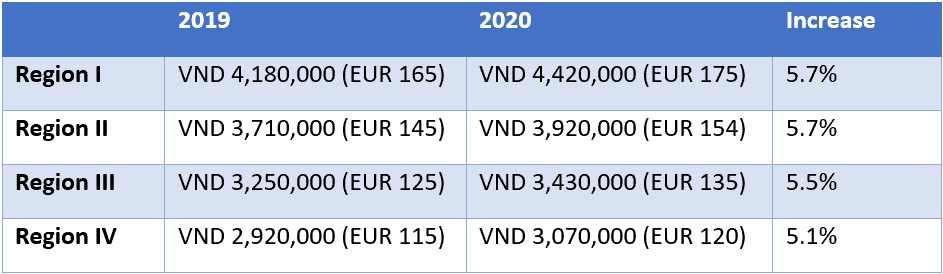
  • Companies are not permitted to pay unskilled employees monthly wages which are lower than the relevant minimum wage. Wages paid to employees who have undergone vocational training should be at least 7% higher than the minimum salary, according to the country’s Ministry of Labor, Invalids and Social Affairs.Region I includes the urban and suburban districts of Hanoi and Hai Phong in the north, and the urban and suburban districts of Ho Chi Minh City and its neighboring provinces of Dong Nai, Binh Duong, and Ba Ria – Vung Tau in the south.
  • Region II includes the outskirts of Hanoi and Ho Chi Minh City, as well as other large and medium-sized cities throughout Vietnam, such as Da Nang, Nha Trang, and Can Tho.
  • Region III includes smaller provincial cities and suburban districts.
  • Region IV includes all remaining areas, including the least developed and sparsely populated rural and mountainous regions of Vietnam.

Comment

Employers with employees in each of the four regions mentioned above should be aware of these changes and ensure that they are complying with them by paying their employees the minimum wage for that region. Contract and payroll reviews are therefore recommended to ensure compliance.

RELATED INSIGHTS​ 

May 20, 2021
Due to the resurgence of COVID-19 in Thailand since March 2021, the Cabinet has approved new reductions in employers’ and employees’ mandatory contributions to the Social Security Fund (SSF). Contribution rates will be calculated as a percentage of each employee’s monthly wages, based on a minimum and maximum monthly wage that will be confirmed in the formal regulation published in the Government Gazette. Effective May 18, 2021, the new contribution rates for mandatory SSF contributions approved by the cabinet are as follows: From June 1 to August 31, 2021 From September 1, 2021, onward The approval of the cabinet will now be considered by the Office of the Council of State. Thereafter, the new regulation will be published in the Government Gazette before formally coming into effect. For more information on this issue, or any other aspect of labor law in Thailand, please contact Chusert Supasitthumrong at +66 2056 5793 or [email protected].
May 10, 2021
Attorneys from Tilleke & Gibbins’ offices in Myanmar, Thailand, and Vietnam have contributed chapters on labor law in these jurisdictions to the Global Employment Law Guide, published by Lex Mundi. The guide provides answers to key employment-related legal questions in 57 jurisdictions around the world, with all entries provided by member firms in the global Lex Mundi legal network. Each chapter contains in-depth information on the jurisdiction’s legal framework governing employment relationships, including coverage of the following topics: Employment categories and contract types Employee rights and protections Employment termination Leave and social benefits Restrictive covenants COVID-19 vaccination mandates and post-pandemic workplace reopening Readers can browse the contributions, generate country-specific reports, and compare attorney-client privilege in multiple jurisdictions. For more information, please visit the Lex Mundi website.