
You are using an outdated browser and your browsing experience will not be optimal. Please update to the latest version of Microsoft Edge, Google Chrome or Mozilla Firefox. Install Microsoft Edge

December 24, 2019

Vietnam’s Regional Minimum Wages to Increase

Taylor Vinters – International Employment Law Update

On January 1, 2020, region-based minimum wages for non-state employees in Vietnam will increase by an average of 5.5%. The increase was passed by Vietnam’s National Wage Council on July 11, 2019, and approved by the prime minister on November 17 of the same year.

As the cost of living varies dramatically throughout Vietnam, the government divides the country into four salary regions for the purpose of issuing minimum wages, reflecting the economic realities of the urban/rural divide and other developmental factors. The increase in the minimum wage for 2020 is summarised in the table below.

Monthly minimum wage by region:
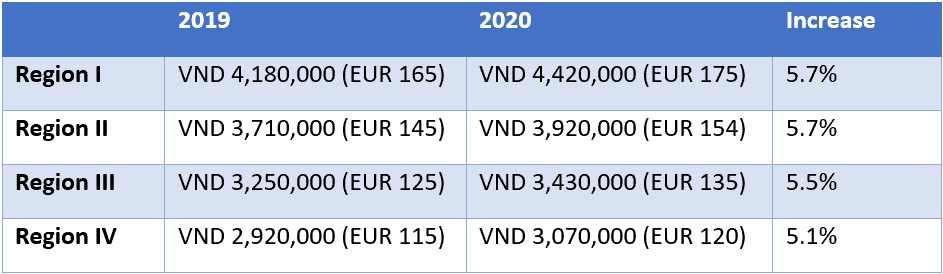
  • Companies are not permitted to pay unskilled employees monthly wages which are lower than the relevant minimum wage. Wages paid to employees who have undergone vocational training should be at least 7% higher than the minimum salary, according to the country’s Ministry of Labor, Invalids and Social Affairs.Region I includes the urban and suburban districts of Hanoi and Hai Phong in the north, and the urban and suburban districts of Ho Chi Minh City and its neighboring provinces of Dong Nai, Binh Duong, and Ba Ria – Vung Tau in the south.
  • Region II includes the outskirts of Hanoi and Ho Chi Minh City, as well as other large and medium-sized cities throughout Vietnam, such as Da Nang, Nha Trang, and Can Tho.
  • Region III includes smaller provincial cities and suburban districts.
  • Region IV includes all remaining areas, including the least developed and sparsely populated rural and mountainous regions of Vietnam.

Comment

Employers with employees in each of the four regions mentioned above should be aware of these changes and ensure that they are complying with them by paying their employees the minimum wage for that region. Contract and payroll reviews are therefore recommended to ensure compliance.

RELATED INSIGHTS​ 

August 5, 2021
With the latest wave of COVID-19 continuing to have a serious impact on Thailand, many businesses have been looking for ways to survive. Some have temporarily reduced employees’ wages, while others have resorted to a complete or partial halt to operations. In these unprecedented circumstances, it is vital that business owners understand the legal criteria and steps for implementing a temporary cessation of operations in Thailand, as outlined in this article. Any business can apply for a temporary cessation of operations under section 75 of the Labor Protection Act (LPA) if there is a necessity and a significant cause, such as the business being unable to operate as usual, and if the necessity is not considered force majeure under Thai law. (If it is deemed force majeure, an employer may be able to withhold all wages—more on this below.) If these criteria are met, the employer can choose whether to seek temporary cessation of operations on a whole or partial basis, depending on the actual situation and necessity. The employer then has to inform a labor inspection officer and the employees at least three business days in advance of the intended cessation of operations. Once this is done, operations may be halted, but the employer must pay employees at least 75 percent of their wages, calculated based on the rate on their latest working day, and these payments must continue throughout the entire cessation period. “Necessity” and force majeure Though the LPA does not indicate what qualifies as a “necessity” allowing an employer to call for a temporary cessation, past rulings from the Supreme Court provide some guidance on this issue. For instance, reduced purchase orders from customers and financial difficulties faced by the employer can amount to a situation of “necessity.” Additionally, the situation has to be significant
July 28, 2021
Lawyers from Tilleke & Gibbins’ labor and employment team including Kien Trung Trinh, Sarah Galeski, and Nam Ngoc Trinh have written the Vietnam chapter of Practical Law’s Employment and Employee Benefits Global Guide. The 2021 edition of the handbook provides a high-level comparative overview of employment laws and regulations across 32 jurisdictions around the world. Tilleke & Gibbins also contributed the Myanmar chapter of the guide. The Vietnam chapter covers a wide range of typical employment matters, such as limitations on working hours, paid leave requirements, minimum wage, and health and safety obligations. In addition, the guide provides insight on a number of topics of special interest to foreign investors doing business in Vietnam, including the following: Mandatory contents of a labor contract; Visas and permits required for expatriate employees; Employers’ obligations for protecting employees’ privacy and personal data; Procedural requirements for the dismissal of an employee; Employer and parent company liability. The 2021 edition also includes a special section on Covid-19 related provisions of labor law. To read the Vietnam chapter, click on the link below.
June 22, 2021
The latest updates to the Employment and Employee Benefits Global Guide, a Thomson Reuters Practical Law online publication that provides an overview of employment and employee benefits in jurisdictions worldwide, includes a revised chapter on employment regulations in Myanmar. The Myanmar chapter was written by members of Tilleke & Gibbins’ Yangon office, including Yuwadee Thean-ngarm, director, Nwe Oo, attorney-at-law, and Sher Hann Chua, consultant. The chapter covers a wide range of key employment topics, including employment status, background checks, regulation of the employment relationship, minimum wage, working hours and holidays, illness and injury of employees, discrimination and harassment, termination of employment, resolution of employer-employee disputes, redundancy/layoffs, employee representation and consultation, business transfer and insolvency, employee relocation, health and safety obligations, taxation of employment income, intellectual property issues, and more. Practical Law, produced by Thomson Reuters, is the world’s leading legal resource for business lawyers, publishing a huge range of guides for hundreds of jurisdictions and practice areas. The Employment and Employee Benefits Global Guide covers 42 jurisdiction around the world, with Tilleke & Gibbins also providing the Vietnam chapter of the guide. To view the latest version of the Myanmar chapter, please visit the Practical Law website.