
You are using an outdated browser and your browsing experience will not be optimal. Please update to the latest version of Microsoft Edge, Google Chrome or Mozilla Firefox. Install Microsoft Edge

December 24, 2019

Vietnam’s Regional Minimum Wages to Increase

Taylor Vinters – International Employment Law Update

On January 1, 2020, region-based minimum wages for non-state employees in Vietnam will increase by an average of 5.5%. The increase was passed by Vietnam’s National Wage Council on July 11, 2019, and approved by the prime minister on November 17 of the same year.

As the cost of living varies dramatically throughout Vietnam, the government divides the country into four salary regions for the purpose of issuing minimum wages, reflecting the economic realities of the urban/rural divide and other developmental factors. The increase in the minimum wage for 2020 is summarised in the table below.

Monthly minimum wage by region:
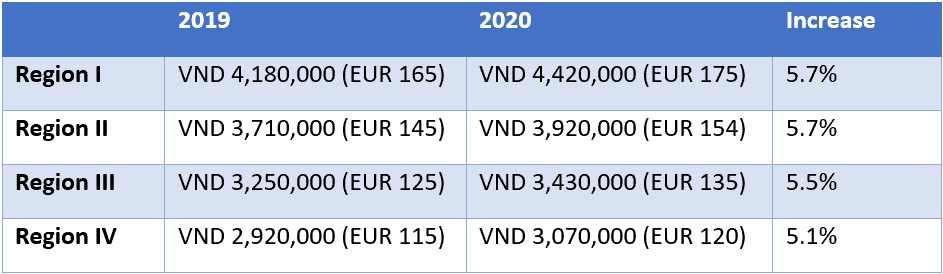
  • Companies are not permitted to pay unskilled employees monthly wages which are lower than the relevant minimum wage. Wages paid to employees who have undergone vocational training should be at least 7% higher than the minimum salary, according to the country’s Ministry of Labor, Invalids and Social Affairs.Region I includes the urban and suburban districts of Hanoi and Hai Phong in the north, and the urban and suburban districts of Ho Chi Minh City and its neighboring provinces of Dong Nai, Binh Duong, and Ba Ria – Vung Tau in the south.
  • Region II includes the outskirts of Hanoi and Ho Chi Minh City, as well as other large and medium-sized cities throughout Vietnam, such as Da Nang, Nha Trang, and Can Tho.
  • Region III includes smaller provincial cities and suburban districts.
  • Region IV includes all remaining areas, including the least developed and sparsely populated rural and mountainous regions of Vietnam.

Comment

Employers with employees in each of the four regions mentioned above should be aware of these changes and ensure that they are complying with them by paying their employees the minimum wage for that region. Contract and payroll reviews are therefore recommended to ensure compliance.

RELATED INSIGHTS​ 

April 29, 2026
Vietnam’s education sector is entering a new regulatory era. On December 10, 2025, the National Assembly adopted a series of new and amended laws in the field of education, including the 2025 Law on Vocational Education, the 2025 Law on Higher Education, and the amended Law on Education No. 123/2025/QH15 (Amended Law on Education). These laws together took effect on January 1, 2026, marking a significant reform of Vietnam’s legal framework governing the education sector. The legislative package introduces a new lawmaking approach under which foundational and principle-based provisions are codified in the Amended Law on Education, while the Law on Higher Education and the Law on Vocational Education serve as specialized statutes providing supplementary, sector-specific regulatory detail tailored to their respective subsectors. The Amended Law on Education fundamentally restructures how educational institutions are established, governed, and licensed, with direct implications for private investors, foreign-invested entities, and education service providers operating in Vietnam. Below are several highlights of the key changes under the amended law, especially in the private sector, that stakeholders should understand: Change in the National Education System In addition to primary education, lower secondary (junior high school) education is now compulsory in Vietnam. Accordingly, diplomas are no longer awarded upon completion of lower secondary school but only for upper education levels. The national education system is also expanded through the introduction of vocational high school as a new level of vocational education. Such reform creates additional learning pathways that not only enable learners to pursue both further education and participate in the labor market, but also better align education and training with socioeconomic development needs. New Hurdle for Joint Investors: Mandatory Corporate Entity Requirement Where two or more investors jointly establish an education institution, the investors are no longer permitted to directly establish such an institution.
March 31, 2026
Against the backdrop of Vietnam’s rapid economic and technological transformation and its ambition to build a knowledge-driven economy, the National Assembly of Vietnam adopted Law on Higher Education No. 125/2025/QH15 on December 10, 2025, The new law took effect on January 1, 2026, replacing Law on Higher Education No. 08/2012/QH13 of 2012 and its subsequent amendments after more than a decade of implementation. The new law reflects a significant policy shift toward enhancing the institutional autonomy of higher education institutions (“HEIs”)—universities and other university-level institutions. By granting broader autonomy, Vietnam aims to enable HEIs to operate more proactively, better respond to market needs, and improve the quality and efficiency of education and research activities. Comprehensive Institutional Autonomy in HEIs The new law marks a significant shift by granting HEIs comprehensive autonomy as a statutory right, within the bounds of the licensed scope of educational operation and the legal framework, rather than a conditional right as provided under the former law. Under the new law, HEIs are empowered to exercise autonomy over their academic expertise, training, scientific research, international cooperation, organizational structure, personnel, finance, and other higher education activities. The expansion of institutional autonomy is also accompanied by a correspondingly strengthened framework of institutional accountability. However, Vietnam maintains a certain degree of control and imposes restrictions on institutional autonomy in sensitive and strategically important areas. These controls and restrictions include limitations on training autonomy in the majors of teacher training, national defense, and security; and restrictions on financial and personnel management autonomy for HEIs under the administration of the Ministry of National Defense and the Ministry of Public Security. New Model for Curriculum Development The new law removes the concept of “opening a training major” and focuses regulation on how training programs are developed and delivered. Under the previous regime,
March 31, 2026
On December 10, 2025, the National Assembly of Vietnam adopted Law on Vocational Education No. 124/2025/QH15, which took effect on January 1, 2026, replacing Law on Vocational Education No. 74/2014/QH13 of 2014. The new law broadens the categories of institutions eligible to deliver vocational training, introduces vocational upper secondary schools, and shifts governance structures for private institutions from ownership-representative boards of management to stakeholder-based school councils. These reforms aim to diversify training providers, align programs with labor market needs, and create a more flexible, open vocational education ecosystem, offering expanded opportunities for foreign and domestic investors, universities, and enterprises. Some highlights of the new Law on Vocational Education are presented below. Expansion of Vocational Training Levels and Programs In addition to elementary, intermediate, and college—the three levels of vocational training program set out under the 2014 Law on Vocational Education—the new law expands the structure by introducing two new levels: Vocational high school training programs are placed between elementary and intermediate levels, and are aimed at combining upper secondary education with vocational training, expanding options for learners after graduating from the lower secondary level. Other vocational training programs are not specified in detail under the new law, but aim to equip learners with the capability to perform and handle one or several simple tasks of an occupation. Expansion of Vocational Education Providers The new law reclassifies and extends vocational education providers by classifying them into two distinct categories: Vocational education institutions, which include colleges, intermediate schools, and vocational high schools. Establishments participating in vocational education activities, which include vocational education centers, vocational-continuing education centers, continuing education centers, other centers with vocational education functions, enterprises, cooperatives, and higher education institutions. Vocational education providers may provide one vocational training level only, or several/all levels, depending on the type of provider. The
January 16, 2026
Employment law specialists from Tilleke & Gibbins in Vietnam have contributed the Vietnam chapter to the Guide to Restructuring a Cross-Border Workforce from International Employment Lawyer. This comprehensive global guide, covering 50 jurisdictions worldwide, addresses the complex issue of workplace restructurings, with a particular focus on the needs of multinational companies. The Vietnam chapter was authored by partner Kien Trung Trinh, counsel Sarah Galeski, and associates Dung Thi Phuong Le and Nguyen Thi Huong Nguyen. The Q&A-style chapter provides in-depth analysis of key areas related to workplace restructuring, including: Reduction in workforce; Restructuring or reorganization of the business; Changing terms and conditions; and Areas to watch. A PDF of the Vietnam chapter can be downloaded through the button below. Tilleke & Gibbins also contributed the Cambodia, Laos, Myanmar, and Thailand chapters to the Guide to Restructuring a Cross-Border Workforce 2026. To browse the full guide for all 45 jurisdictions, please visit the International Employment Lawyer website.