
You are using an outdated browser and your browsing experience will not be optimal. Please update to the latest version of Microsoft Edge, Google Chrome or Mozilla Firefox. Install Microsoft Edge

December 24, 2019

Vietnam’s Regional Minimum Wages to Increase

Taylor Vinters – International Employment Law Update

On January 1, 2020, region-based minimum wages for non-state employees in Vietnam will increase by an average of 5.5%. The increase was passed by Vietnam’s National Wage Council on July 11, 2019, and approved by the prime minister on November 17 of the same year.

As the cost of living varies dramatically throughout Vietnam, the government divides the country into four salary regions for the purpose of issuing minimum wages, reflecting the economic realities of the urban/rural divide and other developmental factors. The increase in the minimum wage for 2020 is summarised in the table below.

Monthly minimum wage by region:
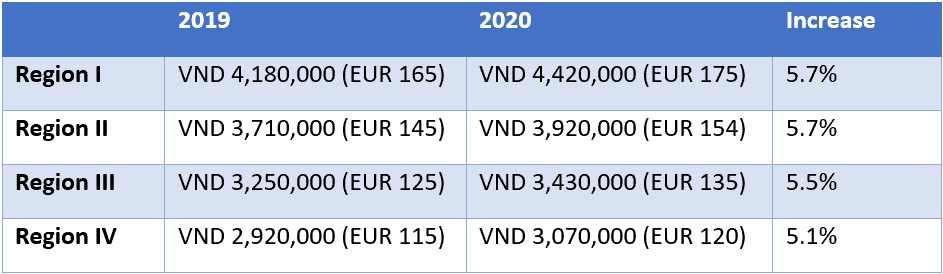
  • Companies are not permitted to pay unskilled employees monthly wages which are lower than the relevant minimum wage. Wages paid to employees who have undergone vocational training should be at least 7% higher than the minimum salary, according to the country’s Ministry of Labor, Invalids and Social Affairs.Region I includes the urban and suburban districts of Hanoi and Hai Phong in the north, and the urban and suburban districts of Ho Chi Minh City and its neighboring provinces of Dong Nai, Binh Duong, and Ba Ria – Vung Tau in the south.
  • Region II includes the outskirts of Hanoi and Ho Chi Minh City, as well as other large and medium-sized cities throughout Vietnam, such as Da Nang, Nha Trang, and Can Tho.
  • Region III includes smaller provincial cities and suburban districts.
  • Region IV includes all remaining areas, including the least developed and sparsely populated rural and mountainous regions of Vietnam.

Comment

Employers with employees in each of the four regions mentioned above should be aware of these changes and ensure that they are complying with them by paying their employees the minimum wage for that region. Contract and payroll reviews are therefore recommended to ensure compliance.

RELATED INSIGHTS​ 

December 15, 2023
As part of its membership in Lex Mundi, Tilleke & Gibbins has published an updated edition of its Guide to Doing Business in Thailand for 2023. This guide outlines the key factors for starting and operating a business in the Thai market. Issues covered include: Investment incentives Financial facilities Exchange controls Import and export regulations Structures for doing business Requirements for the Establishment of a Business Operation of the Business Cessation or Termination of the Business Labor legislation, relations, and supply Tax Immigration requirements This publication is part of Lex Mundi’s Country Guides series prepared by member firms in more than 100 jurisdictions worldwide. The guides serve as a useful resource for planning international business strategy and researching new markets. The full Guide to Doing Business in Thailand is available through the button below.
October 20, 2023
On September 18, 2023, the Vietnamese government issued Decree No. 70/2023/ND-CP (“Decree 70”) amending and supplementing certain provisions of Decree No. 152/2020/ND-CP (“Decree 152”), which regulates foreign workers working in Vietnam and the recruitment and management of Vietnamese workers working for foreign entities in Vietnam. While Decree 70 relaxes some conditions relating to foreign workers, the general goal of protecting and prioritizing domestic labor over foreign labor remains. The major changes introduced in Decree 70 are summarized below. 1. Amended Definitions and Requirements for Worker Classifications Decree 70 introduces several changes to the requirements for foreign workers to be classified as “experts” and “technical workers.” Under Decree 152, foreign workers needed to hold bachelor’s degrees or receive training directly related to their intended job positions in Vietnam. However, under Decree 70, experts are only required to have a university degree or higher and at least three years of relevant work experience suitable for their intended positions in Vietnam. Similarly, it is no longer necessary for technical workers to have training in a specific technical field to be eligible to work in Vietnam. Instead, a technical worker is defined as someone who has undergone at least one year of training and possesses at least three years of working experience suitable for their intended job position. Additionally, Decree 70 clarifies and expands the scope of the term “executive director”. Accordingly, an executive director can be (i) the head of a branch, representative office, or business location of an enterprise (which helps clarify the previous definition of “executive director” in Decree 152); or (ii) an individual who oversees at least one field within an agency, organization, or enterprise while being under the direct supervision of the head of that agency, organization, or enterprise. 2. Application for Work Permit The general procedure for
October 12, 2023
Myanmar has made important amendments to its minimum wage framework by increasing the minimum compensation for workers in both the public and private sectors. Background In May 2018, the National Committee for Setting the Minimum Wage determined that all workers in Myanmar should receive a minimum wage of MMK 4,800 per day (approx. USD 2.29), equivalent to MMK 600 per hour for an eight-hour workday. This rule applied to all workers, without differentiation in location or job. Government Workers and Organizations In September 2023, the Ministry of Planning and Finance announced that daily workers in government departments and organizations are entitled to receive an additional benefit of MMK 1,000 on top of their existing daily wage, which was already MMK 4,800. Consequently, they could earn a total of MMK 5,800 per day for eight hours of work. Private-Sector Workers On October 9, 2023, the national committee announced an increase of minimum wages for employees in the private sector. According to Notification No. 2/2023, workers at private-sector employers with more than 10 employees are now entitled to minimum compensation of MMK 5,800 per day (approx. USD 2.77)—an additional MMK 1,000 per eight-hour workday over the previously established minimum wage. The changes took effect on October 1, 2023. For more details about these changes, or any aspect of employee compensation or employment law in Myanmar, please contact Tilleke & Gibbins at [email protected].
August 18, 2023
On August 16, 2023, Laos’ Prime Minister’s Office issued Notice No. 1502/PMO, which increases the minimum wage for all workers in Laos. This increase is a continuation of the stepped increases in the minimum wage that began in mid-2022. The recent notice increases the minimum monthly wage from LAK 1,300,000 (approx. USD 66) to LAK 1,600,000 (approx. USD 82), in accordance with an agreement reached in the government’s ordinary session in July 2023. The new minimum wage rate will take effect on October 1, 2023. This is the third minimum wage increase in Laos since June 2022. Two of the main factors responsible for this heightened frequency of minimum wage increases are the depreciation of the Lao kip against foreign currencies and inflation in the price of goods for daily consumption. These stepped increases also show the government’s proactive approach toward addressing the cost-of-living crisis in Laos and its effect on low-wage workers. For more details on the new minimum wage, or on any other labor and employment matters in Laos, please contact Dino Santaniello at [email protected] or +856 21 262 355.