
You are using an outdated browser and your browsing experience will not be optimal. Please update to the latest version of Microsoft Edge, Google Chrome or Mozilla Firefox. Install Microsoft Edge

July 13, 2018

Vietnam Considers Revising Key Aviation Industry Decree

The Vietnamese government has recently published draft amendments to Decree No. 92/2016/ND-CP which governs the conditions for investment and business in the aviation industry (Decree 92). The new amendments will open up expanded opportunities for foreign investors in the burgeoning aviation industry, but will make it more difficult for new domestic entrants, due to increased capitalization requirements. It is expected that the government will continue reviewing and refining the draft for issuance in the coming time.

According to the draft, the investment ceiling for foreign investment in an air carriage business enterprise will be raised to 49% from the previous limitation in which foreign investors were limited to 30% of the share capital. The largest shareholder will be required to be a Vietnamese company or individual.

It is also proposed that there will be no longer be a distinction between international and domestic-only carriers in determining minimum capital requirements. In comparison with Decree 92, the changes to minimum capital requirements can be summarized as follows:
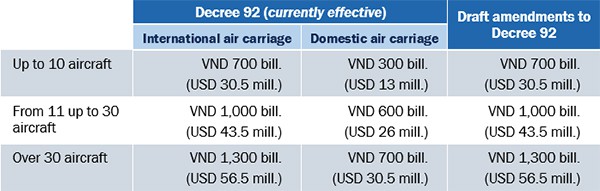
In addition, under the draft, an airport enterprise, whether establishing and maintaining a domestic or international airport, is only required to have minimum capital of VND 200 billion (about USD 8.7 million).

The draft amendments to Decree 92 are indicative of Vietnam’s overall revamping of its aviation regulatory framework. In addition to Decree 92, the Vietnamese Government has been considering amendments to Decree 68/2015/ND-CP governing aircraft registration and rights over aircraft. Decree 68 provides domestic enforcement of the Convention on International Interests in Mobile Equipment (known as the Cape Town Convention), providing aircraft lessors and financiers greater security rights over their assets. The new draft amendments to Vietnam’s aviation regulations show the government is seeking to encourage more foreign investment to meet the country’s rapidly growing air transportation demands.


RELATED INSIGHTS​ 

April 27, 2020
The COVID-19 outbreak has had a devastating effect on Thailand’s aviation industry. Both international and domestic flights have been dramatically curtailed or stopped altogether. When operations do resume, it is uncertain how many passengers will actually fly because of virus fears and economic impacts. Meanwhile, while airlines’ revenue drops, their expenses continue. A lack of cash flow has resulted in airlines resorting to laying off employees or having their employees take leave without pay.
April 16, 2020
On April 15, 2020, the Lao Prime Minister’s Office issued Notification No. 481/PMO, which provides further recommendations on the implementation of PM Order No. 06/PM issued on March 29, 2020, including the extension of the earlier lockdown measures imposed in Laos to May 3, 2020, and reiterating that measures to tackle the COVID-19 pandemic should remain in effect until further notice. 
April 8, 2020
Cross-Border Transportation of GoodsThe National Taskforce Committee for COVID-19 Prevention and Control has issued Guideline No. 020, Regarding Prime Minister’s Order No.02/PM, dated April 2, 2020, which includes directives aimed at the freight sector. The transportation of goods is one of the few operations that is still permitted to cross the Lao border, although this is subject to the following regulations:
April 2, 2020
On March 31, 2020, Vietnam issued Directive No. 16/CT-TTg of the Prime Minister of Vietnam, setting out a wide range of social distancing measures, which we covered in an earlier client alert (click here for details). Following this nationwide announcement, local authorities in various provinces and cities have released their own guidance on implementation of measures for preventing and controlling the COVID-19 outbreak.