You are using an outdated browser and your browsing experience will not be optimal. Please update to the latest version of Microsoft Edge, Google Chrome or Mozilla Firefox. Install Microsoft Edge

May 19, 2023

Vietnam Approves New Power Development Plan

On May 15, 2023, Vietnam’s Deputy Prime Minister Tran Hong Ha signed Decision No. 500 of the Prime Minister approving the National Power Development Plan for the period 2021-2030, with a vision to 2050 (“PDP VIII”), following extensive public consultations and multiple rounds of review since the first draft version was circulated in 2021. The plan was approved in the context that in the past few years, a number of large power projects have been behind schedule for operation, while new projects have not been able to be implemented due to waiting for additional planning.

PDP VIII is the master plan for the development of the power source and transmission grid at 220kV or higher; services in renewable energy and new energy in Vietnam; and works connecting the power grids of Vietnam and neighboring countries.

We set out below some quick updates regarding PDP VIII.

1. Development Targets

Key development targets are summarized in the table below:
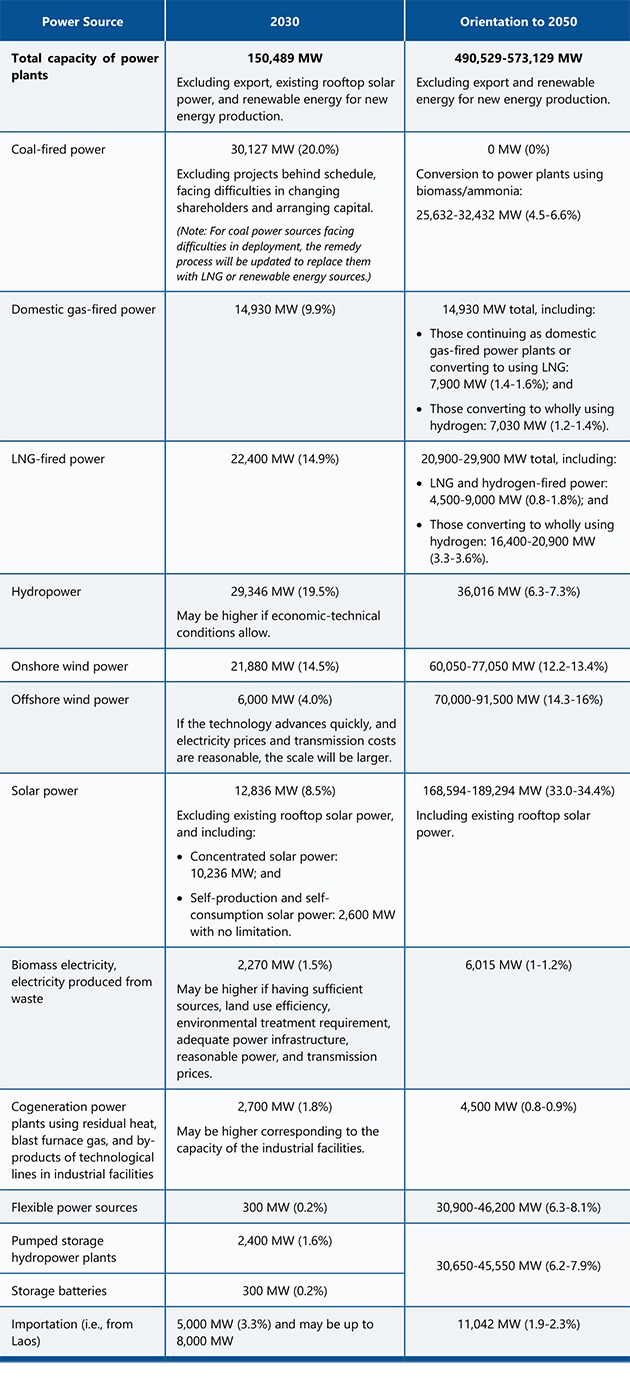
Investors in coal, domestic gas, and LNG projects may need to have a conversion plan ready given the 2050 targets to convert to other sources of energy.

2. Solar Projects

A list of 27 solar power projects that were planned for the period of 2021-2030 but which have not been assigned to investors are not allowed to be deployed but can be considered after 2030, except in the case of deployment in the form of self-production and self-consumption (Appendix IV). These projects represent 4,136.25 MW of capacity that will be left on the sidelines until 2030.

3. Hydropower Projects

A list of 14 potential hydropower projects can be considered if economic and technical conditions allow for more hydropower development (Appendix III). These projects represent 1,244 MW of capacity that can be added to the hydropower targets for 2030.

4. Projects Prioritized for Investment

Certain important projects will be prioritized for investment (Appendix II), including:

  • 13 LNG-fired power projects are expected to be completed by 2030, and two projects by 2035.
  • Six coal-fired power projects are expected to be completed by 2030.
  • Five coal-fired power projects are behind schedule, facing difficulties in changing shareholders and arranging capital. These projects are expected to be completed by 2030.
  • Four cogeneration power sources and power sources using residual heat, blast furnace gas, and by-products of technological lines in industrial facilities are expected to be completed by 2030, and three projects by 2035.
  • 10 domestic gas-fired power projects are expected to be completed by 2030.
  • 25 medium and large hydropower sources are expected to be completed by 2030.
  • Two pumped storage hydropower plants are expected to be completed by 2030, and two plants by 2035.

5. Electricity Importation

Vietnam will build out 500kV and 220kV transmission lines connecting to Laos to import electricity from power plants in Laos according to the memorandum of understanding signed between the two governments.

6. Total Investment Capital

For the period 2021-2030, the total investment capital for power sources and grid systems is targeted to be USD 134.7 billion, in which investment capital for power sources will be USD 119.8 billion (averaging USD 12 billion per year), and for grid systems will be USD 14.9 billion (averaging USD 1.5 billion per year).

For the period 2031-2050, the total investment capital for power sources and grid systems is targeted to be USD 399.2-523.1 billion, in which investment capital for power sources will be USD 364.4-511.2 billion (averaging USD 18.2-24.2 billion per year), and for grid systems will be USD 34.8-38.6 billion (averaging USD 1.7-1.9 billion per year).

7. Next Steps

The Ministry of Industry and Trade will submit the Implementation Plan for PDP VIII to the Prime Minister in June 2023 and formulate and submit to the government the amended Law on Electricity and the new Law on Renewable Energy for submission to the National Assembly in 2024. PDP VIII also specifies that a direct power purchase agreement (DPPA) pilot program will be issued but is silent on the timeline.

For more details on PDP VIII, or on any aspect relating to Vietnam’s energy sector, please contact Tram Ngoc Bich Nguyen at [email protected], Duong Duy Nguyen at [email protected], or Duc Minh Pham at [email protected].

RELATED INSIGHTS​ 

June 4, 2024
As Vietnam continues its rapid economic development, the demand for sustainable and reliable energy sources has never been more critical. Solar power has emerged as a key component of Vietnam’s strategy to diversify its energy portfolio and reduce its carbon footprint. Recent developments of the regulatory framework governing solar power projects in Vietnam, as discussed below, highlight the country’s commitment to renewable energy and its efforts to create a conducive environment for solar power investments. Objectives for the Development of Solar Power Projects On May 15, 2023, the Prime Minister issued Decision No. 500/QD-TTg, approving the National Power Development Plan for 2021-2030 with a vision to 2050 (“PDP VIII”). Following this, on April 1, 2024, the Prime Minister promulgated the Implementation Plan for PDP VIII (“Implementation Plan”). These documents underscore Vietnam’s commitment to promoting renewable energy, particularly solar. They emphasize self-production and self-consumption of solar power, the development of rooftop solar systems, and the promulgation of the direct power purchase mechanism. The integration of solar power with battery storage is also encouraged, contingent upon economic viability. PDP VIII sets ambitious capacity targets for solar power. By 2030, the capacity is projected to reach approximately 12,836 MW, accounting for 8.5% of the total power capacity. This includes 10,236 MW from concentrated solar power and 2,600 MW from self-production and self-consumption solar power. By 2050, the capacity is expected to rise to between 168,594 MW and 189,294 MW, representing 33.0-34.4% of the total power capacity. Additionally, PDP VIII and the Implementation Plan list 27 solar power projects, totaling 4,136.25 MW, slated for implementation after 2030. However, these projects may be advanced under self-production and self-consumption arrangements. Draft Decree on Direct Power Purchase Agreements On April 15, 2024, the Ministry of Industry and Trade (“MOIT”) released a draft decree on direct power
June 3, 2024
Nearly a year after Vietnam’s issuance of its National Power Development Plan for 2021-2030, with a vision to 2050 (“PDP VIII”), the Prime Minister issued Decision No. 262/QD-TTg dated April 1, 2024, approving the Implementation Plan for PDP VIII (“Implementation Plan”). Among other contents, the Implementation Plan sets forth the list of prioritized power source projects through 2030, and the capacity of renewable energy sources through 2030, as detailed below. Prioritized Power Source Projects through 2030 The Implementation Plan lists out six types of power source projects prioritized for development through 2023 according to the capacity approved under PDP VIII. They include: Domestic gas-fired power (14,930 MW) LNG-fired power (22,400 MW) Coal-fired power (30,127 MW) Cogeneration power using residual heat, blast furnace gas, and by-products of technological lines in industrial facilities (2,700 MW) Hydropower (29,346 MW) Pumped storage hydropower (2,400 MW) With respect to each type, the Implementation Plan provides details of projects by location and their operational progress. Such information is set out in Schedule III of the Implementation Plan. For power source projects not included in this list, the provincial People’s Committees will consult with the Ministry of Industry and Trade (“MOIT”) and relevant agencies on compliance with the planning prior to appraisal and issuance of in-principle investment approval. Renewable Energy Projects through 2030 The Implementation Plan allocates the capacity of the following renewable energy sources by locality/region: Offshore wind power (6,000 MW) Onshore wind power (21,880 MW) Hydroelectric power (29,346 MW) Biomass electricity (1,088 MW) Electricity produced from waste (1,182 MW) Rooftop solar power for self-production and self-consumption (2,600 MW) Battery storage (300 MW) With respect to each renewable energy source, the Implementation Plan provides a list of certain renewable energy projects through 2030, including the expected life cycle of the projects, and the allocated capacity
April 29, 2024
On November 4, 2021, Cambodia’s Ministry of Mines and Energy (MME) issued a Prakas No. 0305 on Management of the Steam Energy Subsector within the Energy Sector. The prakas aims to regulate steam energy operations, and requires companies wishing to develop, build, install, or operate steam energy to apply for a steam energy license. As this is the first prakas regulating steam energy operations in Cambodia, all relevant companies operating in steam energy must apply for a steam energy license with the MME. Prakas 0305 discusses permits for three types of activities: Development, Construction, Installation, and Operation of Steam Energy. Companies wishing to develop, build, install, and operate steam energy production facilities must first apply for a permit from the MME. Steam Energy Service Provision. Companies wishing to develop, build, install, and operate steam energy for the purpose of supplying steam energy to consumers must apply for a permit for steam energy service provider in addition to a permit for development, construction, installation, and operation of steam energy. Two-in-One Steam Energy and Electricity Production. Companies wishing to develop and operate both steam energy and electricity production activities must also apply for a permit for two-in-one steam energy and electricity production. Companies operating without the necessary permits are subject to a daily fine of KHR 400,000–4,000,000 (approx. USD 100–1,000). In addition, they may face other penalties, including: An order to halt business activities; Permit suspension; Permit revocation; Judicial action; and Other legal measures as the MME deems fit. For more information on regulations and requirements for steam energy licenses in Cambodia, please contact Tilleke & Gibbins at [email protected].
January 25, 2024
Thailand’s Department of Mineral Fuels (DMF) has developed a framework to regulate carbon capture and storage (CCS) and related activities by introducing “carbon business” to the draft amendment to the Petroleum Act B.E. 2514 (1971). CCS involves the capture, treatment, transport, and underground storage of carbon dioxide produced from industrial power generation. The captured carbon can be used to enhance oil recovery, converted into fuel such as methane or DME (dimethyl ether), or converted to higher-value products. In Thailand, various companies have carried out CCS feasibility studies. Carbon Business and Licensing Under the draft amendment to the Petroleum Act, “carbon business” is defined as exploration for purposes of carbon storage or compression of carbon into carbon storage, while “carbon” is defined as carbon dioxide in the state of gas or supercritical fluid generated as a byproduct or captured from other sources and transported for storage. Any concessionaire, product-sharing contractor, or service contract holder that has been granted permission to explore for or produce petroleum under the Petroleum Act can apply for a carbon business license from the director-general of the DMF with the approval of the Petroleum Committee. Licenses are also available to any other parties who meet the eligibility criteria to be prescribed later by a ministerial regulation. Licenses for these parties will be allocated through competitive bidding according to procedures to be announced by the minister of the Ministry of Energy (MOE). In granting a license, the minister of the MOE and the director-general of the DMF will consider the geological suitability of carbon storage, storage systems, surrounding areas of carbon storage, risk of carbon leakage and movement, environmental impacts, and the applicant’s financial potential and ability in environmental management. Responsibilities of Carbon Business Operators Carbon business operators are required to monitor and inspect their installations, structures,