You are using an outdated browser and your browsing experience will not be optimal. Please update to the latest version of Microsoft Edge, Google Chrome or Mozilla Firefox. Install Microsoft Edge

May 19, 2023

Vietnam Approves New Power Development Plan

On May 15, 2023, Vietnam’s Deputy Prime Minister Tran Hong Ha signed Decision No. 500 of the Prime Minister approving the National Power Development Plan for the period 2021-2030, with a vision to 2050 (“PDP VIII”), following extensive public consultations and multiple rounds of review since the first draft version was circulated in 2021. The plan was approved in the context that in the past few years, a number of large power projects have been behind schedule for operation, while new projects have not been able to be implemented due to waiting for additional planning.

PDP VIII is the master plan for the development of the power source and transmission grid at 220kV or higher; services in renewable energy and new energy in Vietnam; and works connecting the power grids of Vietnam and neighboring countries.

We set out below some quick updates regarding PDP VIII.

1. Development Targets

Key development targets are summarized in the table below:
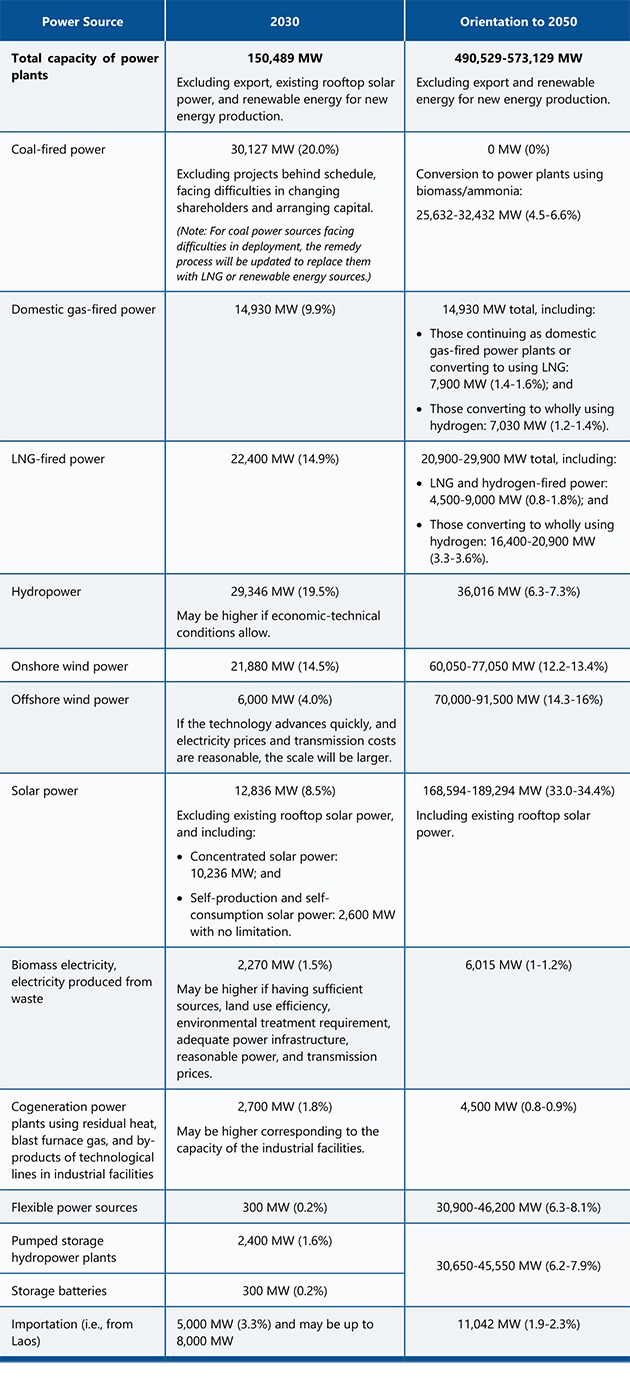
Investors in coal, domestic gas, and LNG projects may need to have a conversion plan ready given the 2050 targets to convert to other sources of energy.

2. Solar Projects

A list of 27 solar power projects that were planned for the period of 2021-2030 but which have not been assigned to investors are not allowed to be deployed but can be considered after 2030, except in the case of deployment in the form of self-production and self-consumption (Appendix IV). These projects represent 4,136.25 MW of capacity that will be left on the sidelines until 2030.

3. Hydropower Projects

A list of 14 potential hydropower projects can be considered if economic and technical conditions allow for more hydropower development (Appendix III). These projects represent 1,244 MW of capacity that can be added to the hydropower targets for 2030.

4. Projects Prioritized for Investment

Certain important projects will be prioritized for investment (Appendix II), including:

  • 13 LNG-fired power projects are expected to be completed by 2030, and two projects by 2035.
  • Six coal-fired power projects are expected to be completed by 2030.
  • Five coal-fired power projects are behind schedule, facing difficulties in changing shareholders and arranging capital. These projects are expected to be completed by 2030.
  • Four cogeneration power sources and power sources using residual heat, blast furnace gas, and by-products of technological lines in industrial facilities are expected to be completed by 2030, and three projects by 2035.
  • 10 domestic gas-fired power projects are expected to be completed by 2030.
  • 25 medium and large hydropower sources are expected to be completed by 2030.
  • Two pumped storage hydropower plants are expected to be completed by 2030, and two plants by 2035.

5. Electricity Importation

Vietnam will build out 500kV and 220kV transmission lines connecting to Laos to import electricity from power plants in Laos according to the memorandum of understanding signed between the two governments.

6. Total Investment Capital

For the period 2021-2030, the total investment capital for power sources and grid systems is targeted to be USD 134.7 billion, in which investment capital for power sources will be USD 119.8 billion (averaging USD 12 billion per year), and for grid systems will be USD 14.9 billion (averaging USD 1.5 billion per year).

For the period 2031-2050, the total investment capital for power sources and grid systems is targeted to be USD 399.2-523.1 billion, in which investment capital for power sources will be USD 364.4-511.2 billion (averaging USD 18.2-24.2 billion per year), and for grid systems will be USD 34.8-38.6 billion (averaging USD 1.7-1.9 billion per year).

7. Next Steps

The Ministry of Industry and Trade will submit the Implementation Plan for PDP VIII to the Prime Minister in June 2023 and formulate and submit to the government the amended Law on Electricity and the new Law on Renewable Energy for submission to the National Assembly in 2024. PDP VIII also specifies that a direct power purchase agreement (DPPA) pilot program will be issued but is silent on the timeline.

For more details on PDP VIII, or on any aspect relating to Vietnam’s energy sector, please contact Tram Ngoc Bich Nguyen at [email protected], Duong Duy Nguyen at [email protected], or Duc Minh Pham at [email protected].

RELATED INSIGHTS​ 

August 2, 2022
The Ministry of Energy is preparing to open a bidding round for the right to explore and produce petroleum in three offshore exploration blocks in the Gulf of Thailand: Exploration Block Nos. G1/65, G2/65, and G3/65. Announced in April 2022 with an eye toward national energy sustainability and security, this is the first opportunity for exploration of new offshore areas in 15 years. The total area of the three exploration blocks is 35,164.01 square kilometers, and operations in the exploration blocks will be subject to the terms and conditions of the required production sharing contract (PSC). Under the PSC, the Thai government is entitled to receive royalty payments against profits, any applicable cost recovery, and profit petroleum. The government also has the authority to monitor the petroleum operations in collaboration with the successful bidder. On July 27, 2022, the Department of Mineral Fuels (DMF) held a conference for prospective investors in order to clarify general information regarding the petroleum bidding round. Currently, interested investors can request the right to enter the bidding-round data room located at the DMF by emailing [email protected] by September 2, 2022. To participate in the bidding round, interested investors must submit an application together with required documents to the DMF during the period of September 5–16, 2022. For further information on the bidding round, or on any aspect of energy law in Thailand, please contact Tilleke & Gibbins at [email protected] or +66 2056 5555.
February 28, 2022
On February 9, 2022, the Director-General of the Department of Mineral Fuels (DMF) stated that the DMF is planning to request that the Deputy Prime Minister and the Minister of Energy sign an invitation to open bids for Petroleum Exploration and Production Licenses in the Gulf of Thailand for the first time in 15 years. The DMF’s Chief Department expects that this auction, which will cover three offshore areas, could increase Thailand’s petroleum reserves, and it could lead to the possible discovery of new sources of petroleum for Thailand, which would boost the country’s energy resources, and reduce losses from energy imports. The plots in the Gulf of Thailand that will be auctioned in the 24th bid round are as follows: Plot No. G1/65 with a total area of 8,487 square kilometers. This area is divided into 2 sub-areas: Area A totaling 8,298.49 square kilometers, and Area B totaling 188.71 square kilometers; Plot G2/65 with a total area of 15,030 square kilometers; and Plot No. G3/65 with a total area of 11,646.67 square kilometers. This area is divided into 2 sub-areas: Area A totaling 11,028.22 square kilometers, and Area B totaling 618.45 square kilometers. Generally, Thailand initiates its concession and production sharing contract process with the announcement of an exploration area or a plot in the Government Gazette. Thereafter, the DMF Committee will consider and announce the invitation, so that private sector firms can submit their applications to receive respective rights. The DMF’s sub-committee will consider the applications by: checking the qualifications stipulated under Section 24 of the Petroleum Act; assessing the suitability of the exploration project; and determining the benefits which are offered by the applicant. After considering the requests, the DMF’s sub-committee will consider the petroleum laws and regulations, before submitting the matter to the Petroleum Committee—under
February 22, 2022
The many new and unique challenges in recent years—from epidemics, to travel restrictions, to supply chain disruptions and energy-related reactions to all of the above, we have all had to adjust to a new status quo. The energy industry has felt these impacts acutely, and as the industry seeks to meet the current challenges and move forward toward a more sustainable future, it is helpful to take stock of where things stand and where they might be headed in the coming years. In the midst of this uncertainty, Energy Law in Southeast Asia by the Tilleke & Gibbins Energy Industry Team seeks to provide clarity on the legal and regulatory environment surrounding energy industry activities. Each chapter of Energy Law in Southeast Asia takes the reader through the essential information surrounding energy and environmental regulations in general and the specific laws and practices for the major areas of energy projects—both in terms of the current energy mix and the sources taking on a larger role as we transition toward a lower-carbon future. These chapter subsections are: Regulatory Structure Oil and Gas Coal Solar Wind Hydropower Biomass and Biogas Environmental Regulations In providing this legal overview of major areas across the spectrum of energy projects in Southeast Asia, we have sought to create a resource for all involved in the energy industry, regardless of their specific area of interest or the different obstacles or challenges they seek to resolve. Energy Law in Southeast Asia is written by specialists on Tilleke & Gibbins’ Energy Industry Team, who together have over 200 years of accumulated energy experience. Spread throughout Tilleke & Gibbins’ offices in Southeast Asia, they function both as an integrated regional team to advise multinational enterprises on their regional energy project portfolios, and as experts for investors and companies looking
January 27, 2022
The Energy Generating Authority of Thailand (EGAT) has launched a pilot project to study the energy consumption and the economic, social, and environmental impact of electric motorcycle taxis, as well as the behavior of drivers and passengers. The project, which was launched on December 27, 2021, as part of EGAT’s Carbon Neutrality Policy, will continue for a year, after which EGAT will consider the data and decide whether electric motorcycle taxis should be introduced nationwide. EGAT is also currently encouraging the use of electric bikes within their own organization, and they initially expect this to help reduce annual carbon dioxide emissions by 37 tons and prevent the release of about 838,000 milligrams of dust per year. EGAT expects additional significant reductions from electric motorcycle taxi pilot projects in multiple locations. A study conducted in Kenya in 2015 by that country’s energy regulator found that sub-150cc motorcycles emit approximately 46.5 grams of carbon dioxide per kilometer, and these emissions increase proportionally in accordance with engine size. According to Thailand’s Office of Industrial Economics, citing data collected by the Federation of Thai Industries Automotive Industry Group, a total of 1,516,096 motorcycles were sold in Thailand in 2020—a surprisingly robust figure in light of the impact of the COVID-19 pandemic. Assuming that public motorcycles travel an average of 15,000 kilometers per year, each motorcycle is therefore producing approximately 0.7 tons of carbon dioxide per year. If Thailand is able to change 50% of its yearly sales of standard motorcycle to electric motorcycles, annual carbon dioxide emissions could decrease by approximately 530,000 tons. Furthermore, since 28.8% of carbon dioxide emissions in Thailand are generated from the transport sector, the transition to electric mobility vehicles looks to be one of the most promising solutions for lowering carbon dioxide emissions in the country. Considering developments