You are using an outdated browser and your browsing experience will not be optimal. Please update to the latest version of Microsoft Edge, Google Chrome or Mozilla Firefox. Install Microsoft Edge

May 19, 2023

Vietnam Approves New Power Development Plan

On May 15, 2023, Vietnam’s Deputy Prime Minister Tran Hong Ha signed Decision No. 500 of the Prime Minister approving the National Power Development Plan for the period 2021-2030, with a vision to 2050 (“PDP VIII”), following extensive public consultations and multiple rounds of review since the first draft version was circulated in 2021. The plan was approved in the context that in the past few years, a number of large power projects have been behind schedule for operation, while new projects have not been able to be implemented due to waiting for additional planning.

PDP VIII is the master plan for the development of the power source and transmission grid at 220kV or higher; services in renewable energy and new energy in Vietnam; and works connecting the power grids of Vietnam and neighboring countries.

We set out below some quick updates regarding PDP VIII.

1. Development Targets

Key development targets are summarized in the table below:
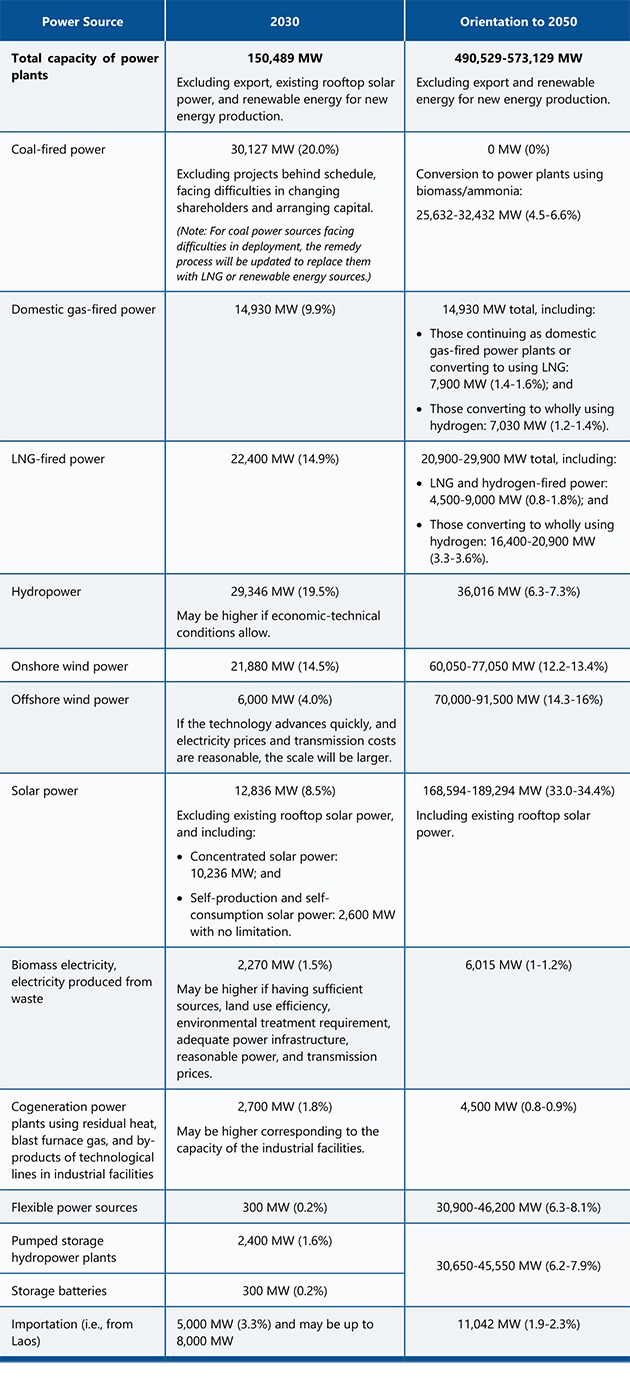
Investors in coal, domestic gas, and LNG projects may need to have a conversion plan ready given the 2050 targets to convert to other sources of energy.

2. Solar Projects

A list of 27 solar power projects that were planned for the period of 2021-2030 but which have not been assigned to investors are not allowed to be deployed but can be considered after 2030, except in the case of deployment in the form of self-production and self-consumption (Appendix IV). These projects represent 4,136.25 MW of capacity that will be left on the sidelines until 2030.

3. Hydropower Projects

A list of 14 potential hydropower projects can be considered if economic and technical conditions allow for more hydropower development (Appendix III). These projects represent 1,244 MW of capacity that can be added to the hydropower targets for 2030.

4. Projects Prioritized for Investment

Certain important projects will be prioritized for investment (Appendix II), including:

  • 13 LNG-fired power projects are expected to be completed by 2030, and two projects by 2035.
  • Six coal-fired power projects are expected to be completed by 2030.
  • Five coal-fired power projects are behind schedule, facing difficulties in changing shareholders and arranging capital. These projects are expected to be completed by 2030.
  • Four cogeneration power sources and power sources using residual heat, blast furnace gas, and by-products of technological lines in industrial facilities are expected to be completed by 2030, and three projects by 2035.
  • 10 domestic gas-fired power projects are expected to be completed by 2030.
  • 25 medium and large hydropower sources are expected to be completed by 2030.
  • Two pumped storage hydropower plants are expected to be completed by 2030, and two plants by 2035.

5. Electricity Importation

Vietnam will build out 500kV and 220kV transmission lines connecting to Laos to import electricity from power plants in Laos according to the memorandum of understanding signed between the two governments.

6. Total Investment Capital

For the period 2021-2030, the total investment capital for power sources and grid systems is targeted to be USD 134.7 billion, in which investment capital for power sources will be USD 119.8 billion (averaging USD 12 billion per year), and for grid systems will be USD 14.9 billion (averaging USD 1.5 billion per year).

For the period 2031-2050, the total investment capital for power sources and grid systems is targeted to be USD 399.2-523.1 billion, in which investment capital for power sources will be USD 364.4-511.2 billion (averaging USD 18.2-24.2 billion per year), and for grid systems will be USD 34.8-38.6 billion (averaging USD 1.7-1.9 billion per year).

7. Next Steps

The Ministry of Industry and Trade will submit the Implementation Plan for PDP VIII to the Prime Minister in June 2023 and formulate and submit to the government the amended Law on Electricity and the new Law on Renewable Energy for submission to the National Assembly in 2024. PDP VIII also specifies that a direct power purchase agreement (DPPA) pilot program will be issued but is silent on the timeline.

For more details on PDP VIII, or on any aspect relating to Vietnam’s energy sector, please contact Tram Ngoc Bich Nguyen at [email protected], Duong Duy Nguyen at [email protected], or Duc Minh Pham at [email protected].

RELATED INSIGHTS​ 

July 7, 2023
Cambodia has the potential to be one of the top countries in the world for generating renewable energy through solar, based on the average amount of sunlight hours available per day and the consistent sunshine throughout the year. The Cambodian government has recognized this potential and has made major updates to its energy policies in recent years. Solar power is now taking over a much larger portion of the total energy mix in Cambodia, especially as a number of utility-scale solar power plants have come online in recent years. The long-term Power Development Master Plan 2022–2040 sets out the long-term energy policy for Cambodia and requires a bigger role for renewables. The use of solar power will play a key role in this aim to increase the role of renewables, with the plan foreseeing almost 30% of all national power generated through solar technologies by 2040. Two of the latest legislative and regulatory steps by the government are the Ministry of Mines and Energy’s guidelines for rooftop solar systems, and most recently the long-awaited Environment and Natural Resources Code, which was enacted on June 29, 2023. Rooftop Solar Projects Many companies, from small startups to multinationals, are exploring the potential for rooftop solar in Cambodia. However, despite the favorable natural factors, the regulatory framework was not always clear or friendly to rooftop solar, hampering investment. This started slowly changing with the adoption of the first solar energy regulation in 2018, which provided the country’s first official guidance on both solar power plants and rooftop solar. It provided some much-needed clarity, but the 2018 solar energy regulation—and especially the subsequent electricity tariff schemes—often kept rooftop projects from being financially viable. Many players in the industry voiced their doubts about the regulations and tariffs, focusing especially on the capacity charge—a monthly
March 22, 2023
Attorneys from Tilleke & Gibbins have contributed the Cambodia, Laos, Myanmar, and Vietnam sections to DLA Piper’s Global Government Contracting Country by Country guide, which provides essential information for businesses in 75 jurisdictions on how to source and enter into government contracting opportunities. The guide provides procurement information for jurisdictions in Africa, the Americas, Asia-Pacific, Europe, and the Middle East, and includes information on how to find procurement opportunities, the structure of procurement laws, and in-country resources and relevant publications. Each jurisdictional section includes valuable information on procedures for government tenders, bidding, and contract execution, as well as an overview of the legal and regulatory framework governing government procurement. Businesses can refer to the guide to gain a better understanding of procurement processes and regulations in each jurisdiction, which can help them identify potential opportunities and make informed decisions when pursuing government contracts. The guide’s procurement information for Cambodia, Laos, Myanmar, and Vietnam, combined with the online platform’s comprehensive resources, provides businesses and governments with a valuable tool to navigate the complex regulatory landscape of government contracting in the region. The full Global Contracting Country-by-Country guide is available on the DLA Piper website.
February 20, 2023
On December 20, 2022, the Notification re: Rules, Procedures, and Conditions on Transfer of Energy Licenses of the Thailand Energy Regulatory Commission (ERC) became effective. The notification sets out the new standard and procedure for transferring licenses for energy industry operation. The notable changes in the notification are provided below. Anti-Competition Consideration and Impact Assessment Report In considering the transfer of a license, in addition to ensuring the transferee meets all the qualifications for an applicant for the license, the ERC will consider if the transfer would (1) create a monopoly, reduce or restrict competition, or result in market dominance; (2) affect the contracting parties of the transferors or energy users; or (3) affect energy security or the public interest. In this respect, the vetting process for an application for license transfer would be separated into two different approaches. If the ERC believes that the transfer of the energy license would affect competition, energy users, energy security, or the public interest, the transferor will need to submit an impact assessment report on the license transfer to the ERC. In this regard, the ERC may establish a sub-committee or an independent consultant to contemplate the transfer at the transferor’s expense. However, if the ERC believes that the transfer of license would not lead to any impact, the transferor will not be required to submit the impact assessment. Also, if the license transfer is related to any transactions specified under the ERC’s Regulation re: Rules and Procedures on Merger and Cross-Shareholding in Energy Businesses, B.E. 2565, the ERC can combine the license transfer application with the M&A application. After approval, the ERC might require the transferee to periodically report to the ERC and comply with measures stipulated by the ERC. Therefore, an energy license holder which plans to carry out M&A
February 3, 2023
The Federation of Thai Industries (FTI) announced on January 16, 2023, the opening of registration for carbon credit trading on its Renewable Energy and Carbon Credit Exchange Platform. This new online platform supports the domestic carbon market and provides Thai exporters with the ability to purchase carbon credits, allowing them to address demands from importing nations to conform to carbon emission reduction regulations. This is expected to be a positive step forward for the current practice in Thailand, in which the carbon market operates as a voluntary and unregulated buy-sell platform, free from government regulation. Developed in partnership with the Thailand Greenhouse Gas Management Organization (TGO), the FTI: CC/RE/REC X Platform, or FTIX, is intended to increase the promotion of national carbon credits, renewable energy, and renewable energy certificates, thus improving the country’s efforts to mitigate climate change. Entrepreneurs interested in registering for carbon credit trading on the FTIX can do so through the FTIX website at fti-cc.com. The platform initially supports carbon credit trading through over-the-counter methods. In the near future, the FTIX will be developed to support 100% renewable energy (i.e., RE100 energy) and renewable energy certificate trading. However, the related tax and carbon pricing policies have not yet been issued. The TGO is currently in discussions with the Fiscal Policy Office and the Ministry of Finance regarding fiscal policy for the FTIX. For more information on the FTIX, or on any aspect of renewable energy activities in Thailand, please contact Charuwan Charoonchitsathian at [email protected], Napassorn Lertussavavivat at [email protected], or Ratchapat Triteeyaputranonta at [email protected].