You are using an outdated browser and your browsing experience will not be optimal. Please update to the latest version of Microsoft Edge, Google Chrome or Mozilla Firefox. Install Microsoft Edge

May 19, 2023

Vietnam Approves New Power Development Plan

On May 15, 2023, Vietnam’s Deputy Prime Minister Tran Hong Ha signed Decision No. 500 of the Prime Minister approving the National Power Development Plan for the period 2021-2030, with a vision to 2050 (“PDP VIII”), following extensive public consultations and multiple rounds of review since the first draft version was circulated in 2021. The plan was approved in the context that in the past few years, a number of large power projects have been behind schedule for operation, while new projects have not been able to be implemented due to waiting for additional planning.

PDP VIII is the master plan for the development of the power source and transmission grid at 220kV or higher; services in renewable energy and new energy in Vietnam; and works connecting the power grids of Vietnam and neighboring countries.

We set out below some quick updates regarding PDP VIII.

1. Development Targets

Key development targets are summarized in the table below:
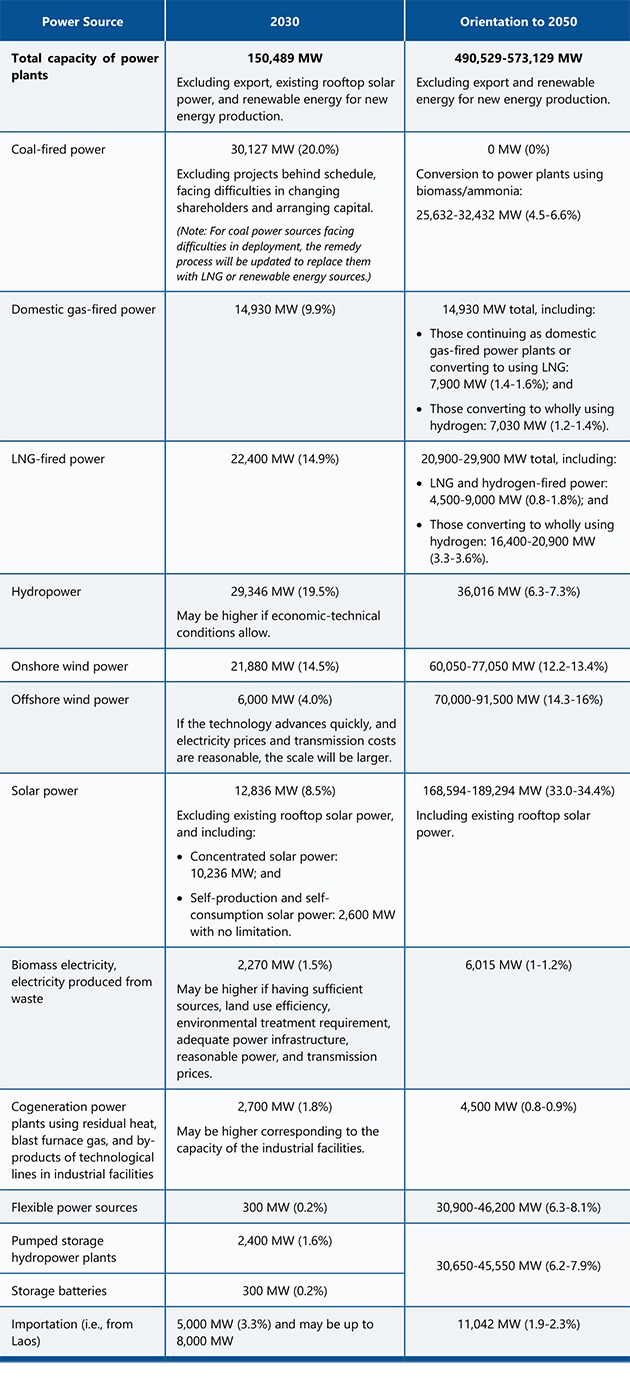
Investors in coal, domestic gas, and LNG projects may need to have a conversion plan ready given the 2050 targets to convert to other sources of energy.

2. Solar Projects

A list of 27 solar power projects that were planned for the period of 2021-2030 but which have not been assigned to investors are not allowed to be deployed but can be considered after 2030, except in the case of deployment in the form of self-production and self-consumption (Appendix IV). These projects represent 4,136.25 MW of capacity that will be left on the sidelines until 2030.

3. Hydropower Projects

A list of 14 potential hydropower projects can be considered if economic and technical conditions allow for more hydropower development (Appendix III). These projects represent 1,244 MW of capacity that can be added to the hydropower targets for 2030.

4. Projects Prioritized for Investment

Certain important projects will be prioritized for investment (Appendix II), including:

  • 13 LNG-fired power projects are expected to be completed by 2030, and two projects by 2035.
  • Six coal-fired power projects are expected to be completed by 2030.
  • Five coal-fired power projects are behind schedule, facing difficulties in changing shareholders and arranging capital. These projects are expected to be completed by 2030.
  • Four cogeneration power sources and power sources using residual heat, blast furnace gas, and by-products of technological lines in industrial facilities are expected to be completed by 2030, and three projects by 2035.
  • 10 domestic gas-fired power projects are expected to be completed by 2030.
  • 25 medium and large hydropower sources are expected to be completed by 2030.
  • Two pumped storage hydropower plants are expected to be completed by 2030, and two plants by 2035.

5. Electricity Importation

Vietnam will build out 500kV and 220kV transmission lines connecting to Laos to import electricity from power plants in Laos according to the memorandum of understanding signed between the two governments.

6. Total Investment Capital

For the period 2021-2030, the total investment capital for power sources and grid systems is targeted to be USD 134.7 billion, in which investment capital for power sources will be USD 119.8 billion (averaging USD 12 billion per year), and for grid systems will be USD 14.9 billion (averaging USD 1.5 billion per year).

For the period 2031-2050, the total investment capital for power sources and grid systems is targeted to be USD 399.2-523.1 billion, in which investment capital for power sources will be USD 364.4-511.2 billion (averaging USD 18.2-24.2 billion per year), and for grid systems will be USD 34.8-38.6 billion (averaging USD 1.7-1.9 billion per year).

7. Next Steps

The Ministry of Industry and Trade will submit the Implementation Plan for PDP VIII to the Prime Minister in June 2023 and formulate and submit to the government the amended Law on Electricity and the new Law on Renewable Energy for submission to the National Assembly in 2024. PDP VIII also specifies that a direct power purchase agreement (DPPA) pilot program will be issued but is silent on the timeline.

For more details on PDP VIII, or on any aspect relating to Vietnam’s energy sector, please contact Tram Ngoc Bich Nguyen at [email protected], Duong Duy Nguyen at [email protected], or Duc Minh Pham at [email protected].

RELATED INSIGHTS​ 

January 10, 2024
On December 15, 2023, the Electricity Authority of Cambodia (EAC) issued a notification requiring all owners of solar power systems to report their systems to their local electricity supplier by January 31, 2024. Systems that have already been reported under existing regulations are exempt from this requirement. Systems that remain unreported after the deadline will be deemed illegal and subject to penalties, including possible disconnection from the national grid. The rationale for the reporting requirement is that the EAC expects to adopt a new solar power regulation soon. Electricite du Cambodge (the main state-owned utility provider in Cambodia) and EAC-licensed private electricity providers are now gathering data on the current use of solar power systems in order to prepare for, adopt, and execute the upcoming regulation. The reporting requirement is to facilitate this gathering of data. The upcoming regulation, planned for early 2024 according to the notification, follows last year’s Prakas No. 159, which contained the Ministry of Mines and Energy’s guidelines and principles for rooftop solar systems. The EAC now needs to issue implementing regulations that are in line with the ministry’s guidelines and principles. Although stand-alone solar power systems that did not have a connection to the national grid were previously not regulated and did not require any authorizations, the EAC is now stating that all types of solar power systems need to adhere to the reporting requirement under the notification. According to the EAC, the upcoming regulation will address all types of systems, and the December 15 notification clearly announces that all types of solar power systems will need to obtain EAC approval under the upcoming regulation. Solar power system operators in Cambodia should report their systems to their local electricity providers by January 31, 2024, to avoid any penalties, while remaining vigilant for the upcoming
January 3, 2024
Thailand’s Energy Regulatory Commission (ERC) has issued the Notification on the Criteria for Regulating the Licensed Pool Manager B.E. 2566 (2023), which took effect on November 30, 2023. It followed an earlier notification, which took effect on October 13, 2023, that added the new license for the country’s pool gas manager. The new notification aims to regulate natural gas sale agreements and promote competition among players in the regulated natural gas market—that is, those who utilize natural gas for electricity generation under the Electricity Generating Authority of Thailand (EGAT) scheme, including industrial and NGV (natural gas for vehicles) consumers who rely on natural pool gas. The establishment of the pool gas scheme is aimed at encouraging new shippers to enter the market and providing new natural gas shippers with fair opportunities to compete with existing shippers, as all licensed shippers in the regulated market are subject to the same natural gas costs under this new scheme. Under this pool gas scheme, the pool manager plays a critical part in reselling natural gas in the country. Some of its responsibilities include the following: Purchasing natural gas or liquid natural gas (LNG) from licensed shippers in the regulated market at the rate at which the shippers procured the natural gas, including incidental expenses such as pipeline transportation and LNG station fees; Collecting data on the quantity and price of the gas purchased from the licensed shippers and calculating the pool gas price as specified in the ERC-approved manual, which is basically the average price of the natural gas procurement cost of all shippers in the pool; and Reselling natural gas or LNG to licensed shippers at the pool gas pricing rate in the quantity distributed to the pool by each shipper. Apart from its function in facilitating the primary procedures of
December 15, 2023
As part of its membership in Lex Mundi, Tilleke & Gibbins has published an updated edition of its Guide to Doing Business in Thailand for 2023. This guide outlines the key factors for starting and operating a business in the Thai market. Issues covered include: Investment incentives Financial facilities Exchange controls Import and export regulations Structures for doing business Requirements for the Establishment of a Business Operation of the Business Cessation or Termination of the Business Labor legislation, relations, and supply Tax Immigration requirements This publication is part of Lex Mundi’s Country Guides series prepared by member firms in more than 100 jurisdictions worldwide. The guides serve as a useful resource for planning international business strategy and researching new markets. The full Guide to Doing Business in Thailand is available through the button below.
July 25, 2023
Thailand’s Energy Regulatory Commission (ERC) is in the process of reviewing a draft regulation that updates the nationality qualifications for the ultimate shareholders and directors of applicants for an energy business license. The draft ERC Regulation Re: Qualifications, Documents and Application for Electricity Business—which is intended to replace the ERC Regulation Re: Application and Permission for Electricity Business B.E. 2551 and its amendments—is likely to be adopted soon and will affect licensed companies that are foreign majority owned when they apply for or renew their energy business licenses. The draft regulation requires partnerships, limited companies, and public limited companies to have the following qualifications unless there is an international agreement granting national treatment for a specific commitment (mode 3 or mode 4) or exemption by other laws: Juristic persons must be established under Thai law or registered in Thailand with the objective of carrying out electricity business; For private limited companies, foreign ultimate shareholders must not hold more than 49% of the total shares, and the number of the foreign shareholders must not exceed half of all shareholders; At least half of all directors must have Thai nationality; and Any authorized directors must have Thai nationality. When the draft regulation is adopted, it will not take retroactive effect on previously granted energy business licenses, which will continue to be valid until they expire if there is no material change to the license as defined by the draft regulation. Once the license is up for renewal (energy business licenses are normally issued for a specific period of time), it will be subject to the draft regulation. All license applications submitted prior to the effective date of the draft regulation and under consideration will be deemed applications for a license under the draft regulation. As noted above, the new qualification requirements