You are using an outdated browser and your browsing experience will not be optimal. Please update to the latest version of Microsoft Edge, Google Chrome or Mozilla Firefox. Install Microsoft Edge

May 19, 2023

Vietnam Approves New Power Development Plan

On May 15, 2023, Vietnam’s Deputy Prime Minister Tran Hong Ha signed Decision No. 500 of the Prime Minister approving the National Power Development Plan for the period 2021-2030, with a vision to 2050 (“PDP VIII”), following extensive public consultations and multiple rounds of review since the first draft version was circulated in 2021. The plan was approved in the context that in the past few years, a number of large power projects have been behind schedule for operation, while new projects have not been able to be implemented due to waiting for additional planning.

PDP VIII is the master plan for the development of the power source and transmission grid at 220kV or higher; services in renewable energy and new energy in Vietnam; and works connecting the power grids of Vietnam and neighboring countries.

We set out below some quick updates regarding PDP VIII.

1. Development Targets

Key development targets are summarized in the table below:
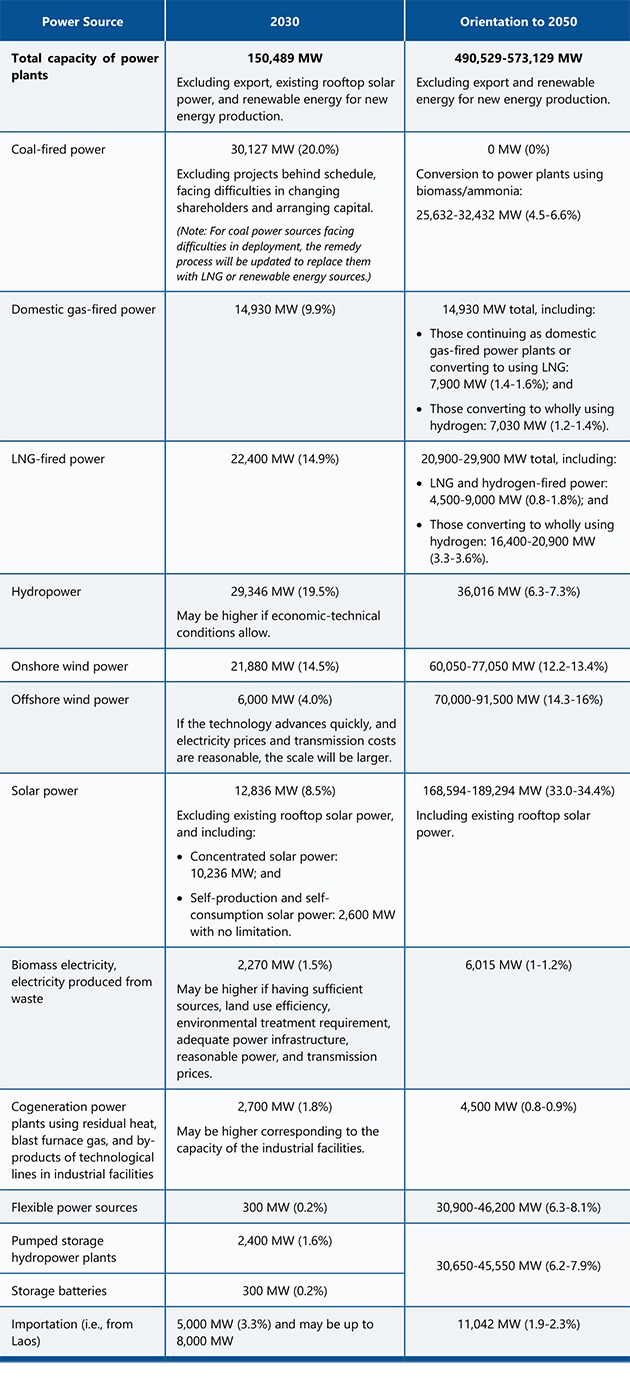
Investors in coal, domestic gas, and LNG projects may need to have a conversion plan ready given the 2050 targets to convert to other sources of energy.

2. Solar Projects

A list of 27 solar power projects that were planned for the period of 2021-2030 but which have not been assigned to investors are not allowed to be deployed but can be considered after 2030, except in the case of deployment in the form of self-production and self-consumption (Appendix IV). These projects represent 4,136.25 MW of capacity that will be left on the sidelines until 2030.

3. Hydropower Projects

A list of 14 potential hydropower projects can be considered if economic and technical conditions allow for more hydropower development (Appendix III). These projects represent 1,244 MW of capacity that can be added to the hydropower targets for 2030.

4. Projects Prioritized for Investment

Certain important projects will be prioritized for investment (Appendix II), including:

  • 13 LNG-fired power projects are expected to be completed by 2030, and two projects by 2035.
  • Six coal-fired power projects are expected to be completed by 2030.
  • Five coal-fired power projects are behind schedule, facing difficulties in changing shareholders and arranging capital. These projects are expected to be completed by 2030.
  • Four cogeneration power sources and power sources using residual heat, blast furnace gas, and by-products of technological lines in industrial facilities are expected to be completed by 2030, and three projects by 2035.
  • 10 domestic gas-fired power projects are expected to be completed by 2030.
  • 25 medium and large hydropower sources are expected to be completed by 2030.
  • Two pumped storage hydropower plants are expected to be completed by 2030, and two plants by 2035.

5. Electricity Importation

Vietnam will build out 500kV and 220kV transmission lines connecting to Laos to import electricity from power plants in Laos according to the memorandum of understanding signed between the two governments.

6. Total Investment Capital

For the period 2021-2030, the total investment capital for power sources and grid systems is targeted to be USD 134.7 billion, in which investment capital for power sources will be USD 119.8 billion (averaging USD 12 billion per year), and for grid systems will be USD 14.9 billion (averaging USD 1.5 billion per year).

For the period 2031-2050, the total investment capital for power sources and grid systems is targeted to be USD 399.2-523.1 billion, in which investment capital for power sources will be USD 364.4-511.2 billion (averaging USD 18.2-24.2 billion per year), and for grid systems will be USD 34.8-38.6 billion (averaging USD 1.7-1.9 billion per year).

7. Next Steps

The Ministry of Industry and Trade will submit the Implementation Plan for PDP VIII to the Prime Minister in June 2023 and formulate and submit to the government the amended Law on Electricity and the new Law on Renewable Energy for submission to the National Assembly in 2024. PDP VIII also specifies that a direct power purchase agreement (DPPA) pilot program will be issued but is silent on the timeline.

For more details on PDP VIII, or on any aspect relating to Vietnam’s energy sector, please contact Tram Ngoc Bich Nguyen at [email protected], Duong Duy Nguyen at [email protected], or Duc Minh Pham at [email protected].

RELATED INSIGHTS​ 

September 25, 2025
Tilleke & Gibbins’ labor and employment team in Hanoi and Ho Chi Minh City has contributed the Vietnam chapter to Labor and Employment Disputes 2026. Drawing on the expertise of three of the firm’s employment specialists, the chapter provides practical guidance for navigating employment disputes in Vietnam and covers: Pre-action considerations: key requirements, third-party funding, contingency fee arrangements Issuing a claim: forum, territorial jurisdiction, standing, commencing claims, fees, service, defendants and legal personality, types of claims, time limits, counterclaims Case management: procedure, rules, amendments to claims, adding parties, consolidating proceedings, class and collective actions, evidence, witnesses, tactical considerations Interim relief: availability, requirements Trial: hearings conduct and time frames, confidentiality and public access, media reporting, elements of successful claims and burden of proof Alternative dispute resolution: available types, requirements and expectations, enforcement Collective employment and labor rights: enforcement and standing Remedies and enforcement: available remedies, assessing compensation, enforcement mechanisms Appeals: procedure, time frames, other means of challenge Updates and trends: recent cases and developments, technology developments, other issues The Vietnam chapter is available for download below. Tilleke & Gibbins also contributed the Cambodia and Thailand chapters to Labor and Employment Disputes 2026. Readers can also gain 30 days of complementary access to the full Labor and Employment Disputes 2026 guide and the rest of Lexology Panoramic’s varied offerings through this link.
July 18, 2025
Vietnam’s electric vehicle (EV) industry is experiencing rapid growth, driven by a strong wave of new legislation, strategic plans, and government incentives. The government’s clear commitment to electrification is attracting foreign investment, supporting advanced production, and reducing reliance on internal combustion engine (ICE) imports. Recent national strategies, sector regulations, and technical standards demonstrate a rare level of regulatory momentum in Southeast Asia, positioning Vietnam as a competitive player in the global EV supply chain and an attractive market for foreign investors. An overview of legal developments for the EV sector in Vietnam is presented below. National Action Program for Green Transportation A key driver of Vietnam’s EV growth has been the National Action Program for Green Transportation through 2050 stipulated in Decision No. 876/QD-TTg of the prime minister dated July 22, 2022. The National Action Program sets a detailed roadmap for the green energy transition in road transport. For the period 2022–2030, the focus is on promoting the manufacturing, assembly, import, and conversion of road motor vehicles to electric power, expanding the use of 100% E5 gasoline for road vehicles, developing charging infrastructure to meet the needs of residents and businesses, and encouraging both new and existing bus stations and rest stops to meet green criteria. For the period 2031–2050, the roadmap aims to gradually restrict and ultimately cease by 2040 the manufacturing, assembly, and import of fossil fuel-powered cars, motorcycles, and mopeds for domestic use. By 2050, the goal is for 100% of road motor vehicles and construction vehicles participating in traffic to use electricity or green energy, for all bus stations and rest stops to meet green criteria, and for all machinery and equipment for loading and unloading to transition from fossil fuels to electricity or green energy. The program also calls for the completion of nationwide
July 16, 2025
On June 27, 2025, the National Assembly of Vietnam officially passed the amended Law on Atomic Energy, which will take effect on January 1, 2026. This legislative milestone follows the release of the fourth draft in June 2025, which was circulated for public consultation and builds upon earlier drafts from February, April, and early June. (See our previous article on the draft version here), Many provisions have been retained or refined to ensure greater specificity and alignment with Vietnam’s current legal framework. Once in force, the amended law will replace the 2008 Law on Atomic Energy (No. 18/2008/QH12), marking a significant step forward in modernizing Vietnam’s legal infrastructure for nuclear energy. The new law aims to harmonize with international standards, promote the safe and sustainable development of nuclear power, and facilitate future nuclear projects in the country. Noteworthy Updates in the Final Legislation Definition of National Radiation and Nuclear Safety Authority (NRNSA): The law introduces a clear definition of the NRNSA, outlining its roles and responsibilities in line with IAEA standards. Currently, this function is performed by the Vietnam Agency for Radiation and Nuclear Safety (VARANS) under the Ministry of Science and Technology. Digital Transformation Requirements: New provisions mandate the development of an integrated digital platform for data management, administrative procedures, and safety oversight, enhancing transparency and security. Policy Support for Training and Privatization: The law sets out principles for workforce incentives and sector privatization, with detailed regulations to be issued by the government. Dedicated Safety and Security Mechanism: A new section outlines inspection, supervision, violation handling, and enforcement procedures in the field of atomic energy, particularly for nuclear power plants. The NRNSA is empowered to conduct unscheduled inspections, suspend operations, and recommend license revocation when safety risks are identified. Key Provisions Retained or Clarified from the Draft Licensing