You are using an outdated browser and your browsing experience will not be optimal. Please update to the latest version of Microsoft Edge, Google Chrome or Mozilla Firefox. Install Microsoft Edge

May 19, 2023

Vietnam Approves New Power Development Plan

On May 15, 2023, Vietnam’s Deputy Prime Minister Tran Hong Ha signed Decision No. 500 of the Prime Minister approving the National Power Development Plan for the period 2021-2030, with a vision to 2050 (“PDP VIII”), following extensive public consultations and multiple rounds of review since the first draft version was circulated in 2021. The plan was approved in the context that in the past few years, a number of large power projects have been behind schedule for operation, while new projects have not been able to be implemented due to waiting for additional planning.

PDP VIII is the master plan for the development of the power source and transmission grid at 220kV or higher; services in renewable energy and new energy in Vietnam; and works connecting the power grids of Vietnam and neighboring countries.

We set out below some quick updates regarding PDP VIII.

1. Development Targets

Key development targets are summarized in the table below:
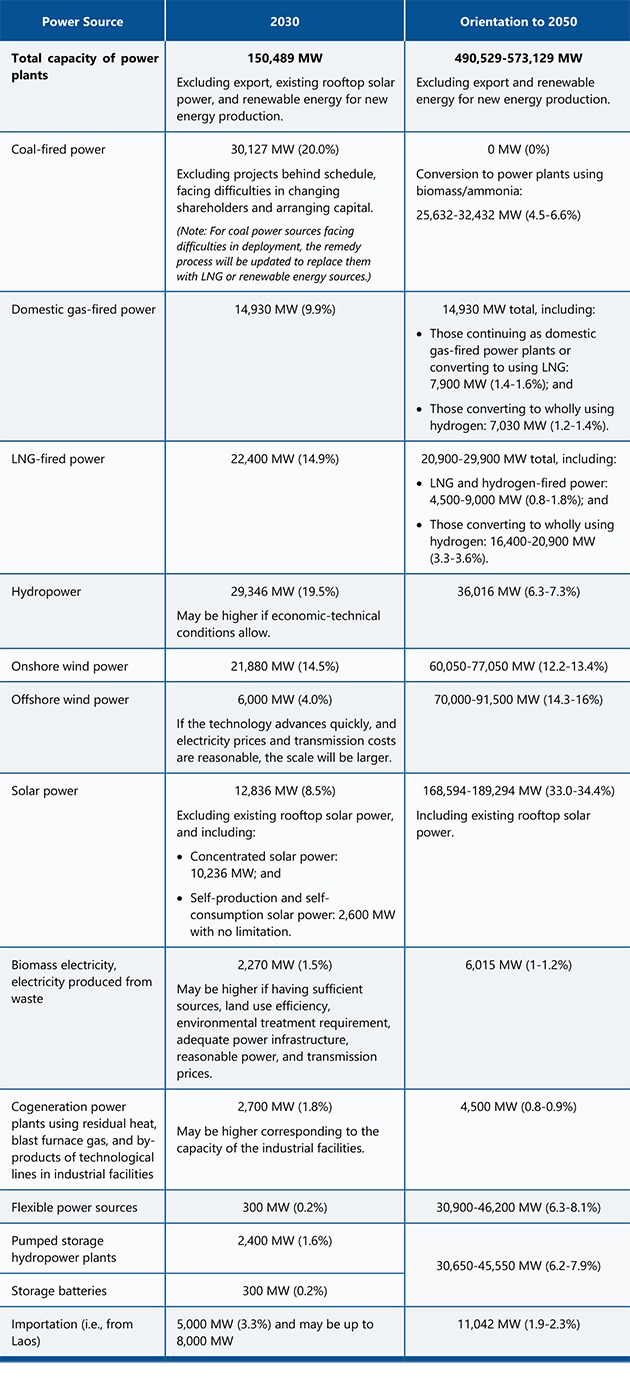
Investors in coal, domestic gas, and LNG projects may need to have a conversion plan ready given the 2050 targets to convert to other sources of energy.

2. Solar Projects

A list of 27 solar power projects that were planned for the period of 2021-2030 but which have not been assigned to investors are not allowed to be deployed but can be considered after 2030, except in the case of deployment in the form of self-production and self-consumption (Appendix IV). These projects represent 4,136.25 MW of capacity that will be left on the sidelines until 2030.

3. Hydropower Projects

A list of 14 potential hydropower projects can be considered if economic and technical conditions allow for more hydropower development (Appendix III). These projects represent 1,244 MW of capacity that can be added to the hydropower targets for 2030.

4. Projects Prioritized for Investment

Certain important projects will be prioritized for investment (Appendix II), including:

  • 13 LNG-fired power projects are expected to be completed by 2030, and two projects by 2035.
  • Six coal-fired power projects are expected to be completed by 2030.
  • Five coal-fired power projects are behind schedule, facing difficulties in changing shareholders and arranging capital. These projects are expected to be completed by 2030.
  • Four cogeneration power sources and power sources using residual heat, blast furnace gas, and by-products of technological lines in industrial facilities are expected to be completed by 2030, and three projects by 2035.
  • 10 domestic gas-fired power projects are expected to be completed by 2030.
  • 25 medium and large hydropower sources are expected to be completed by 2030.
  • Two pumped storage hydropower plants are expected to be completed by 2030, and two plants by 2035.

5. Electricity Importation

Vietnam will build out 500kV and 220kV transmission lines connecting to Laos to import electricity from power plants in Laos according to the memorandum of understanding signed between the two governments.

6. Total Investment Capital

For the period 2021-2030, the total investment capital for power sources and grid systems is targeted to be USD 134.7 billion, in which investment capital for power sources will be USD 119.8 billion (averaging USD 12 billion per year), and for grid systems will be USD 14.9 billion (averaging USD 1.5 billion per year).

For the period 2031-2050, the total investment capital for power sources and grid systems is targeted to be USD 399.2-523.1 billion, in which investment capital for power sources will be USD 364.4-511.2 billion (averaging USD 18.2-24.2 billion per year), and for grid systems will be USD 34.8-38.6 billion (averaging USD 1.7-1.9 billion per year).

7. Next Steps

The Ministry of Industry and Trade will submit the Implementation Plan for PDP VIII to the Prime Minister in June 2023 and formulate and submit to the government the amended Law on Electricity and the new Law on Renewable Energy for submission to the National Assembly in 2024. PDP VIII also specifies that a direct power purchase agreement (DPPA) pilot program will be issued but is silent on the timeline.

For more details on PDP VIII, or on any aspect relating to Vietnam’s energy sector, please contact Tram Ngoc Bich Nguyen at [email protected], Duong Duy Nguyen at [email protected], or Duc Minh Pham at [email protected].

RELATED INSIGHTS​ 

January 12, 2022
Thailand’s Board of Investment (BOI) recently published BOI Notification No. Sor. 8/2564, which extends the scope of investment promotion covering electronic vehicle (EV) industry manufacturers to include the production of “automotive platforms” for electric vehicles, and creates a new category of BOI promoted activities covering the manufacture of electric bicycles (E-bikes). Automotive Platforms The following investment promotion categories have been extended: 4.24 – Manufacture of Battery Electric Vehicles 4.26 – Manufacture of Electric Battery Tricycles 4.27 – Manufacture of Electric Battery Busses and Trucks These categories now include the manufacture of “automotive platforms”—which must include an energy storage system, charging module, and front and rear axle module—benefiting from similar tax incentives and subject to additional conditions, as detailed below. New BOI Promotional Category for E-Bike Production The BOI has also introduced a new category, No. 4.28, covering the manufacture of E-bikes. Projects under this category will be eligible for a three-year CIT exemption with an additional one-year exemption if certain criteria are met. Applications for this category must cover the manufacture of E-bikes, the manufacture or sourcing of electric batteries, and a management plan for used batteries. In addition to the general conditions for EV projects (industrial standards, manufacturing timelines, etc.), the BOI has also imposed the following conditions specific to E-bike projects: E-bike frames must be produced from light-weight materials such as aluminum alloy, chromium–molybdenum alloy steel (chrome moly), titanium alloy, and carbon fiber; and E-bike batteries must adopt environmentally-friendly technology. Interestingly the BOI allows E-bike production lines to jointly use manufacturing lines for ordinary bicycles. However, the sale of ordinary bicycles is regarded as non-BOI-promoted income and will not be entitled to BOI tax incentives. These new provisions, intended to stimulate both local and foreign investments in the electric automotive industry, seem to complete the BOI promotion
December 31, 2021
In the last week of December, 2021, the Ministry of Justice published the Law Amending Certain Provisions of the Laws on Tax No. 01/NA, dated August 7, 2021, in the Government Gazette. The Law will come into force on January 1, 2022. The most notable amendments relate to Value Added Tax (VAT), which are summarized below. The new law also makes changes to the laws on tax management, income tax, and excise tax, which Tilleke & Gibbins will provide updates on in due course.
November 24, 2021
Attorneys from Tilleke & Gibbins have provided the latest update to the Thailand contribution to Doing Business in…, a Q&A-style guide published by Thomson Reuters Practical Law that presents an overview of the legal framework for doing business in 63 jurisdictions worldwide. The Thailand chapter of the guide outlines Thailand’s legal system and key laws applicable to foreign companies doing business in the country. The chapter specifically covers the following main topics: Legal system: Thailand’s court system and codified legal system. Foreign investment: Lists of reserved business activities, restrictions on doing business with certain jurisdictions, exchange controls and currency regulations, and grants and incentives available to investors. Business vehicles: Ordinary partnerships, registered ordinary partnerships, limited partnerships, private limited companies, and public companies. Environment: Main laws and regulations, factory operation. Employment: Laws, employment contract requirements, work permits, and termination and redundancy. Tax: Taxes on employment, tax and nontax resident employees and businesses, corporate income tax, value added tax, special business tax, municipal tax, stamp duty, dividends, interest, intellectual property royalties. Competition: Important aspects of Thailand’s regulatory regime surrounding competition, centered around the updated Trade Competition Act. Antibribery and corruption: Laws, compliance requirements, regulatory authority. Intellectual property: Patents, trademarks, registered and unregistered designs, and copyright. Marketing agreements and advertising: Regulation of marketing agreements, Thailand’s Consumer Protection Act, direct marketing, role of the Consumer Protection Board and Food and Drug Administration. E-commerce: E-commerce laws and regulations, marketing and sales via online platforms. Data protection: An outline of Thailand’s Personal Data Protection Act. Product liability: Procedures and regulations for product liability and product safety, including the Unsafe Goods Liability Act and the Consumer Case Procedure Act. Product liability: Key regulatory authorities for trade competition, environmental issues, and financial services. To browse, download, or print the Thailand chapter, please visit the Practical Law website.
October 25, 2021
Michael Ramirez, a counsel in Tilleke & Gibbins’ dispute resolution group in Bangkok, has updated the firm’s contribution to the Global Attorney-Client Privilege Guide, published by Lex Mundi. The newly expanded guide provides information on what constitutes attorney-client privilege in over 70 countries around the world. The Thailand section of the guide contains in-depth information on the function and applications of attorney-client privilege in Thailand (or, as explained in the guide, an equivalent concept enshrined in Thai law), including coverage of the following topics: Privilege in corporations Common interest doctrine Litigation funding Crime-fraud exception Work product doctrine/litigation privilege Other privileges including mediation, accountant-client and settlement negotiation The interactive guide features expert contributions by Lex Mundi member firms from jurisdictions worldwide. Readers can browse the contributions, generate country-specific reports, and compare attorney-client privilege in multiple jurisdictions. For more information, please visit the Lex Mundi website.