You are using an outdated browser and your browsing experience will not be optimal. Please update to the latest version of Microsoft Edge, Google Chrome or Mozilla Firefox. Install Microsoft Edge

December 31, 2021

VAT Reduced to 7% under Amendments to Lao Tax Laws

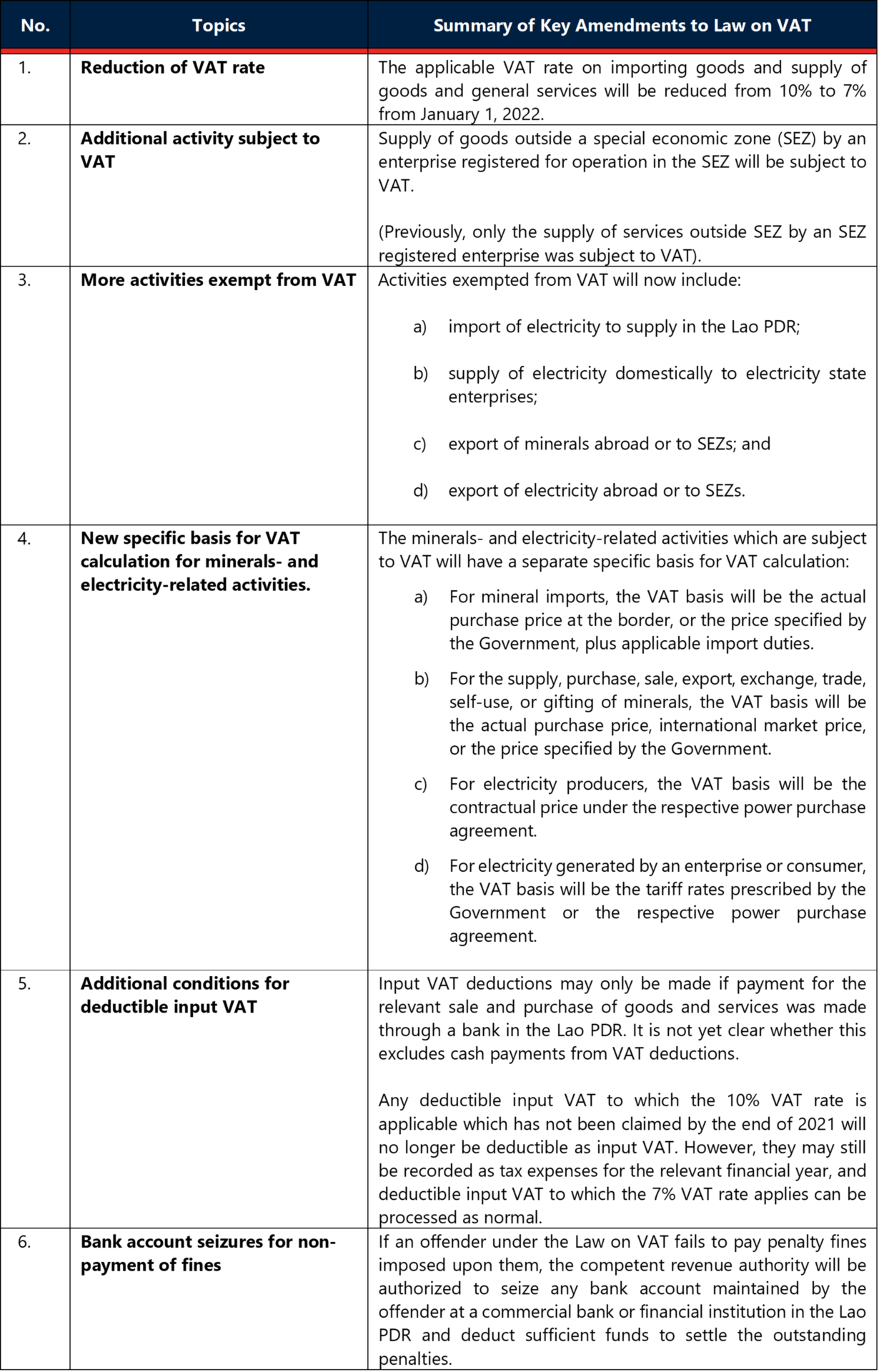
In the last week of December, 2021, the Ministry of Justice published the Law Amending Certain Provisions of the Laws on Tax No. 01/NA, dated August 7, 2021, in the Government Gazette. The Law will come into force on January 1, 2022.

The most notable amendments relate to Value Added Tax (VAT), which are summarized below.

The new law also makes changes to the laws on tax management, income tax, and excise tax, which Tilleke & Gibbins will provide updates on in due course.

RELATED INSIGHTS​ 

July 18, 2025
Vietnam’s electric vehicle (EV) industry is experiencing rapid growth, driven by a strong wave of new legislation, strategic plans, and government incentives. The government’s clear commitment to electrification is attracting foreign investment, supporting advanced production, and reducing reliance on internal combustion engine (ICE) imports. Recent national strategies, sector regulations, and technical standards demonstrate a rare level of regulatory momentum in Southeast Asia, positioning Vietnam as a competitive player in the global EV supply chain and an attractive market for foreign investors. An overview of legal developments for the EV sector in Vietnam is presented below. National Action Program for Green Transportation A key driver of Vietnam’s EV growth has been the National Action Program for Green Transportation through 2050 stipulated in Decision No. 876/QD-TTg of the prime minister dated July 22, 2022. The National Action Program sets a detailed roadmap for the green energy transition in road transport. For the period 2022–2030, the focus is on promoting the manufacturing, assembly, import, and conversion of road motor vehicles to electric power, expanding the use of 100% E5 gasoline for road vehicles, developing charging infrastructure to meet the needs of residents and businesses, and encouraging both new and existing bus stations and rest stops to meet green criteria. For the period 2031–2050, the roadmap aims to gradually restrict and ultimately cease by 2040 the manufacturing, assembly, and import of fossil fuel-powered cars, motorcycles, and mopeds for domestic use. By 2050, the goal is for 100% of road motor vehicles and construction vehicles participating in traffic to use electricity or green energy, for all bus stations and rest stops to meet green criteria, and for all machinery and equipment for loading and unloading to transition from fossil fuels to electricity or green energy. The program also calls for the completion of nationwide

July 16, 2025
On June 27, 2025, the National Assembly of Vietnam officially passed the amended Law on Atomic Energy, which will take effect on January 1, 2026. This legislative milestone follows the release of the fourth draft in June 2025, which was circulated for public consultation and builds upon earlier drafts from February, April, and early June. (See our previous article on the draft version here), Many provisions have been retained or refined to ensure greater specificity and alignment with Vietnam’s current legal framework. Once in force, the amended law will replace the 2008 Law on Atomic Energy (No. 18/2008/QH12), marking a significant step forward in modernizing Vietnam’s legal infrastructure for nuclear energy. The new law aims to harmonize with international standards, promote the safe and sustainable development of nuclear power, and facilitate future nuclear projects in the country. Noteworthy Updates in the Final Legislation Definition of National Radiation and Nuclear Safety Authority (NRNSA): The law introduces a clear definition of the NRNSA, outlining its roles and responsibilities in line with IAEA standards. Currently, this function is performed by the Vietnam Agency for Radiation and Nuclear Safety (VARANS) under the Ministry of Science and Technology. Digital Transformation Requirements: New provisions mandate the development of an integrated digital platform for data management, administrative procedures, and safety oversight, enhancing transparency and security. Policy Support for Training and Privatization: The law sets out principles for workforce incentives and sector privatization, with detailed regulations to be issued by the government. Dedicated Safety and Security Mechanism: A new section outlines inspection, supervision, violation handling, and enforcement procedures in the field of atomic energy, particularly for nuclear power plants. The NRNSA is empowered to conduct unscheduled inspections, suspend operations, and recommend license revocation when safety risks are identified. Key Provisions Retained or Clarified from the Draft Licensing
July 9, 2025
On June 16, 2025, the National Assembly of Vietnam adopted Law No. 75/2025/QH15 amending and supplementing a number of articles of the 2012 Advertising Law, with an effective date of January 1, 2026. The amended Advertising Law was enacted to further refine the legal framework for advertising activities in the modern era. Online Advertising Under the amended Advertising Law, “online advertising” is defined to encompass not only advertising on electronic newspapers and electronic information pages (as provided under the 2012 Advertising Law) but also advertising on other electronic venues, including social media, online applications, and digital platforms with internet connection. The amended Advertising Law also imposes new requirements for online advertising, including: Identification signs: Advertisements must have clear identifiable signs in numbers, letters, symbols, images, or sounds to distinguish them from non-advertising content. Control features: For advertisements not in fixed areas, there must be easily recognizable features and icons that allow recipients to turn off the advertisement, notify the service provider of violating advertising content, and refuse to view inappropriate advertising content. Linked content: Content in the links embedded in advertisements must comply with the law. Advertising service providers and publishers must have measures to check and monitor the linked content. Advertising on social media: Organizations and enterprises providing social media services must offer users features to distinguish advertising content from other content. Signage for sponsored content: When advertising, users of social media services must use signs to differentiate advertising or sponsored content from other content they provide. In response to the above requirements for online advertising, the amended Advertising Law sets out obligations of advertisers, advertising service providers, advertising publishers, and advertising conveyors in relation to online advertising. Among these, it is notably the responsibility of individuals and organizations engaging in online advertising to prevent and remove violating