You are using an outdated browser and your browsing experience will not be optimal. Please update to the latest version of Microsoft Edge, Google Chrome or Mozilla Firefox. Install Microsoft Edge

December 31, 2021

VAT Reduced to 7% under Amendments to Lao Tax Laws

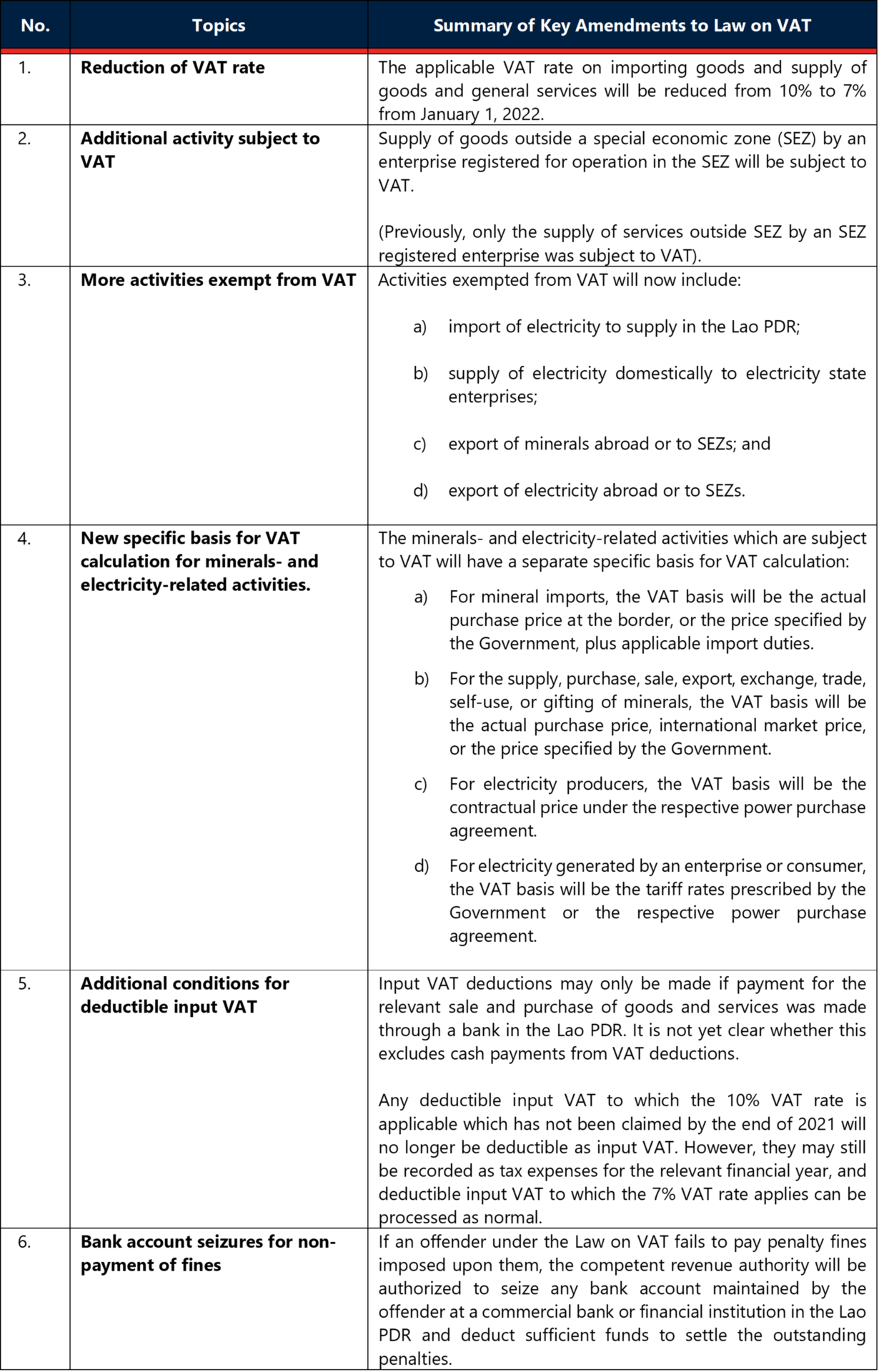
In the last week of December, 2021, the Ministry of Justice published the Law Amending Certain Provisions of the Laws on Tax No. 01/NA, dated August 7, 2021, in the Government Gazette. The Law will come into force on January 1, 2022.

The most notable amendments relate to Value Added Tax (VAT), which are summarized below.

The new law also makes changes to the laws on tax management, income tax, and excise tax, which Tilleke & Gibbins will provide updates on in due course.

RELATED INSIGHTS​ 

February 10, 2026
Data center and cloud investments are forming a major focus of private-sector investment in Thailand, with tech giants like Amazon, Google, Microsoft, and TikTok, as well as numerous telecom and data center companies, committing significant outlays to data center and cloud development. The country’s Board of Investment (BOI) approved projects worth THB 1.87 trillion in 2025, and THB 746 billion of this was from planned data center investments—by far the largest amount from any single industry. Thailand’s swift rise as a regional data center hub is fueled by surging demand for cloud, AI, and digital services, as well as large-scale investments from global tech firms. The country’s strategic location, competitive power costs, robust fiber infrastructure, expanding IT talent, and supportive government policies—including BOI incentives and streamlined approvals—have made it an attractive destination for scalable and sustainable digital infrastructure investments. The BOI’s proactive approach in updating promoted categories and providing both tax and non-tax incentives further ensures Thailand’s continued growth in this sector. 2025 BOI Changes for Data Centers In the middle of 2025, the BOI responded to the remarkable trend by updating investment‑promotion categories across various sectors (e.g., machinery and electrical equipment, public utilities, digital and innovative industries) to accommodate growing investment in data‑center projects. Before the change, which was detailed in a notification that has applied to investment promotion applications submitted from July 1, 2025, onward, data‑center projects under BOI promotion were granted a single A1 incentive (an eight‑year corporate income‑tax exemption) and subject to one uniform set of conditions. The July 2025 notification restructured promotion for data centers into two categories based on power‑usage efficiency: high‑efficiency data centers and other data centers. Under these rules, qualified high‑efficiency data centers are eligible for an eight‑year corporate income tax (CIT) exemption, while for other data centers this exemption is

January 6, 2026
On December 30, 2025, Thailand’s Electronic Transactions Development Agency (ETDA) notified digital marketplace operators of a consolidated list of “high‑risk products” that are subject to strict monitoring on digital platforms. The list was jointly prepared by the Thai Industrial Standards Institute (TISI) and the Food and Drug Administration (FDA) to guide platform compliance in the initial phase of implementation of the Electronic Transaction Committee’s Notification on Other Measures for Marketplace for Goods with Specific Characteristics under Section 18(2) of the 2022 Royal Decree on Digital Platform Businesses Requiring Notification B.E.2568 (2025). The notice is addressed to operators of digital platform services that function as product marketplaces with specific characteristics laid out in the notification. The ETDA states that the TISI and the FDA are closely monitoring the high‑risk product categories on digital platforms, and the published list serves as the baseline reference for platform screening during the initial phase of the notification’s implementation. High‑Risk Product List The list aggregates categories of products that are illegal to sell online or are otherwise tightly regulated under Thai law, with an emphasis on health-related products, controlled substances, medical devices, and a wide range of industrial products that require certification or compliance with specified Thai Industrial Standards, as detailed below. Prohibited and tightly controlled health products. This includes all categories of modern medicines subject to control other than general household remedies; all categories of controlled herbal products except for over-the-counter herbal products; narcotics; psychotropic substances; and medical devices requiring use in medical facilities or a physician’s prescription. Selected industrial products requiring heightened controls. The list highlights dozens of TISI-regulated items commonly sold online. Examples include pacifiers, rice cookers, electrical wire, food wrap film, crayons, washing machines and dryers, air conditioners, electric cookers and air fryers, water heaters, microwave ovens, LED luminaires, hair dryers
December 30, 2025
On December 17, 2025, Laos’ Ministry of Industry and Commerce (MOIC) issued a notice introducing a new digital system that allows e-commerce businesses to obtain required certificates and licenses through an online, application-based platform. Notice No. 3988, which will take effect on February 1, 2026, introduces the E-Trust platform, a downloadable application that allows e-commerce businesses to remotely obtain acknowledgement certificates and business operating licenses. New Digital Registration Options Under the previous framework established by the Decree on E-commerce (2021), businesses were required to complete registration exclusively through paper-based submissions. The new system now offers businesses two registration options: Traditional paper-based process at the Division of E-commerce Management within the MOIC; or Electronic registration and renewal through the E-Trust platform. This change is expected to streamline procedures, reduce administrative burdens, and enhance accessibility for businesses operating outside Vientiane. The E-Trust platform facilitates compliance for both individuals and legal entities required to submit applications and renewals for required certificates and licenses. The development is particularly beneficial for businesses located in remote provinces, as it eliminates the need for physical travel and significantly accelerates processing times. Compliance Requirements and Penalties Businesses must obtain or renew the required certificates and licenses to avoid sanctions under the Decision on Fines and Other Measures for Violation of the Decree and Regulations on E-commerce (No. 2828/MOIC, dated November 11, 2025). Penalties for noncompliance may include monetary fines and other enforcement measures.
December 5, 2025
One morning, a California-based company mapping its Southeast Asia rollout opened an unexpected cease-and-desist letter from a Vietnamese IP firm. To the company’s surprise, the letter asserted that a local client already owned the company’s brand in Vietnam and threatened legal action. This is not an isolated incident. In another recent matter in the sports industry, a squatter demanded at least USD 48,000 from our client to “resolve” a similar conflict. For brands entering Vietnam or expanding distribution there, these tactics can create acute risk at precisely the point at which market momentum is building. Vietnam’s rapid economic growth and deepening integration into global trade have made it an increasingly attractive destination for multinational brands. Those same dynamics have intensified a longstanding issue: trademark squatting. Vietnam has modernized its IP framework over the past decade, but its strict first-to-file trademark system continues to incentivize opportunistic filings by parties with no legitimate interest in a mark. As more foreign brands build their reputation abroad before turning to Vietnam, squatters remain alert to timing gaps and enforcement frictions. The First-to-File System: Advantages and Vulnerabilities Vietnam adheres closely to the first-to-file principle under its Law on Intellectual Property. In practice, exclusive trademark rights belong to whoever submits the earliest valid application to the Vietnam Intellectual Property Office, regardless of prior use in Vietnam. This approach offers administrative clarity and reduces evidentiary burdens compared to use-based jurisdictions. Yet it also creates fertile conditions for squatting. Bad-faith actors regularly monitor foreign markets, identify brands gaining traction, and move quickly to register those marks domestically, often long before the genuine owner enters the market or prioritizes local filings. By the time the true brand seeks protection, the squatter’s application (or registration) stands as a legal obstacle, pushing businesses toward costly oppositions, cancellations, or uncomfortable negotiations