You are using an outdated browser and your browsing experience will not be optimal. Please update to the latest version of Microsoft Edge, Google Chrome or Mozilla Firefox. Install Microsoft Edge

December 31, 2021

VAT Reduced to 7% under Amendments to Lao Tax Laws

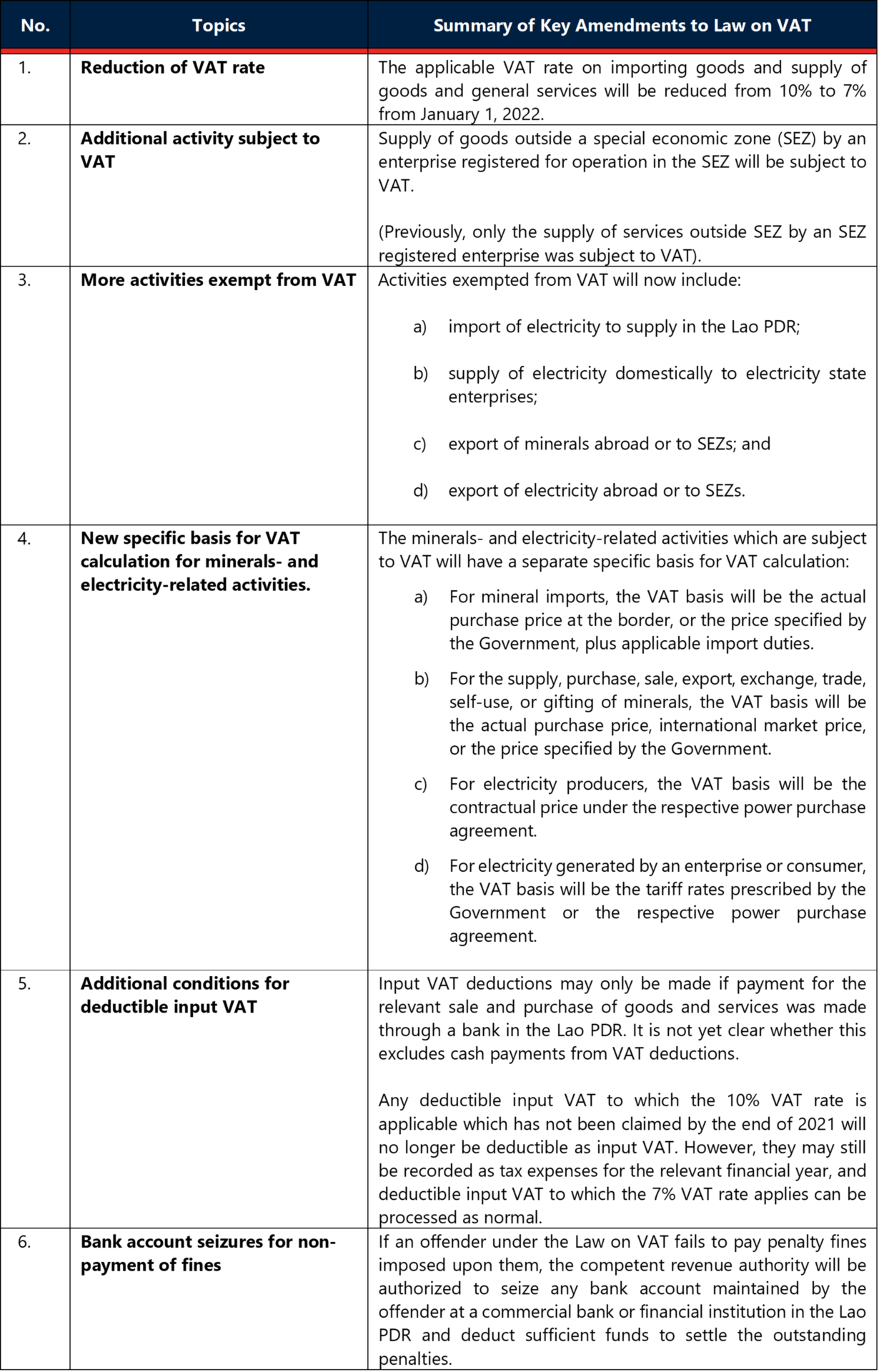
In the last week of December, 2021, the Ministry of Justice published the Law Amending Certain Provisions of the Laws on Tax No. 01/NA, dated August 7, 2021, in the Government Gazette. The Law will come into force on January 1, 2022.

The most notable amendments relate to Value Added Tax (VAT), which are summarized below.

The new law also makes changes to the laws on tax management, income tax, and excise tax, which Tilleke & Gibbins will provide updates on in due course.

RELATED INSIGHTS​ 

August 9, 2023
Cambodia imports a substantial amount of food products to meet its domestic demand. Most of these imported products are from nearby ASEAN countries, with Thailand, Malaysia, and Vietnam providing the bulk of these food imports. However, food products from markets further away are becoming more popular each year, including brands from Australia, Japan, China, the EU, South-Korea, and the US. Many food product owners and distributors do not realize that all types of prepackaged food products, including imports, require product registration before they are permitted to be sold in Cambodia. This usually requires an assessment against mandatory Cambodian Standards and local technical regulations. There are general Cambodian Standards that cover all types of prepackaged food products, as well as product-specific standards and regulations that may be applicable. Furthermore, any type of prepackaged food product sold in Cambodia must bear a Khmer language label that meets the minimum consumer information standards, and the Cambodian Standards. This label requirement is often overlooked, with many products on the market bearing only a foreign language label. Product Registration & Labeling Requirements Back in 2000, a Cambodian Standard on prepackaged food labeling was adopted, clearly mandating Khmer language labeling for all types of prepackaged foods. Unfortunately, this labeling standard was not widely adopted by the industry, and even today compliance is low. Low compliance, combined with a lack of widespread enforcement efforts, led to a misguided understanding that imported food products were not subject to any standards, did not require product registration, and were not required to bear Khmer language labeling. Recent legal developments related to consumer protection and food safety clarified several of these misunderstandings. For example, the regulations clearly state that all types of food product must meet the applicable standards and technical regulations, which is assessed through registration. The new Law
July 28, 2023
Myanmar’s Ministry of Commerce (MOC) issued three notifications related to e-commerce on July 21, 2023, classifying online retail businesses as essential services, requiring them to register with the relevant authorities, and setting the criteria for their registration. Under Notification No. 49/2023 the MOC authorized the Department of Trade (DOT) to issue notifications, orders, and directives relating to online retail businesses. This was followed by Notification No. 50/2023, which classifies online retail businesses as essential services under the Essential Supplies and Services Law and requires them to register with the DOT within six months of the issuance of the notification (i.e., by January 21, 2024). Failure to register within the specified period will be punishable by imprisonment for six months to three years and a fine of up to MMK 500,000 (approx. USD 238). Finally, under Notification No. 51/2023, the MOC set out the criteria and requirements for the registration of online retail businesses by entities, business institutions, and individuals, as well as the duties and liabilities of sellers and consumers. Pursuant to this notification, registration should be completed via the DOT’s online system, fees must be paid digitally, and electronic registration certificates will be issued. Certificates are initially valid for two years, and can be renewed. The MOC will provide information at a later time on the prescribed forms, certificate format, registration and online fees, and online registration portal. In applying for registration, an entity or business institution established under the Myanmar Companies Law, Special Company Act, Co-operative Society Law, or any other existing Myanmar laws must have a website with its own domain name or an online channel with an exact address that is used for online sales and a registered business address within Myanmar. Individual applicants must be at least 18 years old, reside in Myanmar, and

July 25, 2023
Thailand’s Energy Regulatory Commission (ERC) is in the process of reviewing a draft regulation that updates the nationality qualifications for the ultimate shareholders and directors of applicants for an energy business license. The draft ERC Regulation Re: Qualifications, Documents and Application for Electricity Business—which is intended to replace the ERC Regulation Re: Application and Permission for Electricity Business B.E. 2551 and its amendments—is likely to be adopted soon and will affect licensed companies that are foreign majority owned when they apply for or renew their energy business licenses. The draft regulation requires partnerships, limited companies, and public limited companies to have the following qualifications unless there is an international agreement granting national treatment for a specific commitment (mode 3 or mode 4) or exemption by other laws: Juristic persons must be established under Thai law or registered in Thailand with the objective of carrying out electricity business; For private limited companies, foreign ultimate shareholders must not hold more than 49% of the total shares, and the number of the foreign shareholders must not exceed half of all shareholders; At least half of all directors must have Thai nationality; and Any authorized directors must have Thai nationality. When the draft regulation is adopted, it will not take retroactive effect on previously granted energy business licenses, which will continue to be valid until they expire if there is no material change to the license as defined by the draft regulation. Once the license is up for renewal (energy business licenses are normally issued for a specific period of time), it will be subject to the draft regulation. All license applications submitted prior to the effective date of the draft regulation and under consideration will be deemed applications for a license under the draft regulation. As noted above, the new qualification requirements
July 7, 2023
Cambodia has the potential to be one of the top countries in the world for generating renewable energy through solar, based on the average amount of sunlight hours available per day and the consistent sunshine throughout the year. The Cambodian government has recognized this potential and has made major updates to its energy policies in recent years. Solar power is now taking over a much larger portion of the total energy mix in Cambodia, especially as a number of utility-scale solar power plants have come online in recent years. The long-term Power Development Master Plan 2022–2040 sets out the long-term energy policy for Cambodia and requires a bigger role for renewables. The use of solar power will play a key role in this aim to increase the role of renewables, with the plan foreseeing almost 30% of all national power generated through solar technologies by 2040. Two of the latest legislative and regulatory steps by the government are the Ministry of Mines and Energy’s guidelines for rooftop solar systems, and most recently the long-awaited Environment and Natural Resources Code, which was enacted on June 29, 2023. Rooftop Solar Projects Many companies, from small startups to multinationals, are exploring the potential for rooftop solar in Cambodia. However, despite the favorable natural factors, the regulatory framework was not always clear or friendly to rooftop solar, hampering investment. This started slowly changing with the adoption of the first solar energy regulation in 2018, which provided the country’s first official guidance on both solar power plants and rooftop solar. It provided some much-needed clarity, but the 2018 solar energy regulation—and especially the subsequent electricity tariff schemes—often kept rooftop projects from being financially viable. Many players in the industry voiced their doubts about the regulations and tariffs, focusing especially on the capacity charge—a monthly