You are using an outdated browser and your browsing experience will not be optimal. Please update to the latest version of Microsoft Edge, Google Chrome or Mozilla Firefox. Install Microsoft Edge

December 31, 2021

VAT Reduced to 7% under Amendments to Lao Tax Laws

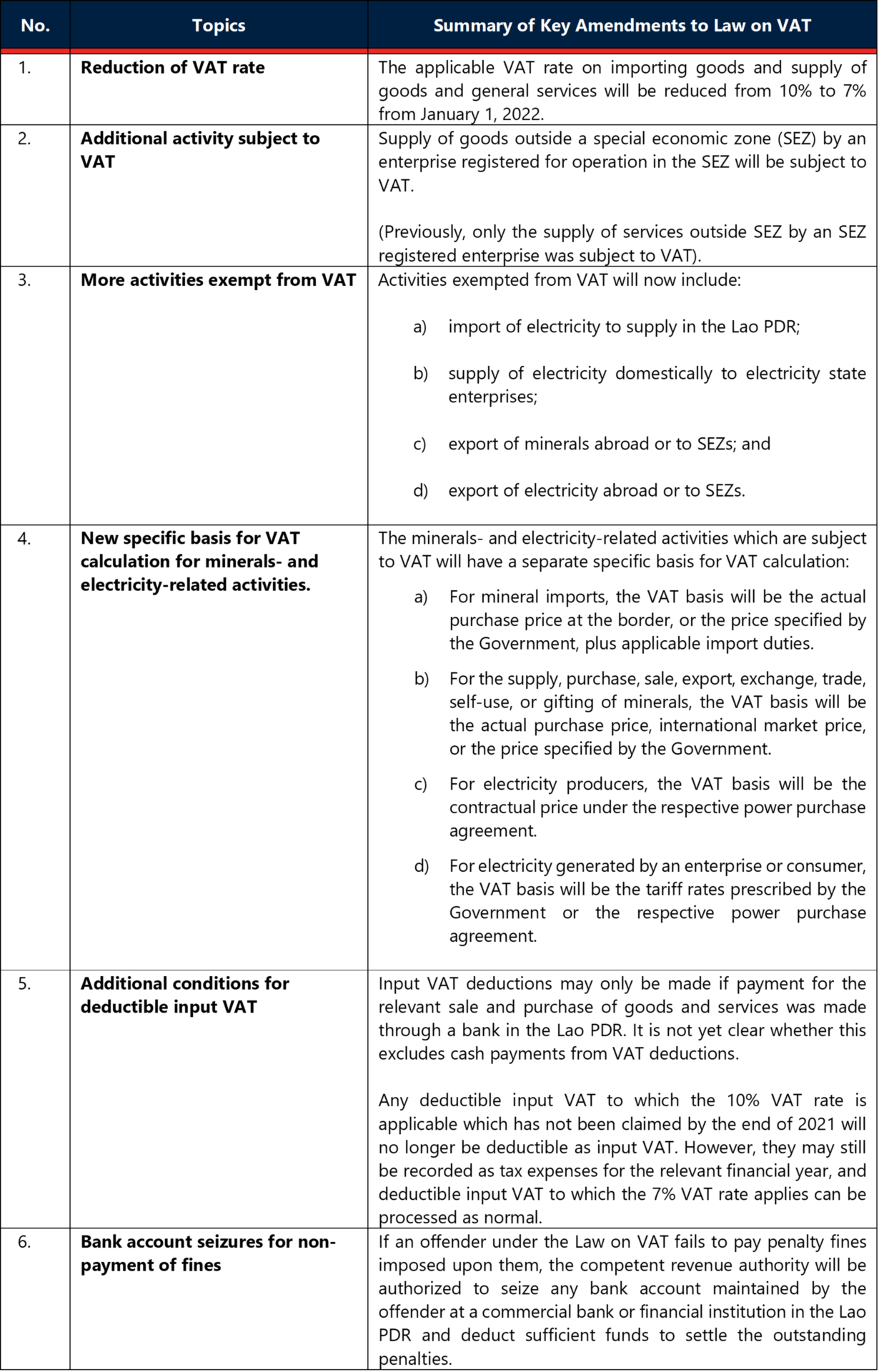
In the last week of December, 2021, the Ministry of Justice published the Law Amending Certain Provisions of the Laws on Tax No. 01/NA, dated August 7, 2021, in the Government Gazette. The Law will come into force on January 1, 2022.

The most notable amendments relate to Value Added Tax (VAT), which are summarized below.

The new law also makes changes to the laws on tax management, income tax, and excise tax, which Tilleke & Gibbins will provide updates on in due course.

RELATED INSIGHTS​ 

June 17, 2026
Thailand’s new labeling requirements for medical devices, which include for the first time a unique device identification (UDI) requirement for software as a medical device (SaMD), take effect on June 20, 2026. The Notification of the Ministry of Public Health regarding Criteria, Methods, and Conditions on Labeling and Instructions for Use for Medical Devices 2025, which replaces a similar notification from 2020, was published in the Government Gazette on December 22, 2025. To ensure clarity, modernity, and patient safety, the regulation requires domestic manufacturers and importers to provide labels and instructions for use (IFU) that are clearly legible, complete, and free of false or misleading claims. It also permits IFU to be provided in electronic format, such as via QR codes, websites, or other digital channels—directly relevant to SaMD, where physical labels are impractical and electronic presentation is the natural medium. The notification distinguishes two categories for labeling language. Home-use medical devices (for lay users outside healthcare facilities) must have labels and IFU in Thai. Professional-use medical devices may display labels and documentation in either Thai or English. This distinction is significant for SaMD developers: software intended for clinical professionals may use English-language interfaces and IFU, while consumer-facing health applications must provide Thai-language content. Labeling and UDI Requirements Labels and IFU must include, at a minimum: Product name and intended purpose Quantity or volume Name and address of domestic manufacturer or importer Thai FDA approval number Lot, version, or serial number Manufacturing date and expiry date For SaMD, the version number requirement is particularly relevant. The regulation also mandates display of a UDI code for SaMD in risk category 2 (moderate-risk), category 3 (moderate- to high-risk), and category 4 (high-risk), according to Thailand’s medical device risk classification system (which complies with the ASEAN Medical Device Directive and the EU

May 25, 2026
After several years of policy discussion and continued efforts led by the Ministry of Commerce (MOC) to relax the list of reserved businesses under the Foreign Business Act B.E. 2542 (1999) (FBA), the reform process has now reached a significant milestone. On May 12, 2026, the Thai cabinet approved in principle two draft subordinate legislative instruments aimed at delisting certain reserved business activities under the FBA and reducing licensing requirements for foreign business operators. These developments signal a renewed and concrete effort by the government to modernize Thailand’s business regulatory framework in order to attract foreign investment and boost Thailand’s competitiveness in the global market. Nine Businesses Set for FBA Delisting Below is a list of the nine businesses that are being targeted for delisting from the FBA’s restrictions. A draft ministerial regulation would delist the first eight reserved businesses, while a royal decree has been drafted to delist the ninth business: Telecommunications services (Type 1 license only, covering operators without their own telecommunications infrastructure), under the supervision of the Office of the National Broadcasting and Telecommunications Commission. Treasury center services subject to the Foreign Exchange Control Act B.E. 2485 and under the supervision of the Bank of Thailand. Securities-collateralized lending, pursuant to the laws governing securities and exchange and derivatives regulated by the Securities and Exchange Commission. Agency, dealer, advisory, or fund management services relating to derivatives where the underlying assets fall outside the scope of the Derivatives Act B.E. 2546 (2003) Intra-group shared services, including administrative, human resources, and IT functions Intra-group domestic debt guarantee services Leasing of partial space for installation of financial service machines and automatic vending machines for employee use Petroleum drilling services Trading of agricultural product derivatives through a futures exchange, with physical delivery or receipt of agricultural products at a futures exchange–designated
May 11, 2026
Thailand’s rise as a regional hub for luxury retail has influenced how market entry is structured and assessed across Southeast Asia. As brands consider establishing a presence in the market, regulatory and operational considerations form a key part of the overall entry assessment. Foreign Ownership Restrictions for Retailers Foreign investment in retail activities is subject to a relatively extensive regulatory framework, particularly in relation to foreign ownership and the approvals required under the Foreign Business Act B.E. 2542 (1999) (FBA). Under the FBA, a company is generally regarded as foreign if 50% or more of its shares are held by non-Thai nationals, in which case the business is required to obtain a foreign business license (FBL) issued by the director-general of the Department of Business Development, with the approval of the Foreign Business Committee. The committee will not grant an FBL unless it is convinced the proposed business demonstrates unique characteristics such as a distinctive business model, innovative processes, specialized services or products, or a clear competitive differentiation that will benefit Thailand; constitutes a highly specialized business or requires specialized technology or expertise; and will not compete with Thai business operators who engage in the same business. The committee makes its decisions on a case-by-case basis depending on the circumstances, which can make the licensing process less predictable in practice. However, there are also alternative pathways for consideration, including exemptions in specific circumstances. For example, foreign-owned businesses in Thailand with at least THB 100 million in registered capital are allowed to open five retail stores in the country. Some businesses may also be able to access preferential treatment under international agreements and treaties between Thailand and certain foreign states, subject to eligibility requirements. Structural and Business Model Challenges The determination of what constitutes a “retail store” may itself present
May 8, 2026
Thailand has liberalized its wine import regime, allowing, for the first time, multiple importers to bring in and distribute the same wine brands. On March 27, 2026, the Ministry of Finance issued the Ministerial Regulation on the Importation of Alcoholic Beverages (No. 3) 2026, which waives the requirement to appoint a sole authorized agent for alcoholic beverages to be specified in notifications from the Excise Department. The Excise Department has already issued its first such notification, expressly exempting wine and sparkling wine made from grapes from the sole agent requirement. For all other types of alcoholic beverages (e.g., beer, tequila, spirits) the sole agent requirement remains in force, and applicants for importer licenses must provide evidence of exclusive distributorship issued by the manufacturer or brand owner. The exemption may be extended to other alcoholic beverage categories through future Excise Department notifications. Implications for Competition and Tourism The reform allows multiple importers to bring in and distribute the same wine brand without routing through the brand owner’s designated exclusive importer, reducing monopolization and boosting competition. Excise Department Director-General Pornchai Thirawet noted that wine was chosen as the starting point because implementation is straightforward in this case and because domestic wine prices remain high—with increased competition expected to exert downward pressure on prices. More broadly, the reform is intended to lower market entry barriers, expand supply, and make wine more accessible to Thai consumers, while supporting Thailand’s position as a regional tourism hub. Product Quality Control and Loss of Sole Agent Accountability Under the previous framework, the designated importer bore full responsibility for the proper storage, handling, and distribution of wine and sparkling wine from importation to final sale. This arrangement helped ensure that products were maintained under appropriate conditions, including temperature control, light exposure, and humidity management, to preserve quality