You are using an outdated browser and your browsing experience will not be optimal. Please update to the latest version of Microsoft Edge, Google Chrome or Mozilla Firefox. Install Microsoft Edge

December 31, 2021

VAT Reduced to 7% under Amendments to Lao Tax Laws

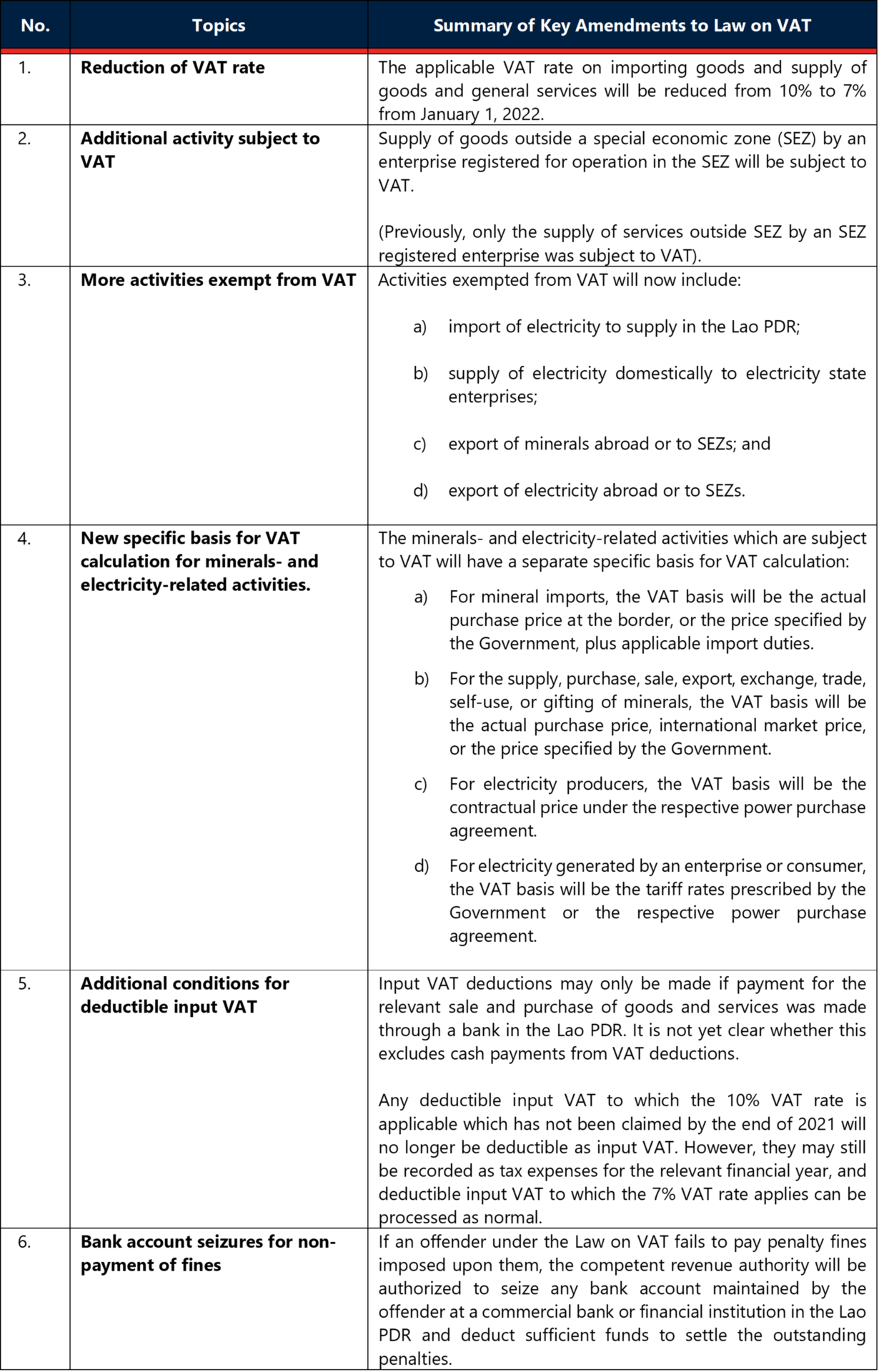
In the last week of December, 2021, the Ministry of Justice published the Law Amending Certain Provisions of the Laws on Tax No. 01/NA, dated August 7, 2021, in the Government Gazette. The Law will come into force on January 1, 2022.

The most notable amendments relate to Value Added Tax (VAT), which are summarized below.

The new law also makes changes to the laws on tax management, income tax, and excise tax, which Tilleke & Gibbins will provide updates on in due course.

RELATED INSIGHTS​ 

August 12, 2024
With the growing prominence of ESG (Environmental, Social, and Governance) factors, businesses in Vietnam are increasingly recognizing their importance in driving global demand, societal impact, and economic value. A comprehensive acknowledgment of ESG-related legal requirements is critical for investors and companies operating in Vietnam to meet stakeholder expectations and ensure compliance. Our guide provides a basic overview of the rapidly evolving ESG landscape in Vietnam, covering a range of key issues for companies doing business in the country: What is ESG, and what does the ESG legal framework look like in Vietnam? Who needs to follow ESG regulations in Vietnam? What are the benefits of ESG compliance? How can enterprises enhance ESG best practices in Vietnam? Please click on the link below to view the full article.
July 9, 2024
On July 3, 2024, the Committee on Contracts of Thailand’s Consumer Protection Board announced the Notification re: Stipulation of Cash-on-Delivery (COD) Logistics Services as a Controlled-Receipt Business under the Consumer Protection Act B.E. 2522 (1979). The notification regulates businesses “providing goods transportation services that collect cash on delivery,” which refers to business operators responsible for transporting goods from sender (i.e., the merchant of the goods) to consumer (i.e., the purchaser of the goods) and upon delivery collects payment from the consumer either in cash or via bank transfer. The obligations that the notification imposes on these business operators are described below. Receipts Business operators must prepare a receipt as evidence of payment according to the specified requirements and deliver it to the consumer immediately upon receiving payment for the goods. The receipt must include text in Thai that is clearly visible and legible, with a font size of at least two millimeters and no more than 11 characters per inch. The text must contain essential information and conditions as specified in the notification, including: The duration that the business operator will hold the money received from the consumer before releasing it to the sender; The timeframe within which the consumer must notify the business operator to return the goods and request a refund; Information about the employees who deliver the goods and collect payment from consumers; The name of the person authorized to issue the receipt; Details about the parcel specifying the nature of the goods, including the name, type, kind, characteristics, size, weight, quantity, color, volume or capacity, and price of the goods; and A statement that the consumer has the right to reject the delivered goods or receive a refund. The receipt also must not contain any statement prohibited by the notification. Examples include: Text stipulating that
June 6, 2024
On January 18, 2024, Vietnam’s National Assembly passed a new Land Law (“Land Law 2024”) that is scheduled to take effect on January 1, 2025, replacing the current Land Law 2013. To mitigate challenges faced by the real estate market, in late May 2024, the government proposed amendments to the Land Law that would move the effective date up five months, to August 1, 2024, pending approval by the National Assembly. One of the key sectors to be impacted by the Land Law 2024 is the energy sector, which requires large land areas for power plants and infrastructure, especially given Vietnam’s 2050 net zero emissions commitment. Below are highlights of how the new Land Law 2024 will affect Vietnam’s energy sector. Annual payment of land rental Under the Land Law 2013, investors implementing energy projects (e.g., solar power projects) are entitled to choose to lease land with either (i) an annual rental payment or (ii) a single upfront payment for the entire term of use. Under the Land Law 2024, these investors are only allowed to use land in the form of an annual rental payment. As the annual land rental is calculated in five-year cycles, based on the land price table decided by the state, this new restriction means that investors in energy projects will face an additional risk of a sudden increase in land rental, disrupting their financial planning. Investors using land sites leased with annual rental payments are also not allowed to mortgage their land-use rights, but can only mortgage assets attached to the land, at credit institutions licensed to operate in Vietnam. Accordingly, this may affect the ability of energy projects to obtain financing during the development stage, because they no longer have assets that can be mortgaged. Obtaining land Under the Land Law 2024,
June 4, 2024
Thailand’s Department of Mineral Fuels (DMF) is in the process of preparing a notification that will open the application period for onshore petroleum exploration and production rights in the country’s 25th bidding round. The 25th round of bidding will cover nine petroleum blocks, including the northeastern areas (blocks L1/66, L2/66, L3/66, L4/66, L5/66, L7/66, and L9/66) and central areas (blocks L6/66 and L8/66). The DMF estimates that application submissions will commence around the middle of 2024, and the successful bidder will be announced at the end of the same year. Based on previous rounds of bidding, applicants must meet the following key criteria: The applicant is a company with the purpose of carrying out petroleum exploration and production; The applicant commands the necessary assets, machinery, equipment, tools, and specialists to explore for, produce, sell, and dispose of petroleum; The applicant has not abandoned its operations under a concession or been subject to revocation of a concession in Thailand; and None of its personnel, shareholders, directors, or authorized directors is listed as a person who has abandoned its operations under a concession, or has been subject to revocation of a concession in Thailand. If the applicant does not itself possess all the qualifications under (2) above, it must have another government-approved company that possesses all the qualifications under (2) and has a capital or management relationship with the applicant, and the applicant must supply guarantees that the company will make available to the applicant all necessary assets, machinery, equipment, tools, and specialists for the applicant to explore for, produce, sell, and dispose of petroleum. Companies with a vested interest in petroleum exploration and production in Thailand must remain vigilant for updates. The DMF is expected to provide an update and more details on the bidding very soon. For more details