You are using an outdated browser and your browsing experience will not be optimal. Please update to the latest version of Microsoft Edge, Google Chrome or Mozilla Firefox. Install Microsoft Edge

December 31, 2021

VAT Reduced to 7% under Amendments to Lao Tax Laws

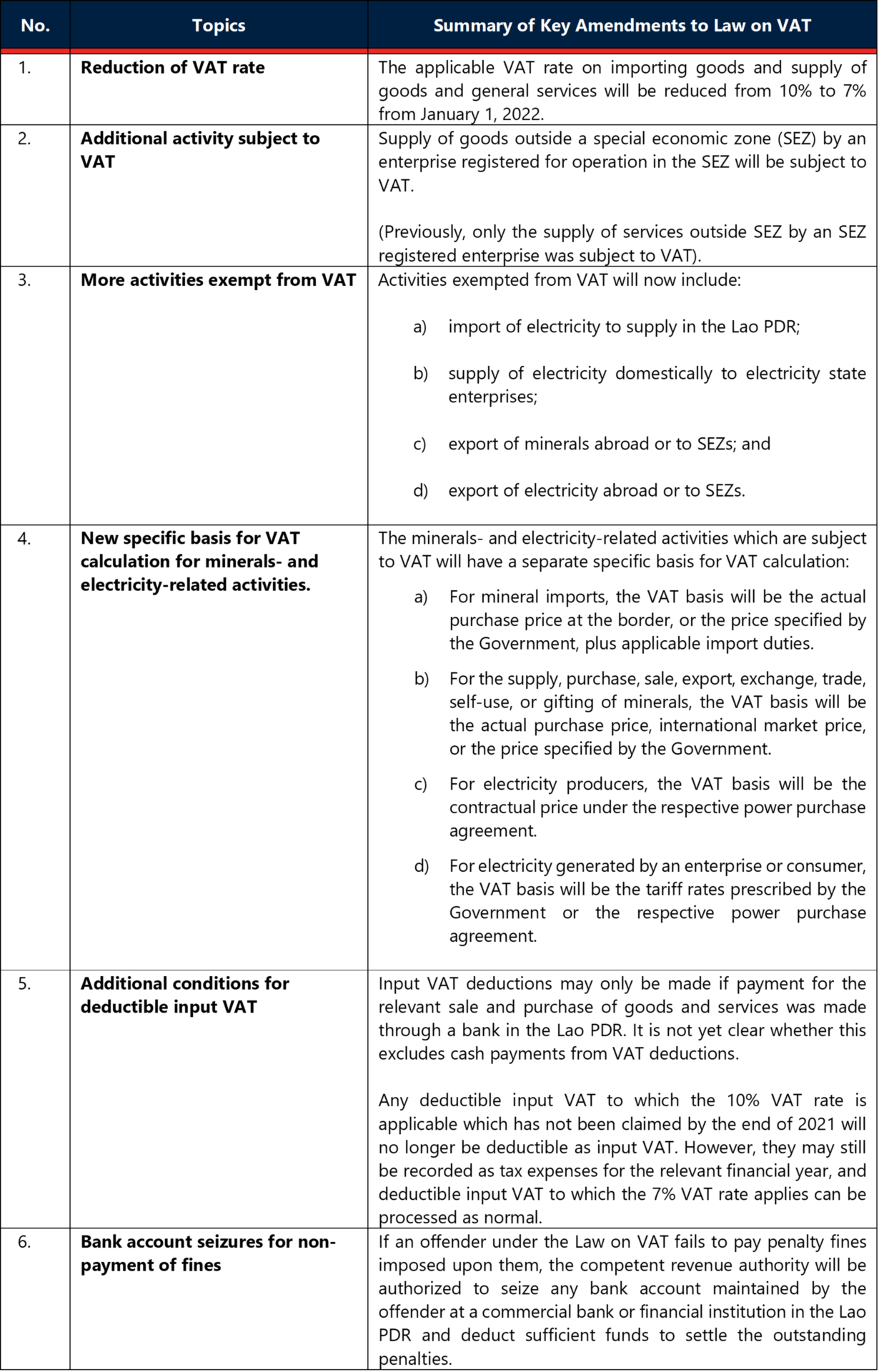
In the last week of December, 2021, the Ministry of Justice published the Law Amending Certain Provisions of the Laws on Tax No. 01/NA, dated August 7, 2021, in the Government Gazette. The Law will come into force on January 1, 2022.

The most notable amendments relate to Value Added Tax (VAT), which are summarized below.

The new law also makes changes to the laws on tax management, income tax, and excise tax, which Tilleke & Gibbins will provide updates on in due course.

RELATED INSIGHTS​ 

October 24, 2025
Thailand currently lacks a specific franchise act. Consequently, the legality of any franchise agreement is determined by its compliance with various existing laws, such as the Civil and Commercial Code, the Trademark Act B.E. 2534 (1991) (as amended), and the Unfair Contract Terms Act B.E. 2530 (1997). Thailand is a freedom-to-contract jurisdiction. This allows for a high degree of flexibility and autonomy in contractual arrangements, provided that the terms do not violate any laws or public policy and do not fall under the scope of unfair contract terms. Given this, the requirement for fairness in franchise agreement terms often leads to uncertainty, but decisions from the Trade Competition Commission of Thailand (TCCT) can provide guidance on whether specific contentious terms are in fact fair.  One issue worth examining in this light is the inclusion of terms on nonrefundable franchise fees and strict purchasing conditions. Franchise Fee: Unfair to Refuse Refund? Nonrefundable franchise fees represent a significant upfront investment for franchisees, often becoming a point of contention if the franchise relationship deteriorates or the franchisor ceases operations. Their fairness and enforceability are frequently scrutinized by regulatory bodies like the TCCT, highlighting the critical balance between contractual freedom and franchisee protection. Faced with one such case, the TCCT considered whether it was unfair for the franchisor to refuse to refund the franchise fee after the franchisor ceased operations.  The franchisee had entered into a service agreement on August 2, 2021, and begun operating on October 9, 2021. However, by November 21, 2023, the franchisee was notified that the system would be shut down for maintenance, and by December 26, 2023, the franchisor announced the cessation of operations due to financial losses. The franchisee then requested a refund of the franchise fee. Unfortunately for the franchisee, the TCCT found that the franchisor’s
October 3, 2025
On September 26, 2025, the Contract Committee under Thailand’s Consumer Protection Board issued a regulation that aims to standardize contracts and enhance consumer protection within the beauty and wellness industry. The Notification on Prescribing the Beauty Service Business as a Contract-Controlled Business B.E. 2568 (2025), which takes effect on January 24, 2026, requires business operators to use a prescribed standard contract in Thai and adhere to strict mandatory provisions and prohibitions. These regulations apply to operators across all in-person and online service channels, including via digital platforms. “Beauty services business” is defined as the provision of services under an agreement allowing consumers to receive a series of treatments, either over a set number of sessions or within a set period. This includes massage, spa, other methods for cleanliness, beauty, or care of facial or body skin, and weight control and body shaping—including services offered electronically. The law excludes surgery, liposuction, and medical treatments performed by licensed practitioners. The notification establishes the following key requirements: Mandatory contract and formatting. All contracts with consumers must use the standard contract form, in Thai, with clear, readable text (minimum font size of 2 millimeters, no more than 11 characters per inch), and include all essential terms from the annexed form. Contract execution. Contracts must be made in duplicate, with one copy given to the consumer at signing. For agreements concluded through electronic channels, the process must comply with the Electronic Transactions Act and use the same required terms. Digital platforms. Business operators who provide services facilitated through a digital platform as an intermediary are ultimately responsible for ensuring the consumer receives a compliant contract. Prohibited clauses. The law prohibits clauses that limit or exclude liability for damages to life, body, health, mind, or property resulting from breach of contract or a wrongful act;
September 25, 2025
Tilleke & Gibbins’ labor and employment team in Hanoi and Ho Chi Minh City has contributed the Vietnam chapter to Labor and Employment Disputes 2026. Drawing on the expertise of three of the firm’s employment specialists, the chapter provides practical guidance for navigating employment disputes in Vietnam and covers: Pre-action considerations: key requirements, third-party funding, contingency fee arrangements Issuing a claim: forum, territorial jurisdiction, standing, commencing claims, fees, service, defendants and legal personality, types of claims, time limits, counterclaims Case management: procedure, rules, amendments to claims, adding parties, consolidating proceedings, class and collective actions, evidence, witnesses, tactical considerations Interim relief: availability, requirements Trial: hearings conduct and time frames, confidentiality and public access, media reporting, elements of successful claims and burden of proof Alternative dispute resolution: available types, requirements and expectations, enforcement Collective employment and labor rights: enforcement and standing Remedies and enforcement: available remedies, assessing compensation, enforcement mechanisms Appeals: procedure, time frames, other means of challenge Updates and trends: recent cases and developments, technology developments, other issues The Vietnam chapter is available for download below. Tilleke & Gibbins also contributed the Cambodia and Thailand chapters to Labor and Employment Disputes 2026. Readers can also gain 30 days of complementary access to the full Labor and Employment Disputes 2026 guide and the rest of Lexology Panoramic’s varied offerings through this link.

September 16, 2025
Thailand has enacted amended alcohol control legislation that significantly tightens restrictions on marketing and advertising, strengthens enforcement, and creates mechanisms to support the country’s tourism objectives. The Alcoholic Beverage Control Act (No. 2) B.E. 2568 (2025), published in the Government Gazette on September 9, 2025, will take effect on November 8, 2025. Key aspects of the new law are outlined below. Continuation of Sales-Hour Restrictions Sales-hour restrictions remain in effect, though now under an updated regulatory pathway. Alcohol sales are permitted only between 11:00 a.m. and 2:00 p.m. and between 5:00 p.m. and midnight, with exceptions for airport terminals, entertainment venues under the Entertainment Place Act 1966, and hotels. Despite earlier discussions about relaxing these hours, no changes have been implemented under the new law. Enhanced Seller Responsibilities Sellers are now expressly permitted to check identification cards to verify purchaser age and may assess the condition of intoxicated customers. The assessment conditions will be announced in a forthcoming notification from the director of the Department of Disease Control. Sellers who willfully or negligently violate the law and cause damage to life, health, or property face possible penalties. Alcohol Vending Machines Permitted The law allows alcohol to be sold in vending machines that can verify buyer information and comply with rules, procedures, and conditions to be prescribed by the Alcoholic Beverage Control Committee. This means the industry must await the committee’s implementing regulations before deploying such machines. Expanded Marketing and Advertising Restrictions The amended law introduces a new suite of advertising restrictions, including more detailed and expansive definitions involving marketing and promotions. “Marketing communication” is broadly defined to include any direct or indirect act of publicizing, presenting, or disseminating information about alcoholic beverages through advertising, public relations, sales promotions, sponsorships, or any other means that may induce or encourage the