You are using an outdated browser and your browsing experience will not be optimal. Please update to the latest version of Microsoft Edge, Google Chrome or Mozilla Firefox. Install Microsoft Edge

December 31, 2021

VAT Reduced to 7% under Amendments to Lao Tax Laws

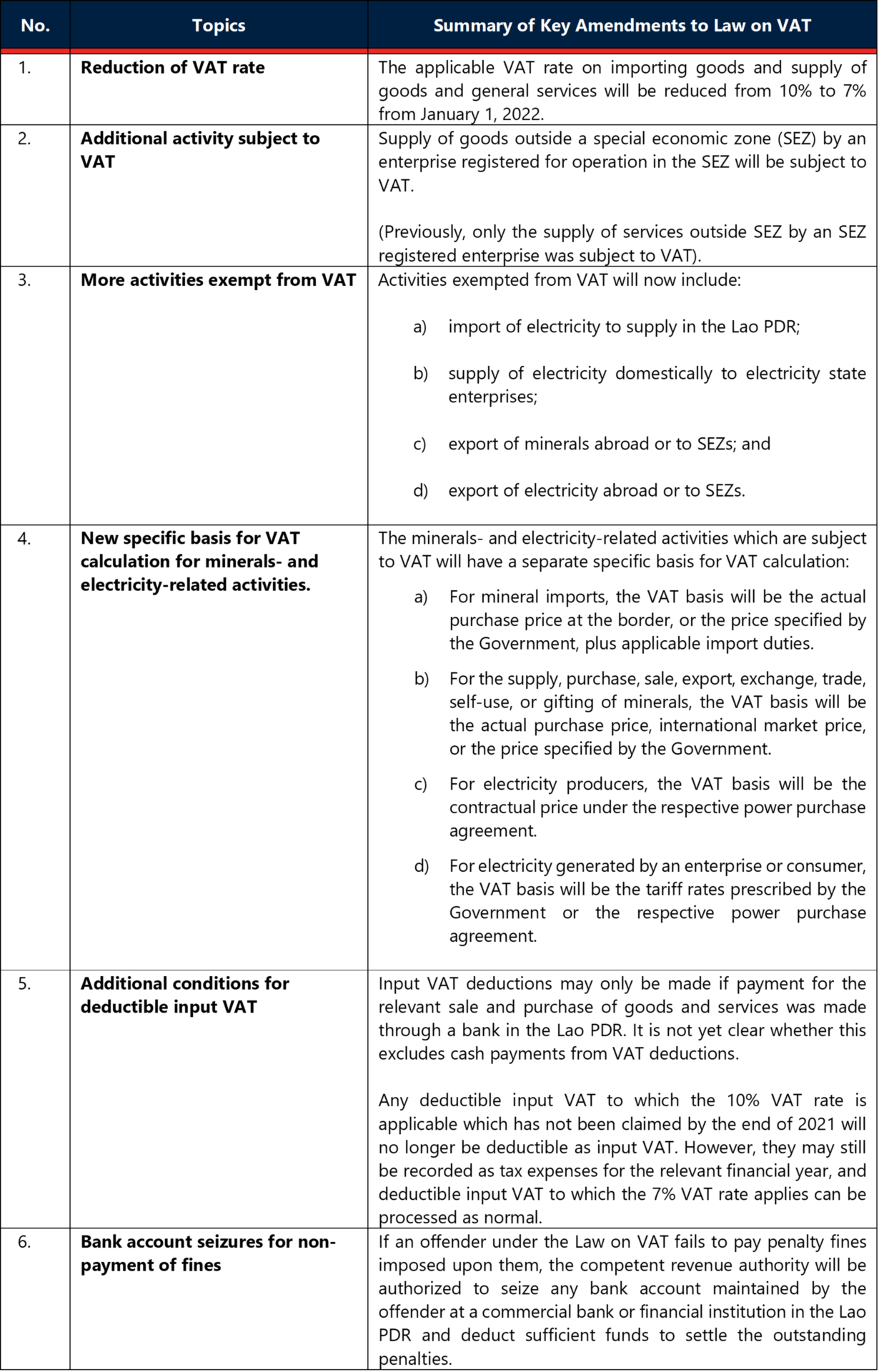
In the last week of December, 2021, the Ministry of Justice published the Law Amending Certain Provisions of the Laws on Tax No. 01/NA, dated August 7, 2021, in the Government Gazette. The Law will come into force on January 1, 2022.

The most notable amendments relate to Value Added Tax (VAT), which are summarized below.

The new law also makes changes to the laws on tax management, income tax, and excise tax, which Tilleke & Gibbins will provide updates on in due course.

RELATED INSIGHTS​ 

November 26, 2025
On November 21, 2025, Myanmar’s Ministry of Commerce (MOC) issued Notification No. 103/2025 promulgating the Geographical Indication Rules (GI Rules), establishing a comprehensive framework for the registration and administration of geographical indications (GI), which are primarily governed by the Trademark Law of 2019. On the same day, the MOC released Notification No. 104/2025 specifying the required forms for GI-related matters. The GI Rules establish a comprehensive set of procedures for the entire GI application process, including filing applications, oppositions, cancellations, and invalidations, and appointing a local representative for GI-related matters. Under the Trademark Law and the GI Rules, domestic and foreign legal entities (organizations) that formally represent a defined group of stakeholders (such as producers or manufacturers of natural products or resources, agricultural products, handicrafts, or industrial products) and other competent authorities from government departments are eligible to apply for GI registration with the Intellectual Property Department (IPD) in Myanmar. Application A GI application can be submitted in either English or Myanmar language electronically, in person, or via post. Foreign applicants seeking to register a GI in Myanmar are required to submit a copy of the registration certificate from their country of origin with the GI application. This certificate must explicitly state the GI name of the protected product. Notably, foreign applicants are mandated to appoint a local representative in Myanmar to act on their behalf for GI-related matters with the IPD and appeal-related matters with the IP Agency. The form for appointing the local representative must be duly notarized in the applicant’s home country to ensure its legal validity and acceptance in accordance with the GI Rules. Application for Use of GI Logo Pursuant to the GI Rules, any interested individual, local or foreign, may submit an application to the IPD for authorization to use the GI logo,
November 21, 2025
On November 17, 2025, Thailand’s Ministry of Interior introduced significant regulatory changes to make rooftop solar adoption easier and more cost-effective for property owners. Ministerial Regulation No. 72 B.E. 2568 (2025), issued under the Building Control Act B.E. 2522 (1979), was published in the Government Gazette on November 19, 2025, with immediate effect. Background Under the Building Control Act (BCA), any alteration made to a building requires either notification of the relevant authority or application for a building alteration permit—unless the alteration falls under a separate list of exceptions specified in the ministerial regulations issued under the BCA. In 2015, installation of solar rooftops on any residential building under 160 square meters was added to this list of exceptions, subject to inspection and notification requirements. The newly enacted regulation now eliminates many of these requirements and introduces a broader and more permissive framework to promote solar adoption nationwide. Key Changes Specifically, the regulation introduces three major changes: Expanded exemption from the definition of “building alteration”: The installation of solar panels on any building roof—regardless of the type of building or the total area of the installation—is no longer considered a building alteration under the BCA, provided that the total weight of the installation does not exceed 20 kg/m2. Removal of structural integrity certification requirement: The new regulation eliminates the obligation to obtain a structural stability certificate from a licensed civil engineer. Removal of notification requirement: Property owners or possessors are no longer required to notify the local authority before installation of a solar rooftop. Impact This significant streamlining of requirements for solar rooftop installation is expected to accelerate the adoption of renewable energy in the country, particularly for residential and commercial properties—similar to the way Thailand’s December 2024 removal of licensing requirements for factory solar rooftop installations encouraged such
November 13, 2025
Tilleke & Gibbins has contributed the Thailand chapter to Franchise 2026, part of the International Comparative Legal Guides (ICLG) series published by Global Legal Group. This annual guide offers comparative analysis of franchise laws and regulations across jurisdictions worldwide, providing practical insights for businesses and legal practitioners operating in the global franchise sector. Each country chapter in the 12th edition follows a Q&A format covering key aspects of franchise law and operations, including: Relevant legislation and rules governing franchise transactions Business organization options for franchised operations Competition law considerations Protection of intellectual property and brands Liability issues and risk mitigation Governing law and dispute resolution Real estate matters Online trading regulations Termination requirements Joint employer risks and vicarious liability Currency controls and taxation Commercial agency considerations Good faith obligations and fair dealing requirements Ongoing relationship management Franchise renewal processes Franchise migration procedures Sustainability commitments Electronic signatures and document retention Current developments in the franchise sector The Thailand chapter, authored by Alan Adcock and Kasama Sriwatanakul, provides an in-depth overview of the legal landscape for franchising and franchising-related activities in Thailand. The complete Thailand chapter is available as a PDF below. The Thailand chapter—and the full Franchise 2026 guide—are also freely available on the ICLG website.
November 12, 2025
Thailand’s Customs Department has announced the cancellation of the longstanding de minimis exemption, which waives import duties on goods valued at THB 1,500 or less, as of January 1, 2026. This policy shift will directly impact e-commerce, logistics, and retail sectors, and will have wide-ranging implications for any company involved in cross-border trade with Thailand. Background Under current regulations, imported goods with a customs value (cost, insurance, and freight, or “CIF”) of THB 1,500 or less are exempt from import duties. This has been a cornerstone of the cross-border e-commerce model, allowing for the duty-free import of millions of small parcels. Under the new policy effective January 1, 2026, all imported goods, regardless of value, will be subject to assessment for import duties upon entry into Thailand. The stated rationale for this change is to create fair competition for Thai small and medium-sized enterprises (SMEs), which must pay VAT and other costs on their goods, putting them at a price disadvantage against foreign sellers who utilize the de minimis loophole. Business Implications This policy change will create new costs, compliance burdens, and operational challenges. For foreign e-commerce sellers and platforms: The most direct impact will be the addition of import duties to low-value items. Assuming the costs are passed on to the consumer, the higher prices and potentially more complex or slower customs clearance processes could lead to increased cart abandonment and reduced consumer demand. Businesses should review their pricing models and develop a clear strategy for calculating, declaring, and paying these new duties. For logistics providers and customs brokers: The administrative burden will be considerable. Carriers that previously handled millions of nondutiable parcels will now be required to process them for duty assessment and collection. This may necessitate new IT systems and streamlined processes to avoid delays at