You are using an outdated browser and your browsing experience will not be optimal. Please update to the latest version of Microsoft Edge, Google Chrome or Mozilla Firefox. Install Microsoft Edge

December 31, 2021

VAT Reduced to 7% under Amendments to Lao Tax Laws

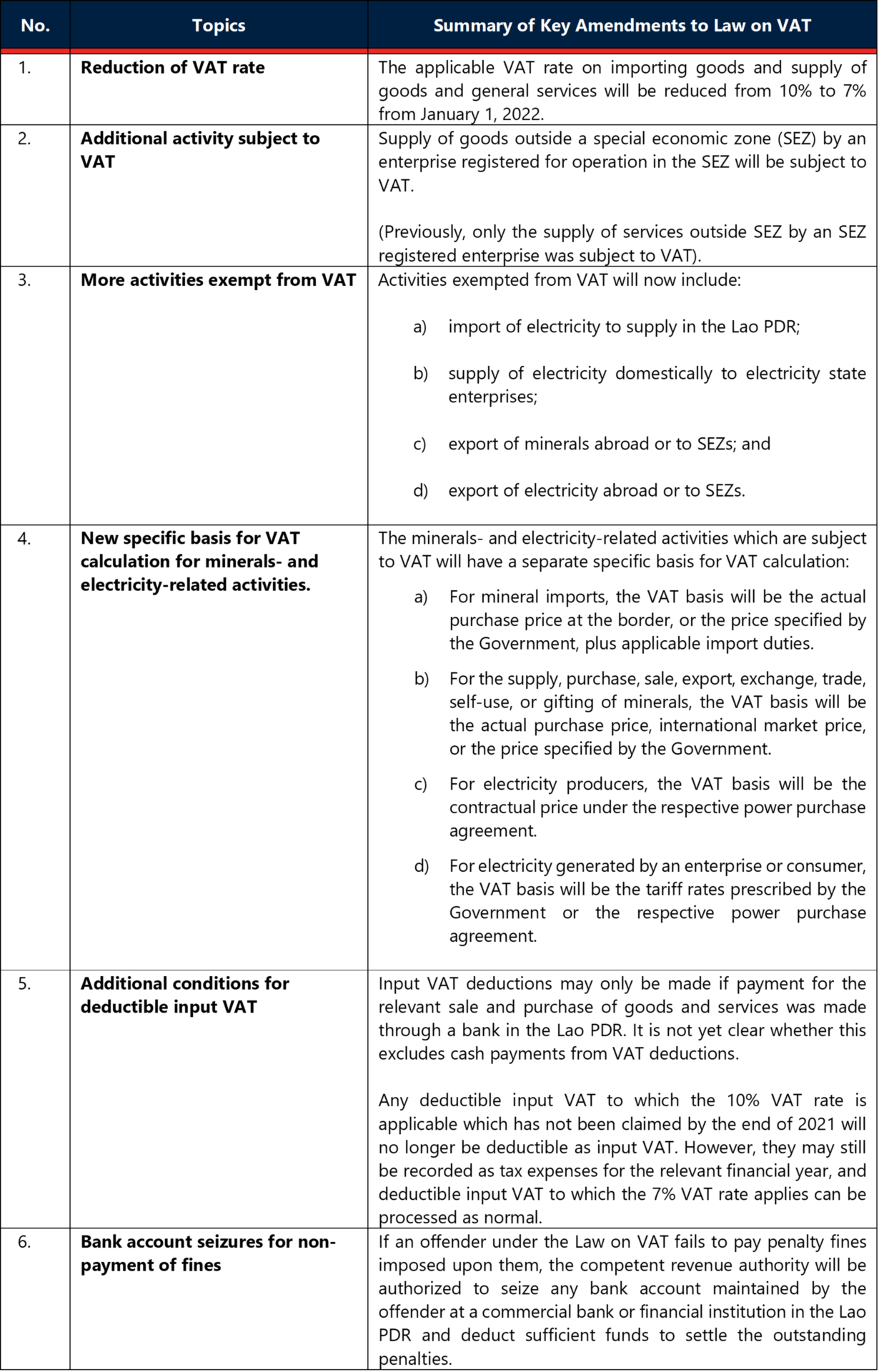
In the last week of December, 2021, the Ministry of Justice published the Law Amending Certain Provisions of the Laws on Tax No. 01/NA, dated August 7, 2021, in the Government Gazette. The Law will come into force on January 1, 2022.

The most notable amendments relate to Value Added Tax (VAT), which are summarized below.

The new law also makes changes to the laws on tax management, income tax, and excise tax, which Tilleke & Gibbins will provide updates on in due course.

RELATED INSIGHTS​ 

January 12, 2022
Thailand’s Board of Investment (BOI) recently published BOI Notification No. Sor. 8/2564, which extends the scope of investment promotion covering electronic vehicle (EV) industry manufacturers to include the production of “automotive platforms” for electric vehicles, and creates a new category of BOI promoted activities covering the manufacture of electric bicycles (E-bikes). Automotive Platforms The following investment promotion categories have been extended: 4.24 – Manufacture of Battery Electric Vehicles 4.26 – Manufacture of Electric Battery Tricycles 4.27 – Manufacture of Electric Battery Busses and Trucks These categories now include the manufacture of “automotive platforms”—which must include an energy storage system, charging module, and front and rear axle module—benefiting from similar tax incentives and subject to additional conditions, as detailed below. New BOI Promotional Category for E-Bike Production The BOI has also introduced a new category, No. 4.28, covering the manufacture of E-bikes. Projects under this category will be eligible for a three-year CIT exemption with an additional one-year exemption if certain criteria are met. Applications for this category must cover the manufacture of E-bikes, the manufacture or sourcing of electric batteries, and a management plan for used batteries. In addition to the general conditions for EV projects (industrial standards, manufacturing timelines, etc.), the BOI has also imposed the following conditions specific to E-bike projects: E-bike frames must be produced from light-weight materials such as aluminum alloy, chromium–molybdenum alloy steel (chrome moly), titanium alloy, and carbon fiber; and E-bike batteries must adopt environmentally-friendly technology. Interestingly the BOI allows E-bike production lines to jointly use manufacturing lines for ordinary bicycles. However, the sale of ordinary bicycles is regarded as non-BOI-promoted income and will not be entitled to BOI tax incentives. These new provisions, intended to stimulate both local and foreign investments in the electric automotive industry, seem to complete the BOI promotion
January 12, 2022
The popularity of the franchise business model has grown rapidly in mainland Southeast Asia in recent years, with some of the world’s top brands becoming common sights in the commercial districts and shopping malls of major regional cities in Cambodia, Laos, Myanmar, Thailand, and Vietnam. Although these countries have not yet enacted franchising-specific laws, certain features of each country’s regulatory regime impact franchising. As such, well-prepared franchise business operations have comfortably adapted to each country’s regulatory framework, and the growth is poised to continue even as the global retail sector redesigns and redoubles its efforts in the wake of the COVID-19 pandemic. In fact, the franchise business model, which is both global and local at the same time, may offer retail entrepreneurs a solution in their quest to meet the challenges of the new retail economic realities. This article explains the legal frameworks that impact the franchise business model in Cambodia, Laos, Myanmar, Thailand, and Vietnam. For each country, this article discusses relevant regulatory considerations for franchise agreements, how to protect intellectual property rights, and judicial and arbitral procedures for resolving disputes that might arise between a franchisor and a franchisee. The full article can be downloaded through the button below.   © 2021. Originally published in the Franchise Law Journal, Vol. 41, No. 2, Fall 2021, by the American Bar Association. Reproduced with permission. All rights reserved. This information or any portion thereof may not be copied or disseminated in any form or by any means or stored in an electronic database or retrieval system without the express written consent of the American Bar Association or the copyright holder.
November 24, 2021
Attorneys from Tilleke & Gibbins have provided the latest update to the Thailand contribution to Doing Business in…, a Q&A-style guide published by Thomson Reuters Practical Law that presents an overview of the legal framework for doing business in 63 jurisdictions worldwide. The Thailand chapter of the guide outlines Thailand’s legal system and key laws applicable to foreign companies doing business in the country. The chapter specifically covers the following main topics: Legal system: Thailand’s court system and codified legal system. Foreign investment: Lists of reserved business activities, restrictions on doing business with certain jurisdictions, exchange controls and currency regulations, and grants and incentives available to investors. Business vehicles: Ordinary partnerships, registered ordinary partnerships, limited partnerships, private limited companies, and public companies. Environment: Main laws and regulations, factory operation. Employment: Laws, employment contract requirements, work permits, and termination and redundancy. Tax: Taxes on employment, tax and nontax resident employees and businesses, corporate income tax, value added tax, special business tax, municipal tax, stamp duty, dividends, interest, intellectual property royalties. Competition: Important aspects of Thailand’s regulatory regime surrounding competition, centered around the updated Trade Competition Act. Antibribery and corruption: Laws, compliance requirements, regulatory authority. Intellectual property: Patents, trademarks, registered and unregistered designs, and copyright. Marketing agreements and advertising: Regulation of marketing agreements, Thailand’s Consumer Protection Act, direct marketing, role of the Consumer Protection Board and Food and Drug Administration. E-commerce: E-commerce laws and regulations, marketing and sales via online platforms. Data protection: An outline of Thailand’s Personal Data Protection Act. Product liability: Procedures and regulations for product liability and product safety, including the Unsafe Goods Liability Act and the Consumer Case Procedure Act. Product liability: Key regulatory authorities for trade competition, environmental issues, and financial services. To browse, download, or print the Thailand chapter, please visit the Practical Law website.

October 26, 2021
Parallel imports—branded goods imported into a domestic market and sold there without the consent of the intellectual property (IP) owner—pose a unique challenge for IP owners. In contrast to counterfeit goods, parallel imported goods are manufactured by or under the license of the IP owner and formulated or packaged for a particular jurisdiction and then imported into a different jurisdiction without the authorization of the IP owner. Intellectual property laws and perspectives on parallel import vary throughout Southeast Asia. The distinct legal landscape in each nation should be carefully navigated in consultation with legal experts to ensure brand protection to the fullest degree. This guide provides insight into the legal frameworks relating to parallel imports in Cambodia, Indonesia, Laos, Myanmar, Thailand, and Vietnam. Each section examines the relevant laws and regulations that pertain to parallel imports and explores the remedies available to IP owners in each country. Finally, the guide presents some strategies to combat parallel importation and maximize IP protection in Southeast Asia. The full guide can be downloaded through the button below.   This guide was prepared with the assistance of Tilleke & Gibbins interns Christian Pederson and Keoni Williams.