You are using an outdated browser and your browsing experience will not be optimal. Please update to the latest version of Microsoft Edge, Google Chrome or Mozilla Firefox. Install Microsoft Edge

December 31, 2021

VAT Reduced to 7% under Amendments to Lao Tax Laws

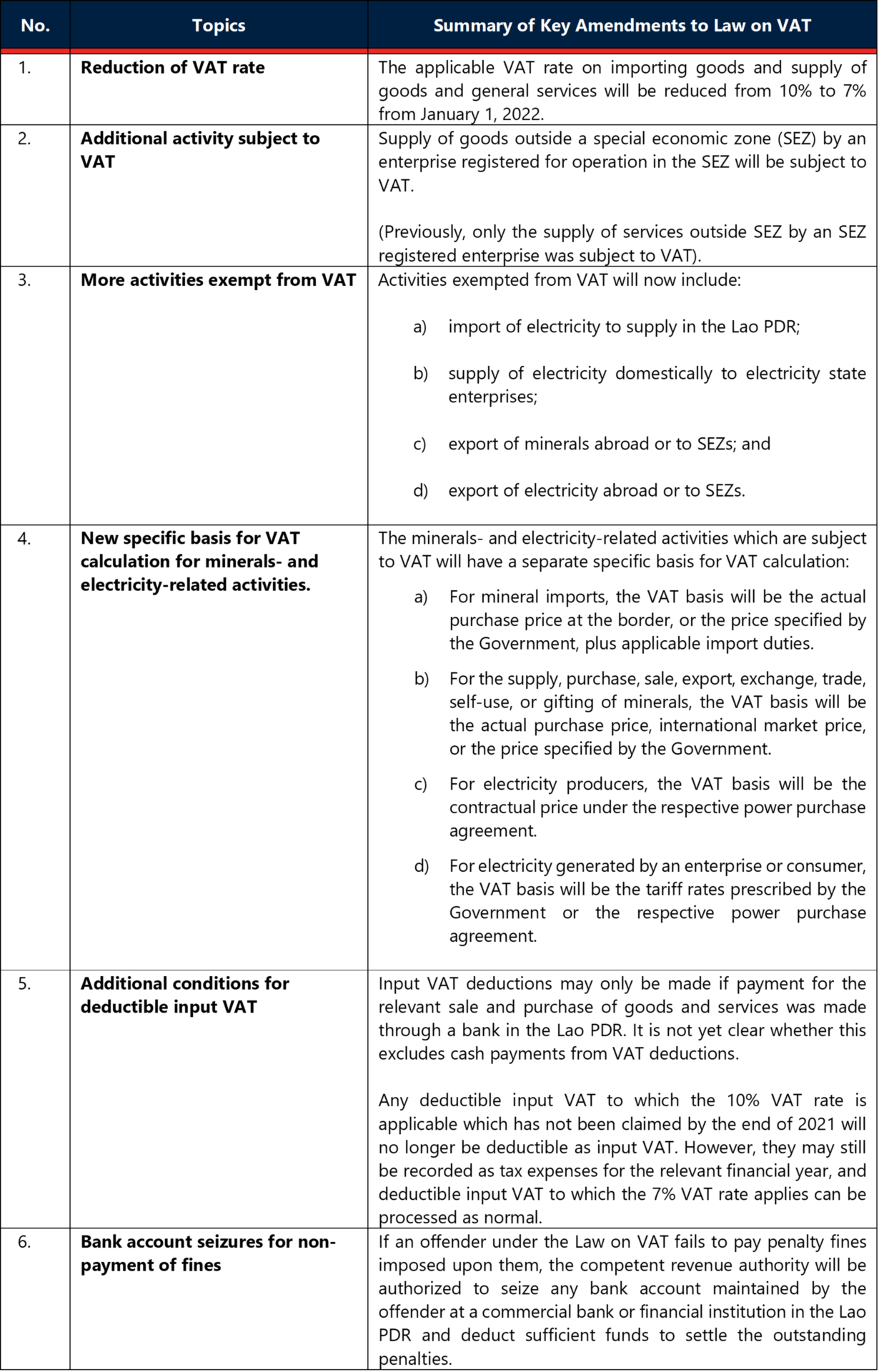
In the last week of December, 2021, the Ministry of Justice published the Law Amending Certain Provisions of the Laws on Tax No. 01/NA, dated August 7, 2021, in the Government Gazette. The Law will come into force on January 1, 2022.

The most notable amendments relate to Value Added Tax (VAT), which are summarized below.

The new law also makes changes to the laws on tax management, income tax, and excise tax, which Tilleke & Gibbins will provide updates on in due course.

RELATED INSIGHTS​ 

September 15, 2022
In the course of our work, we often hear about consumers in Thailand lodging complaints with the Office of the Consumer Protection Board (OCPB) about problems with a purchased product or service. The OCPB is a government agency attached to the Office of the Prime Minister. Its main duties are to protect consumers in Thailand with respect to product advertising, product labeling, and contracts, and to handle consumer complaints. However, there are exceptions to the types of consumer complaints that the OCPB can handle. This is because some consumer complaints must by law be handled by certain specialized agencies. Examples of these exceptions include consumer complaints relating to: health products (food, drugs, cosmetics, medical devices, household dangerous substances, and narcotics); medical services; insurance; pricing of consumer products; condominium juristic person; public land; rail, water, and air transportation; tourism; education; banking and finance; telecommunications; and electricity and water consumption. Procedure When a consumer complaint that the office can accept comes to the OCPB, the officers first consider whether the business operator has violated any laws, in which case the relevant authorities, such as the police, should handle the matter. When the officers consider it appropriate, they may ask the parties to mediate the dispute. Complaints in Bangkok are mediated by officers at the Bangkok OCPB. For complaints lodged in other provinces, the governors of the provinces may assign officers or agencies under their supervision to mediate. The OCPB can mediate twice within 90 days. If the parties still want to continue with the mediation, a subcommittee of the Consumer Protection Board (CPB)—the body that directs the OCPB—will then conduct two more mediation sessions within 90 days. If a resolution is still not reached, the subcommittee can conduct one additional mediation session before declaring the mediation failed and ending the complaint

August 31, 2022
Thailand’s Draft Climate Change Act Countries around the world have given significant attention to climate change legislation, with many national, regional, and global attempts to slow the momentum of climate change. The most notable of these multilateral efforts is the Paris Agreement, a legally binding international treaty on climate change currently adopted by 193 parties. Its goal is to limit the global average temperature to well below 2°C (preferably below 1.5°C) above preindustrial levels, and the treaty’s coordinated efforts to combat climate change are much more ambitious than previous global agreements and discussions. Article 4 of the Paris Agreement requires countries to provide “nationally determined contributions” (NDCs), consisting of their action plans for climate action. Thailand, as a party to the Paris Agreement, has put forth an NDC that pledges to achieve an unconditional greenhouse gas (GHG) emission reduction target of 20% from the business-as-usual projection for 2030, with the possibility of increasing that target to 25% subject to adequate and enhanced access to technology development and transfer, financial resources, and other support. To enable the accomplishment of this pledge, Thailand is looking to enact climate change legislation that functions as a key mechanism for domestic climate action. In 2018, the Office of Natural Resources and Environmental Policy and Planning (ONEP) under the Ministry of Natural Resources and Environment was assigned to prepare a draft Climate Change Act. The draft is now complete, and according to news reports it is set to be submitted to the cabinet for further consideration. The draft Climate Change Act lays out Thailand’s action plan for climate change mitigation and adaptation, including emissions reductions. Some of the key sections in the draft law involve citizen rights, the National Climate Change Policy Committee, and a national GHG database. Rights of Citizens The draft establishes the
August 26, 2022
Thailand’s Board of Investment (BOI) has extended its previously announced period for reduction of import duty on imported raw and essential materials for battery manufacturing for electric vehicles and other applications. The BOI’s announcement No. 5/2565 dated August 8, 2022, extended the reduction period to a maximum of five years. The BOI’s promoted activities list includes two battery-manufacturing business activities: Activity 4.8.3.1 – Battery manufacturing Activity 5.2.6.1 – High energy density battery manufacturing Qualifying battery manufacturers who have cell or module manufacturing processes are eligible for 90% import duty reductions on raw and essential materials that cannot be produced in Thailand. These reductions will be available on an annual basis, and are renewable for five years in total—up from the original two years. Existing projects (i.e., those which have the original two-year duration in their BOI certificate) can also benefit from the extension by preparing a project amendment form, along with a clarification letter and supporting documents, for submission to the BOI office. For more details on these customs duty reductions, or on any aspect of investment promotion in Thailand, please contact Charuwan Charoonchitsathian at [email protected] or +66 2056 5657, or Napassorn Lertussavavivat at [email protected] or +66 2056 5662.
August 16, 2022
On July 21, 2022, Vietnam’s Ministry of Industry and Trade (MOIT) submitted Report No. 126/BC-BCT to the Prime Minister regarding the mechanism for transitional wind and solar power projects. In this report, the MOIT proposed some recommendations to explicitly address difficulties for outstanding wind and solar power projects (“Transitional Projects”) which have been developed under the Prime Minister’s Decision No. 13/2020/QD-TTg dated April 6, 2020, on the development of solar power projects (Decision 13) and Decision No. 37/2011/QD-TTg dated June 29, 2011, on the development of wind power projects (Decision 37), as amended by Decision No. 39/2018/QD-TTg dated September 10, 2018 (Decision 39). The Transitional Projects primarily include those which have completed construction but have not yet been put into operation, and those which have been put into operation but for which the power price has not yet been decided, due to missing the deadline set forth under the aforementioned decisions to be eligible for the feed-in-tariff (FIT). In particular, the MOIT has proposed the following key recommendations to the Prime Minister: Mechanism for Transitional Projects The MOIT proposes two options: Option 1: Developers of the Transitional Projects negotiate and sign power purchase agreements (PPA) with Vietnam Electricity (EVN) within the price framework issued by the MOIT in accordance with the Law on Electricity, the Law on Prices, and their subordinate guiding legislation; or Option 2: The Prime Minister formulates a new decision specifying the mechanism for bidding on the purchase of power produced by the Transitional Projects, estimated to be implemented for the time limit of three years and within the price framework issued by the MOIT. Mechanism for future wind and solar power projects The MOIT proposes to apply the mechanism that developers of future wind and solar projects negotiate the power price and sign the PPA