You are using an outdated browser and your browsing experience will not be optimal. Please update to the latest version of Microsoft Edge, Google Chrome or Mozilla Firefox. Install Microsoft Edge

December 31, 2021

VAT Reduced to 7% under Amendments to Lao Tax Laws

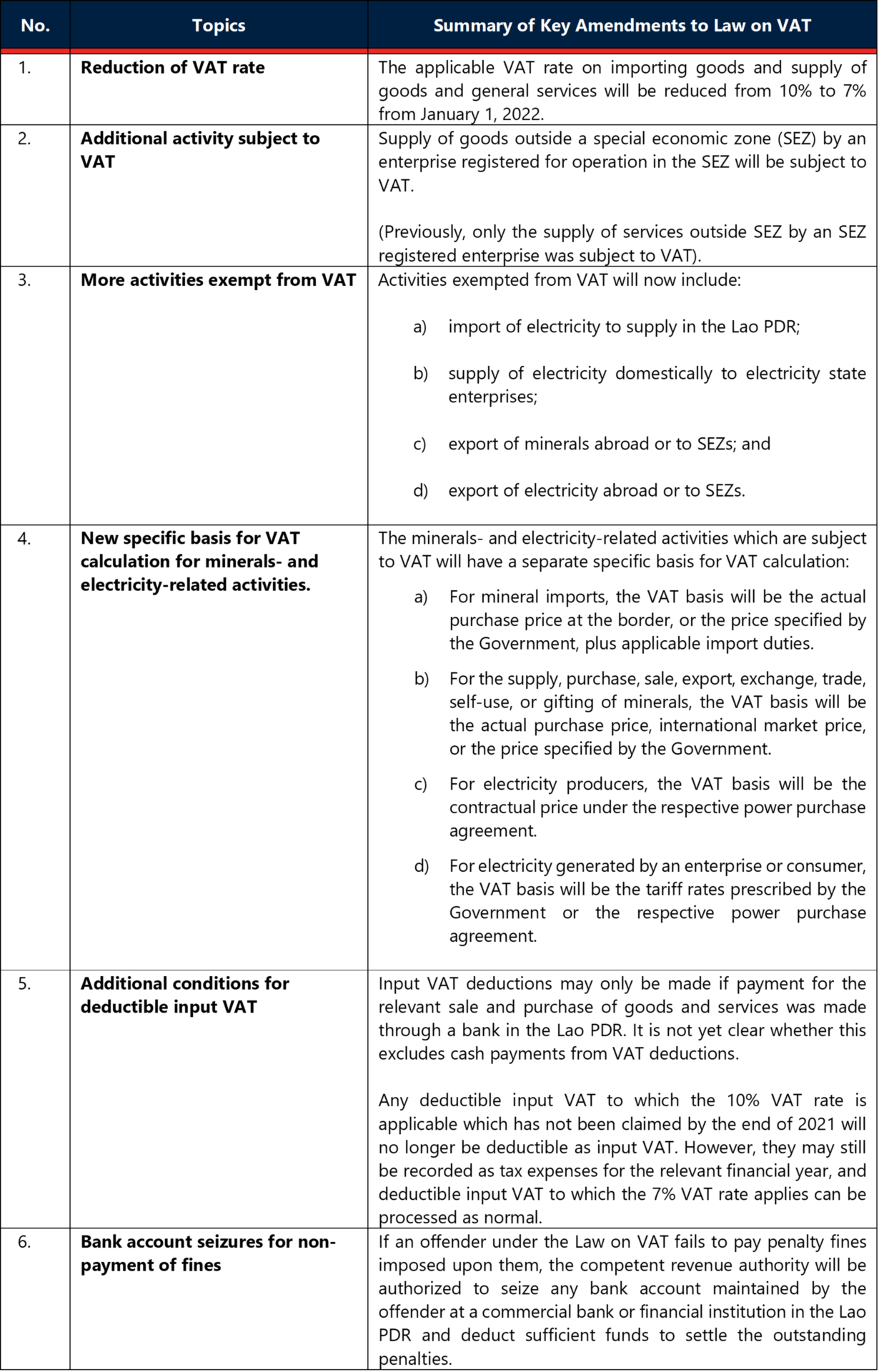
In the last week of December, 2021, the Ministry of Justice published the Law Amending Certain Provisions of the Laws on Tax No. 01/NA, dated August 7, 2021, in the Government Gazette. The Law will come into force on January 1, 2022.

The most notable amendments relate to Value Added Tax (VAT), which are summarized below.

The new law also makes changes to the laws on tax management, income tax, and excise tax, which Tilleke & Gibbins will provide updates on in due course.

RELATED INSIGHTS​ 

June 4, 2024
As Vietnam continues its rapid economic development, the demand for sustainable and reliable energy sources has never been more critical. Solar power has emerged as a key component of Vietnam’s strategy to diversify its energy portfolio and reduce its carbon footprint. Recent developments of the regulatory framework governing solar power projects in Vietnam, as discussed below, highlight the country’s commitment to renewable energy and its efforts to create a conducive environment for solar power investments. Objectives for the Development of Solar Power Projects On May 15, 2023, the Prime Minister issued Decision No. 500/QD-TTg, approving the National Power Development Plan for 2021-2030 with a vision to 2050 (“PDP VIII”). Following this, on April 1, 2024, the Prime Minister promulgated the Implementation Plan for PDP VIII (“Implementation Plan”). These documents underscore Vietnam’s commitment to promoting renewable energy, particularly solar. They emphasize self-production and self-consumption of solar power, the development of rooftop solar systems, and the promulgation of the direct power purchase mechanism. The integration of solar power with battery storage is also encouraged, contingent upon economic viability. PDP VIII sets ambitious capacity targets for solar power. By 2030, the capacity is projected to reach approximately 12,836 MW, accounting for 8.5% of the total power capacity. This includes 10,236 MW from concentrated solar power and 2,600 MW from self-production and self-consumption solar power. By 2050, the capacity is expected to rise to between 168,594 MW and 189,294 MW, representing 33.0-34.4% of the total power capacity. Additionally, PDP VIII and the Implementation Plan list 27 solar power projects, totaling 4,136.25 MW, slated for implementation after 2030. However, these projects may be advanced under self-production and self-consumption arrangements. Draft Decree on Direct Power Purchase Agreements On April 15, 2024, the Ministry of Industry and Trade (“MOIT”) released a draft decree on direct power

June 3, 2024
Nearly a year after Vietnam’s issuance of its National Power Development Plan for 2021-2030, with a vision to 2050 (“PDP VIII”), the Prime Minister issued Decision No. 262/QD-TTg dated April 1, 2024, approving the Implementation Plan for PDP VIII (“Implementation Plan”). Among other contents, the Implementation Plan sets forth the list of prioritized power source projects through 2030, and the capacity of renewable energy sources through 2030, as detailed below. Prioritized Power Source Projects through 2030 The Implementation Plan lists out six types of power source projects prioritized for development through 2023 according to the capacity approved under PDP VIII. They include: Domestic gas-fired power (14,930 MW) LNG-fired power (22,400 MW) Coal-fired power (30,127 MW) Cogeneration power using residual heat, blast furnace gas, and by-products of technological lines in industrial facilities (2,700 MW) Hydropower (29,346 MW) Pumped storage hydropower (2,400 MW) With respect to each type, the Implementation Plan provides details of projects by location and their operational progress. Such information is set out in Schedule III of the Implementation Plan. For power source projects not included in this list, the provincial People’s Committees will consult with the Ministry of Industry and Trade (“MOIT”) and relevant agencies on compliance with the planning prior to appraisal and issuance of in-principle investment approval. Renewable Energy Projects through 2030 The Implementation Plan allocates the capacity of the following renewable energy sources by locality/region: Offshore wind power (6,000 MW) Onshore wind power (21,880 MW) Hydroelectric power (29,346 MW) Biomass electricity (1,088 MW) Electricity produced from waste (1,182 MW) Rooftop solar power for self-production and self-consumption (2,600 MW) Battery storage (300 MW) With respect to each renewable energy source, the Implementation Plan provides a list of certain renewable energy projects through 2030, including the expected life cycle of the projects, and the allocated capacity
April 29, 2024
On November 4, 2021, Cambodia’s Ministry of Mines and Energy (MME) issued a Prakas No. 0305 on Management of the Steam Energy Subsector within the Energy Sector. The prakas aims to regulate steam energy operations, and requires companies wishing to develop, build, install, or operate steam energy to apply for a steam energy license. As this is the first prakas regulating steam energy operations in Cambodia, all relevant companies operating in steam energy must apply for a steam energy license with the MME. Prakas 0305 discusses permits for three types of activities: Development, Construction, Installation, and Operation of Steam Energy. Companies wishing to develop, build, install, and operate steam energy production facilities must first apply for a permit from the MME. Steam Energy Service Provision. Companies wishing to develop, build, install, and operate steam energy for the purpose of supplying steam energy to consumers must apply for a permit for steam energy service provider in addition to a permit for development, construction, installation, and operation of steam energy. Two-in-One Steam Energy and Electricity Production. Companies wishing to develop and operate both steam energy and electricity production activities must also apply for a permit for two-in-one steam energy and electricity production. Companies operating without the necessary permits are subject to a daily fine of KHR 400,000–4,000,000 (approx. USD 100–1,000). In addition, they may face other penalties, including: An order to halt business activities; Permit suspension; Permit revocation; Judicial action; and Other legal measures as the MME deems fit. For more information on regulations and requirements for steam energy licenses in Cambodia, please contact Tilleke & Gibbins at [email protected].
March 25, 2024
Attorneys from Tilleke & Gibbins in Vietnam have provided an updated Vietnam chapter for Fashion Law 2024, a guide to law surrounding the business of fashion in jurisdictions around the world. The guide, which covers 20 key jurisdictions in the global fashion industry, offers insights into local legal frameworks for a range of issues, such as brand enforcement and protection, e-commerce and marketing, and sustainability. The Vietnam chapter of Fashion Law 2024 provides detailed information on the following topics: Main intellectual property rights for fashion products Contractual arrangements in manufacturing, distribution, and advertising Regulations and enforcement of online marketing Unfair competition rules and judicial interpretation Specific regulations on sustainability and ESG in fashion Special import and export rules for fashion products The full Vietnam chapter is available for free through the button below and on the Global Legal Post website. Tilleke & Gibbins also contributed the Thailand chapter to the guide.