You are using an outdated browser and your browsing experience will not be optimal. Please update to the latest version of Microsoft Edge, Google Chrome or Mozilla Firefox. Install Microsoft Edge

December 31, 2021

VAT Reduced to 7% under Amendments to Lao Tax Laws

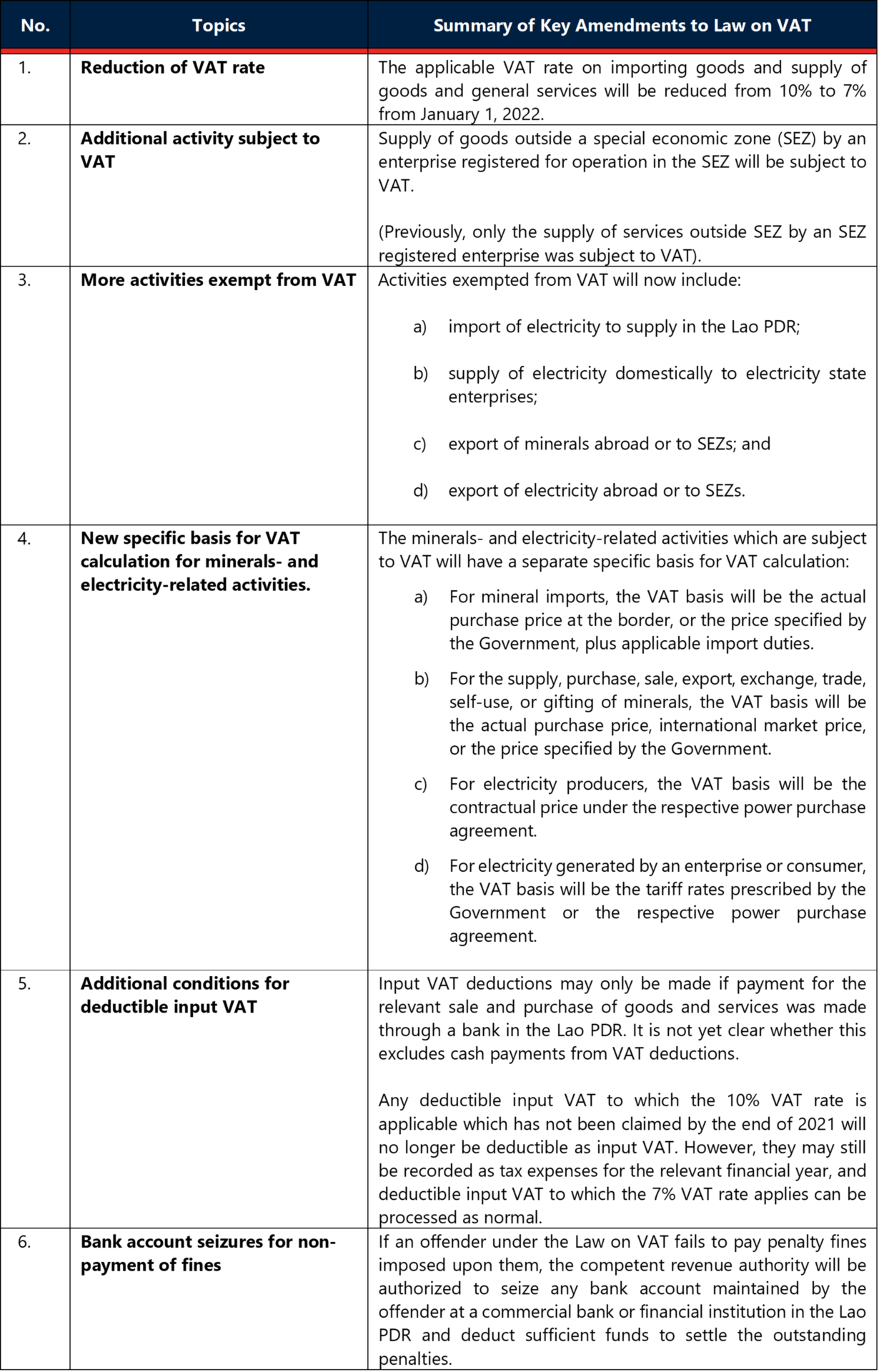
In the last week of December, 2021, the Ministry of Justice published the Law Amending Certain Provisions of the Laws on Tax No. 01/NA, dated August 7, 2021, in the Government Gazette. The Law will come into force on January 1, 2022.

The most notable amendments relate to Value Added Tax (VAT), which are summarized below.

The new law also makes changes to the laws on tax management, income tax, and excise tax, which Tilleke & Gibbins will provide updates on in due course.

RELATED INSIGHTS​ 

January 23, 2025
In 2023, compliance inspections by Vietnam’s Government Inspectorate identified several violations of policies and laws in the management and implementation of planning and investment in renewable energy projects. Since then, many renewable energy enterprises and projects have encountered significant operational challenges. In December 2024, the Ministry of Industry and Trade (MOIT) issued two reports, Report 321/BC-BCT and Report 345/BC-BCT, to implement the 2023 Inspection Conclusion of the Government Inspectorate and address obstacles faced by renewable energy enterprises, Investors in renewable energy projects in Vietnam should carefully consider the potential impacts of proposed solutions in these reports. The reports re-emphasize the types of violations related to renewable energy projects identified in the Inspection Conclusion, with a significant expansion in the number of affected projects. Key violations include: (i) misapplication of FIT (feed-in tariff) incentives; (ii) recognition of COD (commercial operation date) and receipt of FIT prices without written approval of construction acceptance; (iii) overlap with mineral planning, irrigation planning, national defense land use, or other restricted land uses; (iv) incomplete land procedures and documentation; and (v) installation of rooftop solar on agricultural and forestry land used for farming and aquaculture models. Further, these reports mention the government’s solutions to resolve difficulties for renewable energy projects, which include: Allowing additional planning where projects do not violate national security. Allowing rectification of projects’ violations in land and construction process as per law. For projects violating planning on minerals, irrigation, or defense, socio-economic efficiency will be assessed for adjustments or integration. Adjusting electricity prices and recovering incorrect FIT prices for projects not meeting conditions. Requiring rooftop solar projects on non-farming land to comply with regulations or, if land violations occur, FIT prices will be revoked, and electricity prices must be redetermined and recovered. For items (iv) and (v), the authority will issue regulations

January 14, 2025
Thailand’s Department of Industrial Works (DIW) has issued a new regulation (Ministerial Regulation Re: Designation of Type, Kind, and Size of Factories (No. 3) B.E. 2567 (2024)), which removes the factory license requirement for electricity generation from solar energy installations on rooftops, roof decks, or any part of a building used for residential or other purposes, regardless of capacity. The new rules took effect on December 28, 2024. Under the previous regulations, solar rooftop installations had to seek approval from the DIW if their capacity exceeded 1,000 kW (1 MW), which added time and administrative costs when adopting renewable energy solutions. Benefits and Further Compliance The updated regulation benefits industrial operators by facilitating faster installation times and lower costs, as solar rooftops can now be installed without the need for prior approval of a factory license from the DIW. Operators can now more easily contribute to environmental sustainability and carbon reduction efforts. Despite the lifting of the factory licensing requirement, other compliance obligations, such as an energy business license (or exemption from an energy business license), a controlled energy production license, and a construction permit, may still apply. Reason for the Change Removing the classification of rooftop or building-installed solar power plants as factories aligns with Thailand’s renewable energy goals and reduces regulatory burdens for industrial operators. Additionally, it supports the achievement of energy policies aligned with the UN’s Sustainable Development Goals and Thailand’s international commitments to reduce greenhouse gas emissions through the participation of all sectors. For further details on how this change affects business operations or to explore strategies for renewable energy implementation, please contact Supasit Boonsanong at [email protected], Charuwan Charoonchitsathian at [email protected], or Phareeya Yongpanich at [email protected].
December 4, 2024
Thailand Legal Basics, a valuable primer for foreign investors, explores all aspects of living and doing business in Thailand. Written by specialists at Tilleke & Gibbins in Bangkok, it is the only comprehensive English-language guide to the Thai legal system with a focus on the concerns of foreign business and investment.
November 18, 2024
A new notification on required labeling and packaging for alcoholic beverages was published in Thailand’s Government Gazette on November 8, 2024, taking full effect the following day. The notification (Notification of the Alcoholic Beverage Control Committee Re: Criteria, Methods, and Conditions for Packaging of Alcoholic Beverages and Warning Statements of Alcoholic Beverages Both Produced Domestically and Imported into Thailand 2024) essentially reaffirms a mandatory requirement for packaging and warning statements for alcoholic beverages, which echoes existing regulations from 2009 and 2017. Under the authority of the Alcoholic Beverage Control Act B.E. 2551 (2008) (ABCA), the notification reinforces the Alcoholic Beverage Control Committee’s objective of promoting consumer awareness through standardized warning labels. The notification addresses the following key aspects: Packaging definitions. The notification defines packing-related terms for the first time under the ABCA. These terms include (1) packaging, (2) containers (also known as primary packaging), and (3) outer packaging (secondary packaging). Packaging requirements. Containers for alcoholic beverages produced or imported for sale in Thailand must be at least 0.175 liters each. Warning statements. Although alcoholic beverages are classified as food under the Food Act B.E. 2522 (1979), the notification exempts alcoholic beverages from general food labeling requirements prescribed in the Food Act. Instead, it mandates that the following warning statements be prominently displayed: Sale of liquor to persons under 20 years old is prohibited; Drinking reduces driving ability; and Not suitable for persons under 20 years old. Format. The notification specifies that these warning statements must be written in Thai, in bold characters, with a minimum type size of five millimeters. The warning must be enclosed in a box that contrasts with the label background and surrounding content. Exemptions. Certain products, such as alcoholic beverages imported as samples or otherwise not intended for commercial sale, are exempt from the warning