
You are using an outdated browser and your browsing experience will not be optimal. Please update to the latest version of Microsoft Edge, Google Chrome or Mozilla Firefox. Install Microsoft Edge

June 5, 2019

Updates on Thailand’s Trademark Registration Practices

Informed Counsel

The current version of Thailand’s Trademark Act came into force on July 28, 2016. The most recent amendments to the trademark laws introduced multiple-class filings, registration of international trademarks, new methods to calculate official fees, and the acceptance of sound marks. What did not change were the formality requirements and the general examination practices of the Thai Trademark Office. Nevertheless, we have recently come across certain issues that require increased scrutiny from trademark owners.

Priority Claiming   

As Thailand is a party to the Paris Convention, a trademark owner’s right to claim the priority date of a trademark application in a foreign country and then file an application for the same trademark in Thailand within six months of that date has remained unchanged. However, we recently learned that a number of priority claim requests have been rejected by the Trademark Office, which was not an issue we had encountered in the past.    

It would be no surprise if the rejection of the priority claim was the result of a failure to submit the required documents, or if it was due to the material differences in the applied marks in the priority applications. This issue caught our attention because the rejections seemed to target word marks filed in plain block letters. It appears that the Trademark Office has been rejecting priority claim requests for all word marks that were filed using even slightly different fonts from those used by the trademarks appearing in the priority applications.   

Examples of such marks that would be rejected in a priority claim might be as follows.
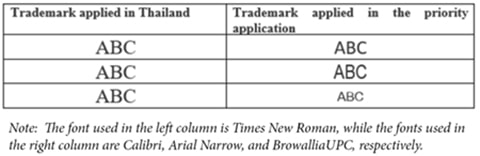
We disagree with this type of rejection and approached the Trademark Office to explain that the marks, as claimed, consist of standard characters, without claiming any particular font style, size, or color. Thus, minor differences between font styles should not be cited as the main reason for rejecting priority claim requests.   

However, we later found that the cause of rejection stems from the Trademark Office’s Internal Guidelines dated 2016, which require that the marks, as claimed, must be identical to the marks in the Thai applications. In particular, for word marks the fonts must be identical. The Internal Guidelines state the criteria for claiming a priority date from a foreign application as follows:

  • Priority application must be stated in the Kor 10 form.
  • The trademark must be the same as set out in the foreign priority application. In this respect, the Registrars are required to examine the primary visual similarities of the marks; e.g., word marks must be in identical fonts.
  • In cases where the trademarks in the foreign applications are in color and the Thai applications contain different colors, the marks are deemed to be the same, except in case of a “group of colors” type of mark.
  • If trademarks applied in foreign applications are Series Marks, and one of the marks in the Series is identical to the trademark applied in Thailand, the two marks are deemed to be the same.
  • The descriptions of goods or services in foreign applications must cover the goods or services listed in the Thai applications.
  • A copy of the priority application must be submitted.
  • Statements certifying that the priority application has never been rejected, withdrawn, or abandoned must be submitted. Such statements must be certified by the trademark owners or their authorized representatives, either within or outside of Thailand.

The Trademark Office’s Internal Guidelines have not been publicly announced, but these Internal Guidelines seem to be used as the basis for rejection of priority claim requests in many cases. Therefore, trademark owners are urged to be aware of this issue and to ensure that when a priority claim is requested, the applicant must strictly comply with these Internal Guidelines.

Multiple-Class Filings   

Since the enactment of the new Trademark Act in 2016, we have always advised our clients who prefer to file multiple-class trademark applications that a problem in one class would delay the whole application, as divisional applications are not allowed in Thailand. This advice remains valid, and we would now like to emphasize that not only will a problem in one class delay the whole application, but it could also result in the rejection of the whole application.   

When a multiple-class trademark application is rejected, the application is rejected in its entirety. The applicant has to appeal with respect to the whole application, even though arguments for some classes may be stronger than other classes, and the Board of Trademarks will issue its decision with respect to the whole application rather than rejecting certain classes and allowing other classes to remain.    

In other words, even if a trademark is descriptive only of certain classes of goods or services, when the Registrar rejects the mark, they usually reject the whole application. Additionally, when the Board of Trademarks issues its decision in an appeal, such decision will target the whole application. We have not yet received a decision by the Board whereby the Board allows only some of the non-affected classes in a multiple-class application to proceed to registration. The Board tends to either accept or reject the application in its entirety, despite there being no official objections targeting some of the classes.    

With this trend of rejecting whole multiple-class applications without allowing divisional applications, trademark owners should consider their risks and may opt to file single-class trademark applications if they anticipate that there might be problem in some but not all classes. On the other hand, if trademark owners anticipate rejection in all classes, filing multiple-class applications would save costs since the appeal for all classes could be filed at the same time.    

We will be closely monitoring these slight and sometimes undisclosed changes in the Trademark Office’s practices, which can have substantial effects on applicants, and will continue to provide timely updates on the trademark registration process in Thailand.

RELATED INSIGHTS​ 

April 30, 2026
Vietnam’s Decree No. 134/2026/ND‑CP, which took effect on 9 April 2026, plays an important role in detailing and implementing Vietnam’s Intellectual Property (IP) Law in the context of rapid digital transformation and the growing application of artificial intelligence (AI). The new decree provides comprehensive guidance on the application of copyright and related‑rights regulations, addressing key issues such as authorship, ownership, statutory exceptions and limitations, registration procedures, and enforcement mechanisms. Through these measures, Decree 134 seeks to achieve an appropriate balance between safeguarding the legitimate interests of rightsholders and fostering innovation, research, and technological advancement, thereby strengthening the state’s framework for the effective management, protection, and exploitation of intellectual property in the digital and AI‑driven environment. Some notable aspects of Decree 134 are discussed below. Copyright for AI-Created Works Decree 134 provides important guidance on the determination of copyright and related rights in works created with the assistance of AI. Article 5a reaffirms the principle that human creativity remains central to copyright protection, clarifying that copyright or related rights arise only where a human makes a substantial and decisive intellectual contribution, exercises effective control over the creative outcome, and assumes responsibility for the content and its legality. At the same time, the provision confirms that AI is regarded solely as a technological tool rather than a rights‑holding subject, thus ensuring consistency with the fundamental concepts of authorship and ownership under the IP Law. By introducing requirements on transparency, proof of human contribution, and compliance with AI‑specific labelling and technical marking obligations, Decree 134 establishes a clear and enforceable legal framework for the responsible use of AI in creative activities. Lawful Use of Copyrighted Texts and Data Article 37a of Decree 134 sets out the specific conditions under which copyrighted texts and data may be lawfully used for scientific research, experimentation,
April 29, 2026
Across the region, local brands have become key drivers of economic growth, cultural identity, and innovation, and Myanmar is no exception. From traditional products and creative industries to modern startups and small and medium‑sized enterprises (SMEs), Myanmar’s local brands are increasingly shaping domestic markets. However, as local brands grow, they also face higher risks of imitation, misuse, and unfair competition. In this context, protecting brand identity, creativity, and innovation through proper intellectual property (IP) strategies is essential to ensure that Myanmar’s homegrown businesses can grow sustainably, compete confidently, and retain the value of what they create. The Key IP Laws for Local Brands In 2019, Myanmar enacted a comprehensive suite of four IP laws, aligning the nation’s IP enforcement framework with international standards. Trademark Law 2019: This law introduced the “first-to-file” system into the country, with trademark rights primarily obtained through registration with the Intellectual Property Department (IPD). Trademarks protect brand names, logos, and other signs that distinguish goods or services. Registration grants the exclusive rights to use the mark and to prevent others from using identical or confusingly similar marks. Each registration lasts for 10 years from the filing date and can be renewed for subsequent 10-year periods. Copyright Law 2019: Copyright, which arises automatically upon creation, protects literary, artistic, musical, and audiovisual works, including software, advertisements, artwork, and social media content. While registration with the IPD is not mandatory under this law, it can be helpful for establishing evidence and supporting any future enforcement. The terms of protection for economic rights associated with copyrights vary depending on the type of work involved. In contrast, the protection for moral rights lasts indefinitely—continuing even after the author’s death. Industrial Design Law 2019: Under this law, any industrial design that is new and independently created can be filed with the
April 21, 2026
Vietnam continues to refine its intellectual property framework to align with the 2025 amendments to the Law on Intellectual Property (IP Law). On March 31, 2026, the government issued Decree 100/2026/ND-CP (Decree 100), which substantially amends Decree 65/2023/ND-CP detailing the implementation of the IP Law (Decree 65). On the same day, the Ministry of Science and Technology released Circular 10/2026/TT-BKHCN (Circular 10), providing detailed procedural guidance and new forms. Both instruments took effect on April 1, 2026, along with the amended IP Law. While the updates touch on every IP right, trademark owners and brand strategists will find several practical and forward-looking changes that directly affect filing strategy, examination timelines, portfolio management, and enforcement readiness. 1. Fast-Track Substantive Examination for Eligible Applications One of the most business-friendly innovations is the new fast-track substantive examination pathway for applications meeting specified eligibility criteria. Successful fast-track applications enjoy a shortened substantive examination period of three months. This offers a significant competitive edge for tech-driven or regulated-sector brands. If the mark is identical or similar to a mark in another person’s trademark application with an earlier filing date in the case of a priority application that has not yet been processed, the fast-track process will return to the ordinary process. However, the law does not touch on cases where marks under fast-track examination face office action due to other reasons (i.e. lack of distinctiveness, confusingly similar to others’ copyright, trade name, industrial design, etc.) 2. AI-Generated Trademarks Receive Clear Protection Pathway Decree 100 explicitly addresses the use of artificial intelligence (AI) in IP creation, amending Article 10a of Decree 65 to confirm that trademarks created with AI systems are fully protectable, provided they meet the standard requirements of registration. Trademarks face no additional “human authorship” hurdle (unlike patents or industrial designs). Brand owners
April 20, 2026
Myanmar’s industrial design registration regime has been steadily gaining momentum since the country officially began accepting applications under the Industrial Design Law of 2019. The Industrial Design Division of Myanmar’s Intellectual Property Department (IPD) has actively advanced examination and registration procedures, and as of March 2026, approximately 300 industrial design applications have been published in the IPD’s publicly accessible database—a meaningful milestone in the development of Myanmar’s emerging intellectual property framework. This figure reflects only published applications; additional filings remain pending and will be published after the conclusion of ongoing examination. Filing Requirements in Practice Compliance with a defined set of mandatory requirements is the foundation for filing a valid design application. These mandatory particulars must be provided at the time of filing in order to establish a filing date. These include the applicant’s and creator’s identifying details, a notarized appointment of representative form, the Locarno Classification of the associated product, and a set of graphic representations of the design across multiple standard views. Applicants must also provide a written description of the design and, where applicable, information relating to any priority claim or request for deferred publication. Filing fees are payable at the time of submission. Beyond these core requirements, applicants typically need to provide supplementary documentation, either at the time of filing or in response to a formality examination. This may include evidence of the applicant’s legal entitlement to the design—particularly where the applicant and creator are different parties—as well as supporting corporate and authorization documents. Where priority rights are claimed, the relevant documents must generally be submitted within three months of the Myanmar filing date, with certified English translations required for any non-English priority applications. The supplementary requirements may vary depending on the nature of the application and the examiner’s requests during the formality examination process.