
You are using an outdated browser and your browsing experience will not be optimal. Please update to the latest version of Microsoft Edge, Google Chrome or Mozilla Firefox. Install Microsoft Edge

June 5, 2019

Updates on Thailand’s Trademark Registration Practices

Informed Counsel

The current version of Thailand’s Trademark Act came into force on July 28, 2016. The most recent amendments to the trademark laws introduced multiple-class filings, registration of international trademarks, new methods to calculate official fees, and the acceptance of sound marks. What did not change were the formality requirements and the general examination practices of the Thai Trademark Office. Nevertheless, we have recently come across certain issues that require increased scrutiny from trademark owners.

Priority Claiming   

As Thailand is a party to the Paris Convention, a trademark owner’s right to claim the priority date of a trademark application in a foreign country and then file an application for the same trademark in Thailand within six months of that date has remained unchanged. However, we recently learned that a number of priority claim requests have been rejected by the Trademark Office, which was not an issue we had encountered in the past.    

It would be no surprise if the rejection of the priority claim was the result of a failure to submit the required documents, or if it was due to the material differences in the applied marks in the priority applications. This issue caught our attention because the rejections seemed to target word marks filed in plain block letters. It appears that the Trademark Office has been rejecting priority claim requests for all word marks that were filed using even slightly different fonts from those used by the trademarks appearing in the priority applications.   

Examples of such marks that would be rejected in a priority claim might be as follows.
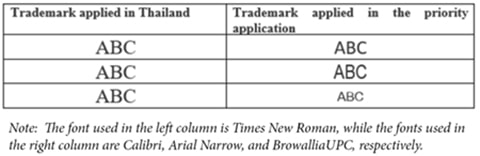
We disagree with this type of rejection and approached the Trademark Office to explain that the marks, as claimed, consist of standard characters, without claiming any particular font style, size, or color. Thus, minor differences between font styles should not be cited as the main reason for rejecting priority claim requests.   

However, we later found that the cause of rejection stems from the Trademark Office’s Internal Guidelines dated 2016, which require that the marks, as claimed, must be identical to the marks in the Thai applications. In particular, for word marks the fonts must be identical. The Internal Guidelines state the criteria for claiming a priority date from a foreign application as follows:

  • Priority application must be stated in the Kor 10 form.
  • The trademark must be the same as set out in the foreign priority application. In this respect, the Registrars are required to examine the primary visual similarities of the marks; e.g., word marks must be in identical fonts.
  • In cases where the trademarks in the foreign applications are in color and the Thai applications contain different colors, the marks are deemed to be the same, except in case of a “group of colors” type of mark.
  • If trademarks applied in foreign applications are Series Marks, and one of the marks in the Series is identical to the trademark applied in Thailand, the two marks are deemed to be the same.
  • The descriptions of goods or services in foreign applications must cover the goods or services listed in the Thai applications.
  • A copy of the priority application must be submitted.
  • Statements certifying that the priority application has never been rejected, withdrawn, or abandoned must be submitted. Such statements must be certified by the trademark owners or their authorized representatives, either within or outside of Thailand.

The Trademark Office’s Internal Guidelines have not been publicly announced, but these Internal Guidelines seem to be used as the basis for rejection of priority claim requests in many cases. Therefore, trademark owners are urged to be aware of this issue and to ensure that when a priority claim is requested, the applicant must strictly comply with these Internal Guidelines.

Multiple-Class Filings   

Since the enactment of the new Trademark Act in 2016, we have always advised our clients who prefer to file multiple-class trademark applications that a problem in one class would delay the whole application, as divisional applications are not allowed in Thailand. This advice remains valid, and we would now like to emphasize that not only will a problem in one class delay the whole application, but it could also result in the rejection of the whole application.   

When a multiple-class trademark application is rejected, the application is rejected in its entirety. The applicant has to appeal with respect to the whole application, even though arguments for some classes may be stronger than other classes, and the Board of Trademarks will issue its decision with respect to the whole application rather than rejecting certain classes and allowing other classes to remain.    

In other words, even if a trademark is descriptive only of certain classes of goods or services, when the Registrar rejects the mark, they usually reject the whole application. Additionally, when the Board of Trademarks issues its decision in an appeal, such decision will target the whole application. We have not yet received a decision by the Board whereby the Board allows only some of the non-affected classes in a multiple-class application to proceed to registration. The Board tends to either accept or reject the application in its entirety, despite there being no official objections targeting some of the classes.    

With this trend of rejecting whole multiple-class applications without allowing divisional applications, trademark owners should consider their risks and may opt to file single-class trademark applications if they anticipate that there might be problem in some but not all classes. On the other hand, if trademark owners anticipate rejection in all classes, filing multiple-class applications would save costs since the appeal for all classes could be filed at the same time.    

We will be closely monitoring these slight and sometimes undisclosed changes in the Trademark Office’s practices, which can have substantial effects on applicants, and will continue to provide timely updates on the trademark registration process in Thailand.

RELATED INSIGHTS​ 

June 30, 2026
Customs recordation is an enforcement mechanism in Myanmar that enables intellectual property (IP) rights holders to seek prevention of the cross-border movement of infringing goods. The enactment of Myanmar’s IP laws in 2019 has enabled customs recordation for registered marks and copyrights under the Trademark Law 2019 and the Copyright Law 2019. By contrast, the Patent Law 2019 and the Industrial Design Law 2019 do not provide a practical framework for customs recordation, and accordingly such rights are not subject to the customs recordation regime. Under the Trademark Law 2019, rights holders may apply for customs recordation and may also ask the Customs Department to suspend the release of goods suspected of bearing counterfeit marks. Likewise, the Copyright Law 2019 allows for customs intervention in relation to pirated works. These provisions reflect Myanmar’s gradual alignment with international standards on border measures, although the implementation framework remains at a relatively early stage of development. Customs Recordation Pursuant to the Trademark Law 2019 and the Copyright Law 2019, the relevant authorities have issued customs rules concerning the protection of registered marks and copyrights. In practice, the process generally begins with the submission of an application to the Customs Department together with supporting documentation. This typically includes proof of registration in Myanmar; details of the rights holder, applicant, and any authorized representative; and a comprehensive description of the genuine goods. Product identification materials—such as photographs, packaging samples, and distinguishing features—are particularly important in helping customs officers identify suspected infringing goods. A recordation remains valid for two years from the date of approval. It may be renewed for additional two-year terms, provided that the renewal application is filed within the thirty days prior to expiry for marks and up to thirty days in advance of the expiry date for copyrights, in accordance with
June 24, 2026
Patent enablement requirements are provided under Article 102 of Vietnam’s Law on Intellectual Property (IP Law). In particular, a patent specification must “fully and clearly disclose the nature of the invention to such an extent that, based on the specification, a person having ordinary skill in the relevant art can implement the invention.” In pharmaceutical and biotechnology patents, this requirement is more complicated and subject to more rigorous assessment. The Patent Examination Guidelines (Guidelines) of the Intellectual Property Office of Vietnam (IP Office) were amended in March 2026 to introduce Annexes III and IV for the pharmaceutical and biotechnology sectors, in which Annex III provides detailed guidelines on the assessment of specification requirements. These amendments were made under a project for strengthening capacity in industrial property examination between the Japan International Cooperation Agency (JICA) and the IP Office. Annex III provides detailed instructions on how examiners assess enablement in a pharmaceutical or biotechnology application, and offers examples of acceptable and unacceptable descriptions with regard to the enablement aspect. Enablement Requirements in Pharma and Biotech Patents Article 12.7 of Circular 10/2026/TT-BKHCN (Circular 10) adds to the requirements of Article 102 of the IP Law that the description must demonstrate the novelty, inventive step, and industrial applicability of the technical solution. For pharmaceutical composition subject matters, Article 12.9 of Circular 10 sets out that the description must present the results of clinical trials and/or the pharmacological effects of the claimed pharmaceutical composition, and must include at least the following information: Substance/mixture used. Testing method (system) employed. Information on the test results. Correlation between the pharmacological effects obtained from the tests and the application of the pharmaceutical product in the prevention, diagnosis, and treatment of diseases. The Guidelines note that pharmacological study results should be presented in a quantified manner, and pharmacological
June 16, 2026
Since the implementation of the Trademark Law 2019 on April 1, 2023, Myanmar has operated under a modern first-to-file trademark system that brings its registration framework closer to international practice. As the new regime continues to develop in practice, applicants are increasingly required to navigate formal examination requirements, substantive objections, and procedural deadlines with greater precision. This article provides a high-level review of the trademark examination process in Myanmar, focusing on the principal stages from initial review to approval, the types of objections commonly raised by the Intellectual Property Department (IPD), and the key considerations for responding effectively. A clear understanding of these issues is essential for applicants seeking to secure registration efficiently and to mitigate avoidable delays or refusals. Examination Process: Key Stages Trademark applications filed with the IPD undergo two stages of review. Formality Examination The IPD first verifies compliance with procedural requirements, including: Correct Nice Classification Clear mark representation Accurate applicant details Clearly defined goods or services Representative details, if the application is filed by a representative Other formality requirements cover translation and transliteration of any non-English or non-Myanmar elements in the mark, color claim details, applicable disclaimers, and payment of official fees. Deficiencies result in an office action requiring correction within 30 days, which may be extended upon request. Registrability Examination The IPD also assesses registrability. A mark may be refused if it: Lacks distinctiveness Is descriptive or generic Misleads the public or violates public order/morality Contains prohibited state symbols Only compliant applications proceed to publication. Responding to Office Actions Applicants must respond within 30 days of notification from the IPD. Depending on the nature of the objection, strategies may include submitting legal arguments for distinctiveness, providing evidence of acquired distinctiveness, filing appropriate disclaimers, clarifying descriptions such as color claims, or amending the listed goods
June 15, 2026
The surge in AI development has led to a desperate demand for large, high-quality training data. However, real-world data can be expensive to collect, difficult to access, and often subject to strict privacy and regulatory constraints. Synthetic data, which consists of artificially generated records that replicate the statistical properties of real-world data without reproducing specific individuals’ information, provides an appealing solution by generating artificial datasets at scale without relying on identifiable personal information. It combines speed, cost efficiency, and regulatory compliance, making it a sensible alternative for organizations seeking to reduce risks while maintaining data utility. When properly anonymized, synthetic datasets may fall outside the scope of laws such as the EU’s General Data Protection Regulation (GDPR) or Thailand’s Personal Data Protection Act (PDPA), reducing compliance burdens while still supporting high-quality model training. However, relying on synthetic data without rigorous legal due diligence could be a strategic mistake. It replaces one set of known risks (scraping, direct privacy liability) with a new set of complex liabilities. The narrative that synthetic data is a “silver bullet” for privacy and IP compliance is dangerous and could be misleading. While synthetic data addresses data scarcity, it also introduces new legal uncertainties. Legal counsel should anticipate downstream risks arising from compromised data sources. Models trained on unlawfully obtained data may need to be decommissioned, even if their outputs appear lawful. What is synthetic data? Synthetic data refers to artificially generated information created using AI techniques such as deep learning and generative models. Instead of copying real records, it reproduces the statistical patterns and relationships found in the original dataset. Synthetic data generally falls into three categories: Fully synthetic data – Entirely new data points generated from learned patterns. The model studies the structure of the original data and produces records that resemble real-world