
You are using an outdated browser and your browsing experience will not be optimal. Please update to the latest version of Microsoft Edge, Google Chrome or Mozilla Firefox. Install Microsoft Edge

March 12, 2025

Updates on Thailand’s Film Incentive Measures

In November 2024, Thai Prime Minister Paethongtarn Shinawatra unveiled ambitious plans to enhance tax incentives for foreign film productions during a networking reception in Los Angeles, coinciding with her visit to the APEC Economic Leaders’ Meeting in Lima, Peru. This event, attended by Motion Picture Association executives and leaders from top US film companies, marked a significant commitment to boosting foreign investment in Thailand’s film industry.

Thailand’s Department of Tourism (DOT) prioritized the initiative by updating the Announcement on Guidelines, Procedures, and Conditions for Applying for Benefits Under the Incentive Measures for Foreign Film Production in Thailand in December 2024 to further position Thailand as a destination for large-scale international film and television productions.

Key Amendments to Film Incentives under the 2024 Announcement

The 2024 announcement introduced major changes, including (1) removal of the rebate cap, previously set at THB 150 million (approx. USD 4.5 million) per project, enabling rebates based on total qualified spending, and (2) an increase in cash rebate rates. The maximum allowable cash rebate rate was increased to 30 percent from the previous cap of 20 percent. The base rate of 15 percent remains unchanged.

The primary incentive available under the 2024 announcement is a 15 percent cash rebate on qualified spending in Thailand of at least THB 50 million (approx. USD 1.5 million).

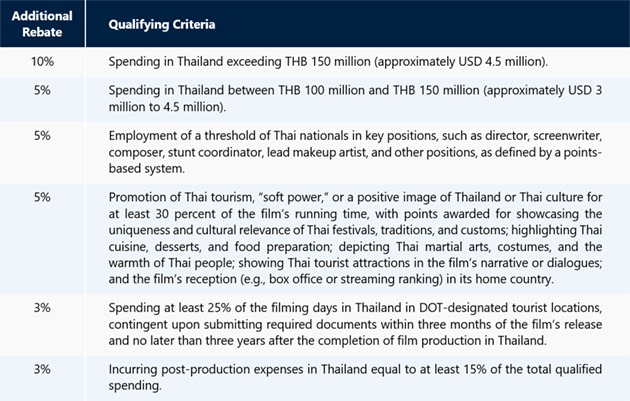
On top of this primary incentive, additional incentives are available; however, the total possible cash rebate is capped at 30 percent, and the additional incentives can only amount to an added 15 percent. Also, the total rebate (including both primary and additional incentives) for films with a budget of less than THB 100 million (approx. USD 3 million) is capped at 25%.

To obtain a higher rebate rate, productions may apply for the following additional incentives:
Compliance Requirements

Foreign production companies seeking to benefit from Thailand’s enhanced film incentives must navigate a structured application and compliance process. The 2024 announcement establishes different processing periods for applications based on spending thresholds. Noncompliance with these procedural requirements could jeopardize eligibility for the rebates, regardless of the actual amount spent in the country.

One of the key criteria for receiving the incentives is that the filming must not cause or result in environmental damage or harm to natural resources; otherwise, the approved incentives will be revoked.

The timing of this policy is noteworthy, given the recent decision regarding an environmental dispute in which Thailand’s Ministry of Natural Resources and Environment sued a major production company for over THB 100 million (approx. USD 3 million), alleging ecological damage caused during filming. The lawsuit claimed that alterations to a bay landscape and failure to comply with legal requirements and agreements established with the authorities resulted in extensive environmental harm, including deforestation and coral reef destruction. After 20 years of legal proceedings, the Thai Supreme Court ruled in 2022 that the production company must pay THB 10 million (approx. USD 300,000), or 10% of the original claim. This case underscores the risk of noncompliance with legal requirements, which can result in negative publicity, financial liability, and the loss of eligibility for incentives.

Tax Implications and Documentation Requirements

The rebate mechanism interacts with several Thai tax considerations that foreign production companies should carefully evaluate. The 2024 announcement specifies that the rebate itself is subject to 1% withholding tax under the Thai Revenue Code. Additionally, service and rental expenses paid to Thai providers typically attract withholding tax rates of 3% and 5%, respectively, while most goods and services in Thailand are subject to 7% VAT (value-added tax), significantly impacting overall production budgeting. The rebate application process also requires comprehensive financial documentation as specified in the requisition form, with all expenses requiring proper verification according to Thai Revenue Department standards.

Understanding which preproduction, production, and postproduction expenses qualify (particularly the requirement that physical production expenses in Thailand must be at least 50% of total qualified spending) requires careful planning. Professional tax and legal advice can help companies optimize their structure to maximize eligible expenses while ensuring regulatory compliance.

Final Remarks

Thailand’s revised film incentives under the DOT’s 2024 announcement provide lucrative opportunities for foreign film and television productions. By enhancing financial incentives, Thailand aims to attract more international projects, thereby stimulating economic growth and promoting cultural exchange. As the global film industry continues to evolve, Thailand’s proactive approach positions it as a competitive and attractive destination for filmmakers worldwide. Productions planning to capitalize on these incentives are advised to consult local experts to navigate the regulatory landscape effectively.


RELATED INSIGHTS​ 

May 13, 2026
Laos has significantly broadened its industrial property administrative review framework, most notably by extending it to cover copyright and related rights for the first time. Decision No. 0306/IC on the Administrative Resolution of Disputes Concerning Industrial Property Registration, New Plant Variety Registration, and Copyright and Related Rights Recordation took effect on April 24, 2026, replacing the previous rules from 2023, which had covered only industrial property and new plant variety matters. Decision No. 0306/IC governs how Laos’ Department of Intellectual Property (DIP) and provincial offices handle formal challenges to industrial property registrations and applications. The proceedings covered include oppositions to pending applications, appeals of refused applications, requests for cancellation of existing registrations, and—newly—disputes concerning the recordation and interpretation of copyright and related rights. These administrative proceedings within the DIP are heard by a government-appointed Administrative Dispute Resolution Committee, which functions similarly to the opposition and review boards found in other jurisdictions. Key Changes Decision No. 0306/IC covers four categories of administrative proceedings: Oppositions: Third-party challenges to a pending industrial property application before it is granted. Refusal appeals: Challenges to the DIP’s decision to refuse their application. Cancellation or deletion requests: Applications to invalidate an existing registered right on the grounds that it should not have been granted. Copyright and related rights disputes: Challenges to or interpretations of copyright and related rights recordations, including determinations of whether a work qualifies for copyright protection under Lao law. The most significant development is the committee’s new jurisdiction over copyright matters. The committee is now empowered to resolve disputes concerning copyright and related rights recordation—this includes the authority to determine whether a work qualifies for copyright protection and to interpret the scope of an existing recordation. Parties who believe a competitor has improperly recorded copyright over a work, or who wish to contest
April 30, 2026
Vietnam’s Decree No. 134/2026/ND‑CP, which took effect on 9 April 2026, plays an important role in detailing and implementing Vietnam’s Intellectual Property (IP) Law in the context of rapid digital transformation and the growing application of artificial intelligence (AI). The new decree provides comprehensive guidance on the application of copyright and related‑rights regulations, addressing key issues such as authorship, ownership, statutory exceptions and limitations, registration procedures, and enforcement mechanisms. Through these measures, Decree 134 seeks to achieve an appropriate balance between safeguarding the legitimate interests of rightsholders and fostering innovation, research, and technological advancement, thereby strengthening the state’s framework for the effective management, protection, and exploitation of intellectual property in the digital and AI‑driven environment. Some notable aspects of Decree 134 are discussed below. Copyright for AI-Created Works Decree 134 provides important guidance on the determination of copyright and related rights in works created with the assistance of AI. Article 5a reaffirms the principle that human creativity remains central to copyright protection, clarifying that copyright or related rights arise only where a human makes a substantial and decisive intellectual contribution, exercises effective control over the creative outcome, and assumes responsibility for the content and its legality. At the same time, the provision confirms that AI is regarded solely as a technological tool rather than a rights‑holding subject, thus ensuring consistency with the fundamental concepts of authorship and ownership under the IP Law. By introducing requirements on transparency, proof of human contribution, and compliance with AI‑specific labelling and technical marking obligations, Decree 134 establishes a clear and enforceable legal framework for the responsible use of AI in creative activities. Lawful Use of Copyrighted Texts and Data Article 37a of Decree 134 sets out the specific conditions under which copyrighted texts and data may be lawfully used for scientific research, experimentation,
April 29, 2026
Across the region, local brands have become key drivers of economic growth, cultural identity, and innovation, and Myanmar is no exception. From traditional products and creative industries to modern startups and small and medium‑sized enterprises (SMEs), Myanmar’s local brands are increasingly shaping domestic markets. However, as local brands grow, they also face higher risks of imitation, misuse, and unfair competition. In this context, protecting brand identity, creativity, and innovation through proper intellectual property (IP) strategies is essential to ensure that Myanmar’s homegrown businesses can grow sustainably, compete confidently, and retain the value of what they create. The Key IP Laws for Local Brands In 2019, Myanmar enacted a comprehensive suite of four IP laws, aligning the nation’s IP enforcement framework with international standards. Trademark Law 2019: This law introduced the “first-to-file” system into the country, with trademark rights primarily obtained through registration with the Intellectual Property Department (IPD). Trademarks protect brand names, logos, and other signs that distinguish goods or services. Registration grants the exclusive rights to use the mark and to prevent others from using identical or confusingly similar marks. Each registration lasts for 10 years from the filing date and can be renewed for subsequent 10-year periods. Copyright Law 2019: Copyright, which arises automatically upon creation, protects literary, artistic, musical, and audiovisual works, including software, advertisements, artwork, and social media content. While registration with the IPD is not mandatory under this law, it can be helpful for establishing evidence and supporting any future enforcement. The terms of protection for economic rights associated with copyrights vary depending on the type of work involved. In contrast, the protection for moral rights lasts indefinitely—continuing even after the author’s death. Industrial Design Law 2019: Under this law, any industrial design that is new and independently created can be filed with the
April 21, 2026
Vietnam continues to refine its intellectual property framework to align with the 2025 amendments to the Law on Intellectual Property (IP Law). On March 31, 2026, the government issued Decree 100/2026/ND-CP (Decree 100), which substantially amends Decree 65/2023/ND-CP detailing the implementation of the IP Law (Decree 65). On the same day, the Ministry of Science and Technology released Circular 10/2026/TT-BKHCN (Circular 10), providing detailed procedural guidance and new forms. Both instruments took effect on April 1, 2026, along with the amended IP Law. While the updates touch on every IP right, trademark owners and brand strategists will find several practical and forward-looking changes that directly affect filing strategy, examination timelines, portfolio management, and enforcement readiness. 1. Fast-Track Substantive Examination for Eligible Applications One of the most business-friendly innovations is the new fast-track substantive examination pathway for applications meeting specified eligibility criteria. Successful fast-track applications enjoy a shortened substantive examination period of three months. This offers a significant competitive edge for tech-driven or regulated-sector brands. If the mark is identical or similar to a mark in another person’s trademark application with an earlier filing date in the case of a priority application that has not yet been processed, the fast-track process will return to the ordinary process. However, the law does not touch on cases where marks under fast-track examination face office action due to other reasons (i.e. lack of distinctiveness, confusingly similar to others’ copyright, trade name, industrial design, etc.) 2. AI-Generated Trademarks Receive Clear Protection Pathway Decree 100 explicitly addresses the use of artificial intelligence (AI) in IP creation, amending Article 10a of Decree 65 to confirm that trademarks created with AI systems are fully protectable, provided they meet the standard requirements of registration. Trademarks face no additional “human authorship” hurdle (unlike patents or industrial designs). Brand owners