
You are using an outdated browser and your browsing experience will not be optimal. Please update to the latest version of Microsoft Edge, Google Chrome or Mozilla Firefox. Install Microsoft Edge

March 12, 2025

Updates on Thailand’s Film Incentive Measures

In November 2024, Thai Prime Minister Paethongtarn Shinawatra unveiled ambitious plans to enhance tax incentives for foreign film productions during a networking reception in Los Angeles, coinciding with her visit to the APEC Economic Leaders’ Meeting in Lima, Peru. This event, attended by Motion Picture Association executives and leaders from top US film companies, marked a significant commitment to boosting foreign investment in Thailand’s film industry.

Thailand’s Department of Tourism (DOT) prioritized the initiative by updating the Announcement on Guidelines, Procedures, and Conditions for Applying for Benefits Under the Incentive Measures for Foreign Film Production in Thailand in December 2024 to further position Thailand as a destination for large-scale international film and television productions.

Key Amendments to Film Incentives under the 2024 Announcement

The 2024 announcement introduced major changes, including (1) removal of the rebate cap, previously set at THB 150 million (approx. USD 4.5 million) per project, enabling rebates based on total qualified spending, and (2) an increase in cash rebate rates. The maximum allowable cash rebate rate was increased to 30 percent from the previous cap of 20 percent. The base rate of 15 percent remains unchanged.

The primary incentive available under the 2024 announcement is a 15 percent cash rebate on qualified spending in Thailand of at least THB 50 million (approx. USD 1.5 million).

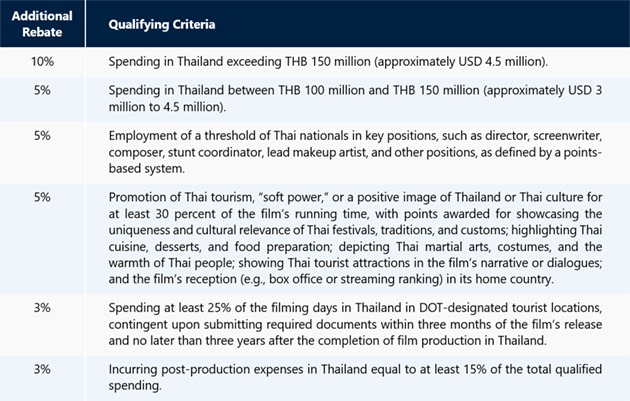
On top of this primary incentive, additional incentives are available; however, the total possible cash rebate is capped at 30 percent, and the additional incentives can only amount to an added 15 percent. Also, the total rebate (including both primary and additional incentives) for films with a budget of less than THB 100 million (approx. USD 3 million) is capped at 25%.

To obtain a higher rebate rate, productions may apply for the following additional incentives:
Compliance Requirements

Foreign production companies seeking to benefit from Thailand’s enhanced film incentives must navigate a structured application and compliance process. The 2024 announcement establishes different processing periods for applications based on spending thresholds. Noncompliance with these procedural requirements could jeopardize eligibility for the rebates, regardless of the actual amount spent in the country.

One of the key criteria for receiving the incentives is that the filming must not cause or result in environmental damage or harm to natural resources; otherwise, the approved incentives will be revoked.

The timing of this policy is noteworthy, given the recent decision regarding an environmental dispute in which Thailand’s Ministry of Natural Resources and Environment sued a major production company for over THB 100 million (approx. USD 3 million), alleging ecological damage caused during filming. The lawsuit claimed that alterations to a bay landscape and failure to comply with legal requirements and agreements established with the authorities resulted in extensive environmental harm, including deforestation and coral reef destruction. After 20 years of legal proceedings, the Thai Supreme Court ruled in 2022 that the production company must pay THB 10 million (approx. USD 300,000), or 10% of the original claim. This case underscores the risk of noncompliance with legal requirements, which can result in negative publicity, financial liability, and the loss of eligibility for incentives.

Tax Implications and Documentation Requirements

The rebate mechanism interacts with several Thai tax considerations that foreign production companies should carefully evaluate. The 2024 announcement specifies that the rebate itself is subject to 1% withholding tax under the Thai Revenue Code. Additionally, service and rental expenses paid to Thai providers typically attract withholding tax rates of 3% and 5%, respectively, while most goods and services in Thailand are subject to 7% VAT (value-added tax), significantly impacting overall production budgeting. The rebate application process also requires comprehensive financial documentation as specified in the requisition form, with all expenses requiring proper verification according to Thai Revenue Department standards.

Understanding which preproduction, production, and postproduction expenses qualify (particularly the requirement that physical production expenses in Thailand must be at least 50% of total qualified spending) requires careful planning. Professional tax and legal advice can help companies optimize their structure to maximize eligible expenses while ensuring regulatory compliance.

Final Remarks

Thailand’s revised film incentives under the DOT’s 2024 announcement provide lucrative opportunities for foreign film and television productions. By enhancing financial incentives, Thailand aims to attract more international projects, thereby stimulating economic growth and promoting cultural exchange. As the global film industry continues to evolve, Thailand’s proactive approach positions it as a competitive and attractive destination for filmmakers worldwide. Productions planning to capitalize on these incentives are advised to consult local experts to navigate the regulatory landscape effectively.


RELATED INSIGHTS​ 

June 15, 2026
The surge in AI development has led to a desperate demand for large, high-quality training data. However, real-world data can be expensive to collect, difficult to access, and often subject to strict privacy and regulatory constraints. Synthetic data, which consists of artificially generated records that replicate the statistical properties of real-world data without reproducing specific individuals’ information, provides an appealing solution by generating artificial datasets at scale without relying on identifiable personal information. It combines speed, cost efficiency, and regulatory compliance, making it a sensible alternative for organizations seeking to reduce risks while maintaining data utility. When properly anonymized, synthetic datasets may fall outside the scope of laws such as the EU’s General Data Protection Regulation (GDPR) or Thailand’s Personal Data Protection Act (PDPA), reducing compliance burdens while still supporting high-quality model training. However, relying on synthetic data without rigorous legal due diligence could be a strategic mistake. It replaces one set of known risks (scraping, direct privacy liability) with a new set of complex liabilities. The narrative that synthetic data is a “silver bullet” for privacy and IP compliance is dangerous and could be misleading. While synthetic data addresses data scarcity, it also introduces new legal uncertainties. Legal counsel should anticipate downstream risks arising from compromised data sources. Models trained on unlawfully obtained data may need to be decommissioned, even if their outputs appear lawful. What is synthetic data? Synthetic data refers to artificially generated information created using AI techniques such as deep learning and generative models. Instead of copying real records, it reproduces the statistical patterns and relationships found in the original dataset. Synthetic data generally falls into three categories: Fully synthetic data – Entirely new data points generated from learned patterns. The model studies the structure of the original data and produces records that resemble real-world
June 10, 2026
In March 2026, the Intellectual Property Office of Vietnam (IP Office) issued a decision refusing a trademark application after considering an opposition based primarily on copyright grounds. The outcome is noteworthy because the foreign brand owner had neither trademark registrations nor applications in Vietnam at the time the opposition was filed, and the IP Office has historically applied a stringent approach to oppositions relying on copyright. The Opposition Maurten is a well-known Swedish sports nutrition brand recognized globally for its innovative hydrogel technology, which is designed to help endurance athletes fuel more effectively without gastrointestinal discomfort. The brand’s distinctive logo is characterized by clean lines and a bold black-and-white color scheme, and has long been associated with the company’s performance products. The brand’s logo is displayed above. An identical mark was filed for registration by a Vietnamese trademark squatter. In 2023, a Vietnamese individual filed an application for registration of an identical mark (Application No. 4-2023-38668), a practice commonly observed in Vietnam as trademark squatting. The brand owner engaged Tilleke & Gibbins to assist with strategy and filing an opposition to the mark. At the time, Maurten had no trademark rights or meaningful use in Vietnam, and global marketing data showed only modest figures without any local presence. Thus, to convince the IP Office to refuse the squatter’s application, instead of relying on trademark rights or use evidence, the opposition strategy centered on the copyright protection of the logo itself, as copyright arises automatically in Vietnam upon creation of the work and does not require registration. (It is worth noting, however, that the IP Office has traditionally been cautious in accepting copyright as a basis for refusing trademark applications.) On September 24, 2024, an opposition was filed on three main grounds: confusing similarity, copyright infringement of the artistic work,
June 10, 2026
For multinational franchisors operating in Thailand, a key risk after franchise termination is that former outlets may continue operating in ways that could easily mislead consumers into believing they remain within the authorized network. To justify such operations, former franchisees often argue that the termination was invalid or ineffective. As a result, these cases are often treated as contractual disputes, making it difficult for franchisors to obtain injunctive relief before a final judgment confirms that the termination was lawful. Franchisors face significant commercial and reputational harm during lengthy proceedings, including consumer confusion, disruption to franchise restructuring, and damage to brand reputation and customer trust. In an encouraging development, the Thai court in a 2025 case responded to the problem of unauthorized post-termination franchise operations by granting interim relief, recognizing broader brand and consumer harm, and awarding substantial damages, highlighting a successful litigation strategy of framing the dispute not merely as a contractual termination issue but as trademark infringement causing ongoing commercial injury. The Subway Case From December 2024 to mid-2025, an unauthorized “Subway®” franchise operation in Thailand attracted substantial public and media attention. Reports and online discussions about unauthorized Subway® stores circulated widely after complaints arose about food quality and customer experience at certain outlets that were allegedly operating after their franchise rights had expired. Because these stores continued to use Subway® trademarks, trade dress, and overall commercial appearance, many consumers were unable to distinguish them from authorized operations, resulting in reputational risks and customer confusion that affected the franchisor’s brand and franchise system in Thailand. Subway treated this matter with the utmost seriousness and moved promptly to protect its brand, franchise system, and customers. It filed a civil action with the IP&IT Court seeking a permanent injunction and damages. During the proceedings, the court granted a preliminary injunction
May 22, 2026
Intellectual property specialists from Tilleke & Gibbins in Vietnam have contributed an updated Intellectual Property Transactions in Vietnam overview for Thomson Reuters Practical Law, an online publication that provides comprehensive legal guides for jurisdictions worldwide. The Vietnam overview was authored by Linh Thi Mai Nguyen, Thanh Phuong Vu, Chi Lan Dang, Son Thai Hoang, and Duc Anh Tran. The chapter provides a high-level examination of key aspects of IP transactions law in Vietnam, including IP assignment and licensing, research and development collaborations, IP in mergers and acquisitions (M&A), lending and taking security over intellectual property rights, settlement agreements, employee- and consultant-created IP, competition law, taxation, and non-tariff trade barriers. Key topics covered in the chapter include: IP assignment: Basis and formalities for assignments of patents, utility models, trade marks, copyright, design rights, trade secrets, confidential information, and domain names in Vietnam. IP licensing: Scope, formalities, and recordal requirements for licensing patents, trade marks, copyright, design rights, and trade secrets. Research and development collaborations: Treatment of improvements, derivatives, and joint ownership of IP, including exploitation and enforcement issues. IP aspects of M&A and security: Due diligence, warranties, transfer formalities, and taking security over intellectual property rights. Practical Law, a legal reference resource from Thomson Reuters, publishes a range of guides for hundreds of jurisdictions and practice areas. The Intellectual Property Transactions Global Guide is a valuable resource for legal practitioners seeking comparative insight into transactional IP issues across multiple jurisdictions. To view the latest version of the Intellectual Property Transactions in Vietnam overview, please visit the Practical Law website and enroll in the free Practical Law trial to gain full access.