
You are using an outdated browser and your browsing experience will not be optimal. Please update to the latest version of Microsoft Edge, Google Chrome or Mozilla Firefox. Install Microsoft Edge

March 12, 2025

Updates on Thailand’s Film Incentive Measures

In November 2024, Thai Prime Minister Paethongtarn Shinawatra unveiled ambitious plans to enhance tax incentives for foreign film productions during a networking reception in Los Angeles, coinciding with her visit to the APEC Economic Leaders’ Meeting in Lima, Peru. This event, attended by Motion Picture Association executives and leaders from top US film companies, marked a significant commitment to boosting foreign investment in Thailand’s film industry.

Thailand’s Department of Tourism (DOT) prioritized the initiative by updating the Announcement on Guidelines, Procedures, and Conditions for Applying for Benefits Under the Incentive Measures for Foreign Film Production in Thailand in December 2024 to further position Thailand as a destination for large-scale international film and television productions.

Key Amendments to Film Incentives under the 2024 Announcement

The 2024 announcement introduced major changes, including (1) removal of the rebate cap, previously set at THB 150 million (approx. USD 4.5 million) per project, enabling rebates based on total qualified spending, and (2) an increase in cash rebate rates. The maximum allowable cash rebate rate was increased to 30 percent from the previous cap of 20 percent. The base rate of 15 percent remains unchanged.

The primary incentive available under the 2024 announcement is a 15 percent cash rebate on qualified spending in Thailand of at least THB 50 million (approx. USD 1.5 million).

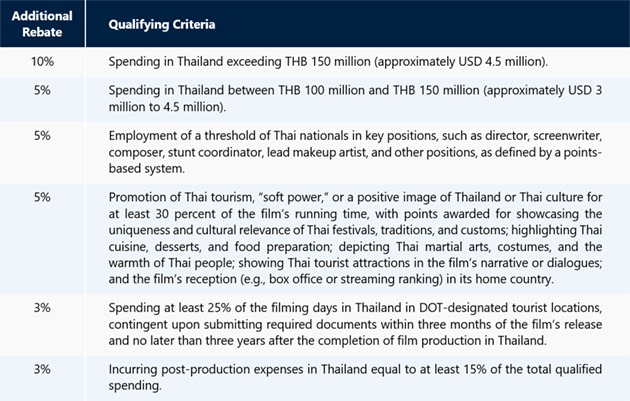
On top of this primary incentive, additional incentives are available; however, the total possible cash rebate is capped at 30 percent, and the additional incentives can only amount to an added 15 percent. Also, the total rebate (including both primary and additional incentives) for films with a budget of less than THB 100 million (approx. USD 3 million) is capped at 25%.

To obtain a higher rebate rate, productions may apply for the following additional incentives:
Compliance Requirements

Foreign production companies seeking to benefit from Thailand’s enhanced film incentives must navigate a structured application and compliance process. The 2024 announcement establishes different processing periods for applications based on spending thresholds. Noncompliance with these procedural requirements could jeopardize eligibility for the rebates, regardless of the actual amount spent in the country.

One of the key criteria for receiving the incentives is that the filming must not cause or result in environmental damage or harm to natural resources; otherwise, the approved incentives will be revoked.

The timing of this policy is noteworthy, given the recent decision regarding an environmental dispute in which Thailand’s Ministry of Natural Resources and Environment sued a major production company for over THB 100 million (approx. USD 3 million), alleging ecological damage caused during filming. The lawsuit claimed that alterations to a bay landscape and failure to comply with legal requirements and agreements established with the authorities resulted in extensive environmental harm, including deforestation and coral reef destruction. After 20 years of legal proceedings, the Thai Supreme Court ruled in 2022 that the production company must pay THB 10 million (approx. USD 300,000), or 10% of the original claim. This case underscores the risk of noncompliance with legal requirements, which can result in negative publicity, financial liability, and the loss of eligibility for incentives.

Tax Implications and Documentation Requirements

The rebate mechanism interacts with several Thai tax considerations that foreign production companies should carefully evaluate. The 2024 announcement specifies that the rebate itself is subject to 1% withholding tax under the Thai Revenue Code. Additionally, service and rental expenses paid to Thai providers typically attract withholding tax rates of 3% and 5%, respectively, while most goods and services in Thailand are subject to 7% VAT (value-added tax), significantly impacting overall production budgeting. The rebate application process also requires comprehensive financial documentation as specified in the requisition form, with all expenses requiring proper verification according to Thai Revenue Department standards.

Understanding which preproduction, production, and postproduction expenses qualify (particularly the requirement that physical production expenses in Thailand must be at least 50% of total qualified spending) requires careful planning. Professional tax and legal advice can help companies optimize their structure to maximize eligible expenses while ensuring regulatory compliance.

Final Remarks

Thailand’s revised film incentives under the DOT’s 2024 announcement provide lucrative opportunities for foreign film and television productions. By enhancing financial incentives, Thailand aims to attract more international projects, thereby stimulating economic growth and promoting cultural exchange. As the global film industry continues to evolve, Thailand’s proactive approach positions it as a competitive and attractive destination for filmmakers worldwide. Productions planning to capitalize on these incentives are advised to consult local experts to navigate the regulatory landscape effectively.


RELATED INSIGHTS​ 

July 6, 2026
Indonesia’s regulation on reporting online intellectual property (IP) infringement provides comprehensive procedural guidance for IP rights holders and their licensees in reporting online infringement complaints. Issued in December 2025 by the Ministry of Law as Regulation No. 47 of 2025 regarding Handling of Intellectual Property Infringement Reports in Electronic Systems, this regulation covers all types of IP rights. It also specifies documentation when reporting infringement, and lays out the procedures for examination, verification, and enforcement actions. Submission of Complaints Complainants may submit reports through the online system of the Directorate General of Intellectual Property (DGIP) or in person at the DGIP office. Complaints may also be filed through an authorized proxy. Under the regulation, complainants are required to provide the following information and documents: Personal details of the complainant; Brief description of the protected work or subject matter (i.e., type of IP and name or address of the infringing website, portal, account, or application, or a link to the location of the infringing content); Complete description of the alleged infringement; Certificate of registration or recordal of the relevant IP; Recordal of IP license agreement, if any; and Other supporting evidence. Verification and Examination Process Upon receiving a complaint, the responsible formality officer may request clarification or additional supporting documents. In the latter case, the complainant must then submit the necessary administrative documents within 14 days of the notification date. Once the documentation is deemed complete and sufficient, the case will be formally registered. Subsequently, the DGIP will establish a verification team to handle online IP violations, which will include the Civil Servant Investigator (PPNS), the Ministry of Communication and Digital Affairs, experts with relevant expertise in IP, and representatives from related associations such as AVISI (Indonesian Video Streaming Association). After examining the report, the team will prepare the Minutes
June 30, 2026
Customs recordation is an enforcement mechanism in Myanmar that enables intellectual property (IP) rights holders to seek prevention of the cross-border movement of infringing goods. The enactment of Myanmar’s IP laws in 2019 has enabled customs recordation for registered marks and copyrights under the Trademark Law 2019 and the Copyright Law 2019. By contrast, the Patent Law 2019 and the Industrial Design Law 2019 do not provide a practical framework for customs recordation, and accordingly such rights are not subject to the customs recordation regime. Under the Trademark Law 2019, rights holders may apply for customs recordation and may also ask the Customs Department to suspend the release of goods suspected of bearing counterfeit marks. Likewise, the Copyright Law 2019 allows for customs intervention in relation to pirated works. These provisions reflect Myanmar’s gradual alignment with international standards on border measures, although the implementation framework remains at a relatively early stage of development. Customs Recordation Pursuant to the Trademark Law 2019 and the Copyright Law 2019, the relevant authorities have issued customs rules concerning the protection of registered marks and copyrights. In practice, the process generally begins with the submission of an application to the Customs Department together with supporting documentation. This typically includes proof of registration in Myanmar; details of the rights holder, applicant, and any authorized representative; and a comprehensive description of the genuine goods. Product identification materials—such as photographs, packaging samples, and distinguishing features—are particularly important in helping customs officers identify suspected infringing goods. A recordation remains valid for two years from the date of approval. It may be renewed for additional two-year terms, provided that the renewal application is filed within the thirty days prior to expiry for marks and up to thirty days in advance of the expiry date for copyrights, in accordance with
June 24, 2026
Patent enablement requirements are provided under Article 102 of Vietnam’s Law on Intellectual Property (IP Law). In particular, a patent specification must “fully and clearly disclose the nature of the invention to such an extent that, based on the specification, a person having ordinary skill in the relevant art can implement the invention.” In pharmaceutical and biotechnology patents, this requirement is more complicated and subject to more rigorous assessment. The Patent Examination Guidelines (Guidelines) of the Intellectual Property Office of Vietnam (IP Office) were amended in March 2026 to introduce Annexes III and IV for the pharmaceutical and biotechnology sectors, in which Annex III provides detailed guidelines on the assessment of specification requirements. These amendments were made under a project for strengthening capacity in industrial property examination between the Japan International Cooperation Agency (JICA) and the IP Office. Annex III provides detailed instructions on how examiners assess enablement in a pharmaceutical or biotechnology application, and offers examples of acceptable and unacceptable descriptions with regard to the enablement aspect. Enablement Requirements in Pharma and Biotech Patents Article 12.7 of Circular 10/2026/TT-BKHCN (Circular 10) adds to the requirements of Article 102 of the IP Law that the description must demonstrate the novelty, inventive step, and industrial applicability of the technical solution. For pharmaceutical composition subject matters, Article 12.9 of Circular 10 sets out that the description must present the results of clinical trials and/or the pharmacological effects of the claimed pharmaceutical composition, and must include at least the following information: Substance/mixture used. Testing method (system) employed. Information on the test results. Correlation between the pharmacological effects obtained from the tests and the application of the pharmaceutical product in the prevention, diagnosis, and treatment of diseases. The Guidelines note that pharmacological study results should be presented in a quantified manner, and pharmacological
June 16, 2026
Since the implementation of the Trademark Law 2019 on April 1, 2023, Myanmar has operated under a modern first-to-file trademark system that brings its registration framework closer to international practice. As the new regime continues to develop in practice, applicants are increasingly required to navigate formal examination requirements, substantive objections, and procedural deadlines with greater precision. This article provides a high-level review of the trademark examination process in Myanmar, focusing on the principal stages from initial review to approval, the types of objections commonly raised by the Intellectual Property Department (IPD), and the key considerations for responding effectively. A clear understanding of these issues is essential for applicants seeking to secure registration efficiently and to mitigate avoidable delays or refusals. Examination Process: Key Stages Trademark applications filed with the IPD undergo two stages of review. Formality Examination The IPD first verifies compliance with procedural requirements, including: Correct Nice Classification Clear mark representation Accurate applicant details Clearly defined goods or services Representative details, if the application is filed by a representative Other formality requirements cover translation and transliteration of any non-English or non-Myanmar elements in the mark, color claim details, applicable disclaimers, and payment of official fees. Deficiencies result in an office action requiring correction within 30 days, which may be extended upon request. Registrability Examination The IPD also assesses registrability. A mark may be refused if it: Lacks distinctiveness Is descriptive or generic Misleads the public or violates public order/morality Contains prohibited state symbols Only compliant applications proceed to publication. Responding to Office Actions Applicants must respond within 30 days of notification from the IPD. Depending on the nature of the objection, strategies may include submitting legal arguments for distinctiveness, providing evidence of acquired distinctiveness, filing appropriate disclaimers, clarifying descriptions such as color claims, or amending the listed goods