
You are using an outdated browser and your browsing experience will not be optimal. Please update to the latest version of Microsoft Edge, Google Chrome or Mozilla Firefox. Install Microsoft Edge

March 12, 2025

Updates on Thailand’s Film Incentive Measures

In November 2024, Thai Prime Minister Paethongtarn Shinawatra unveiled ambitious plans to enhance tax incentives for foreign film productions during a networking reception in Los Angeles, coinciding with her visit to the APEC Economic Leaders’ Meeting in Lima, Peru. This event, attended by Motion Picture Association executives and leaders from top US film companies, marked a significant commitment to boosting foreign investment in Thailand’s film industry.

Thailand’s Department of Tourism (DOT) prioritized the initiative by updating the Announcement on Guidelines, Procedures, and Conditions for Applying for Benefits Under the Incentive Measures for Foreign Film Production in Thailand in December 2024 to further position Thailand as a destination for large-scale international film and television productions.

Key Amendments to Film Incentives under the 2024 Announcement

The 2024 announcement introduced major changes, including (1) removal of the rebate cap, previously set at THB 150 million (approx. USD 4.5 million) per project, enabling rebates based on total qualified spending, and (2) an increase in cash rebate rates. The maximum allowable cash rebate rate was increased to 30 percent from the previous cap of 20 percent. The base rate of 15 percent remains unchanged.

The primary incentive available under the 2024 announcement is a 15 percent cash rebate on qualified spending in Thailand of at least THB 50 million (approx. USD 1.5 million).

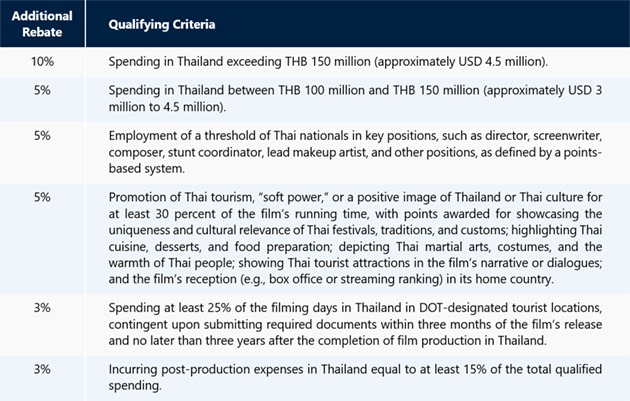
On top of this primary incentive, additional incentives are available; however, the total possible cash rebate is capped at 30 percent, and the additional incentives can only amount to an added 15 percent. Also, the total rebate (including both primary and additional incentives) for films with a budget of less than THB 100 million (approx. USD 3 million) is capped at 25%.

To obtain a higher rebate rate, productions may apply for the following additional incentives:
Compliance Requirements

Foreign production companies seeking to benefit from Thailand’s enhanced film incentives must navigate a structured application and compliance process. The 2024 announcement establishes different processing periods for applications based on spending thresholds. Noncompliance with these procedural requirements could jeopardize eligibility for the rebates, regardless of the actual amount spent in the country.

One of the key criteria for receiving the incentives is that the filming must not cause or result in environmental damage or harm to natural resources; otherwise, the approved incentives will be revoked.

The timing of this policy is noteworthy, given the recent decision regarding an environmental dispute in which Thailand’s Ministry of Natural Resources and Environment sued a major production company for over THB 100 million (approx. USD 3 million), alleging ecological damage caused during filming. The lawsuit claimed that alterations to a bay landscape and failure to comply with legal requirements and agreements established with the authorities resulted in extensive environmental harm, including deforestation and coral reef destruction. After 20 years of legal proceedings, the Thai Supreme Court ruled in 2022 that the production company must pay THB 10 million (approx. USD 300,000), or 10% of the original claim. This case underscores the risk of noncompliance with legal requirements, which can result in negative publicity, financial liability, and the loss of eligibility for incentives.

Tax Implications and Documentation Requirements

The rebate mechanism interacts with several Thai tax considerations that foreign production companies should carefully evaluate. The 2024 announcement specifies that the rebate itself is subject to 1% withholding tax under the Thai Revenue Code. Additionally, service and rental expenses paid to Thai providers typically attract withholding tax rates of 3% and 5%, respectively, while most goods and services in Thailand are subject to 7% VAT (value-added tax), significantly impacting overall production budgeting. The rebate application process also requires comprehensive financial documentation as specified in the requisition form, with all expenses requiring proper verification according to Thai Revenue Department standards.

Understanding which preproduction, production, and postproduction expenses qualify (particularly the requirement that physical production expenses in Thailand must be at least 50% of total qualified spending) requires careful planning. Professional tax and legal advice can help companies optimize their structure to maximize eligible expenses while ensuring regulatory compliance.

Final Remarks

Thailand’s revised film incentives under the DOT’s 2024 announcement provide lucrative opportunities for foreign film and television productions. By enhancing financial incentives, Thailand aims to attract more international projects, thereby stimulating economic growth and promoting cultural exchange. As the global film industry continues to evolve, Thailand’s proactive approach positions it as a competitive and attractive destination for filmmakers worldwide. Productions planning to capitalize on these incentives are advised to consult local experts to navigate the regulatory landscape effectively.


RELATED INSIGHTS​ 

July 21, 2026
Thailand’s Ministry of Digital Economy and Society (MDES) published a notification establishing an expedited court-ordered takedown mechanism for online content in cases of “urgent necessity.” The notification, which was issued on July 17, 2026, under the Computer Crime Act B.E. 2550 (2007), as amended, took effect the following day. It significantly expands the categories of content subject to rapid government-initiated removal. Content Categories Subject to Takedown The notification defines “urgent necessity” (section 20, paragraph 5, of the Computer Crime Act) as circumstances where any delay in suppressing computer data may impact national security, religion, the monarchy, good morals, social culture, or public order. In this regard, it establishes four broad categories of content: Computer Crime Act offenses. National security offenses. IP and other criminal offenses, where it is contrary to public order or good morals and a competent officer has requested its suppression. Content contrary to public order or good morals, a broad residual category encompassing 14 subcategories approved by the Computer Data Screening Committee. The fourth category is the most expansive. Its 14 subcategories include: Content defaming, mocking, satirizing, or devaluing the monarchy. Online gambling advertising or facilitation. Offering illegal firearms for sale. Offering baraku (hookah) products or e-cigarettes for sale. Offering cannabis inflorescences or processed cannabis products for sale. Advertising or soliciting prostitution. Content inciting violence, hatred, or social division. Unauthorized overseas employment advertising. Offering boiled kratom juice for sale. Online sale or advertising of alcoholic beverages. Content satirizing or degrading Buddhism. Money lending at interest rates exceeding legally prescribed limits. Advertising or disseminating information about surrogacy services. Forgery of documents, cards, or official documents. Enforcement Procedure In cases of urgent necessity, a competent official assigned by the MDES permanent secretary must file a petition with supporting evidence to the court with jurisdiction, requesting an order to
July 15, 2026
Ambush marketing refers to a strategy in which a business associates itself with an event, campaign, or brand without paying for official sponsorship rights. The tactic is most visible in sports, concerts, and festivals, where official sponsors have invested substantially for exclusivity. Ambush marketers may use suggestive wording, event-themed imagery, athlete endorsements, venue-adjacent promotions, or social media campaigns implying a commercial connection with the event. Common Forms of Ambush Marketing Ambush marketing typically takes one of the following forms: Direct ambushing: using event names, logos, or mascots suggesting authorization Coattail ambushing: sponsoring an athlete or broadcaster connected with the event Subtle ambushing: themed advertising, venue-adjacent campaigns, or similar visual cues The legal analysis in each case turns on whether the marketing crosses from permissible event-based advertising into infringement, passing off, deception, or wrongful exploitation of goodwill, and the risk assessment is necessarily fact-specific. Thailand has no dedicated ambush marketing statute, so legality depends on execution. A campaign that merely comments on a public event may be permissible, but one that uses protected marks, creates consumer confusion, misrepresents sponsorship status, or makes unsubstantiated claims may trigger liability under various Thai laws, as laid out below. Ambush Marketing and Thailand’s Trademark Act The Trademark Act B.E. 2534 (1991) is the primary tool for addressing campaigns that use registered trademarks, event names, logos, mascots, or confusingly similar signs. The law gives registered trademark owners the exclusive right to use their mark for registered goods, and infringement risk arises when a nonsponsor uses an event mark or a confusingly similar sign in advertising. Even referential or playful use may create liability if it causes public confusion as to sponsorship or commercial connection. The law also preserves passing-off claims for unregistered marks. This matters because event names, taglines, or mascots may not always be
July 13, 2026
When Decree No. 186/2026/ND-CP (Decree 186) takes effect on July 15, 2026, it will introduce the most significant reform of Vietnam’s administrative IP enforcement framework since Decree 99/2013/ND-CP was issued in 2013. These changes are expected to make administrative enforcement faster, more accessible, and better suited to the realities of modern IP disputes. Below are the principal reforms and their practical implications for rights holders and enforcement practitioners. The End of Notarization and Consular Legalization Among the most welcome procedural changes is the abolition of the notarization and consular legalization requirement for powers of attorney (POA) submitted in administrative enforcement proceedings. Under the previous regime, foreign rights holders were generally required to execute a POA, then have it notarized and consular legalized (if seeking customs recordal). In practice, this process frequently delayed enforcement by four to eight weeks, often long enough for infringing goods to disappear before authorities could intervene. Decree 186 removes this bottleneck, now requiring only an original or certified copy of the POA. If the document is in a foreign language, a Vietnamese translation is sufficient, provided it is certified by a competent authority or confirmed by the authorized Vietnamese IP representative. Consular legalization and notarization are no longer required. For rights holders, the practical impact is substantial. Administrative enforcement files that previously took weeks to prepare can now be completed in a matter of days, allowing much faster responses in time-sensitive matters such as warehouse raids, border interventions, and trade-fair enforcement. The decree also introduces a useful administrative simplification. Where an original POA has already been submitted to the same enforcement authority and remains valid, applicants may rely on a copy of that earlier submission by identifying the previous case file. This eliminates unnecessary duplication for rights holders pursuing multiple enforcement actions before the same
July 9, 2026
Recycling, upcycling, and refill-packaging models are now widely promoted as ways to reduce waste, lower carbon emissions, and respond to consumer demand for sustainable products. However, complications arise when these environmentally driven trends intersect with intellectual property law—particularly where reused or altered packaging continues to display third parties’ registered trademarks. Adding to this complexity, Thailand’s draft Sustainable Packaging Management Act aims to introduce new environmental compliance obligations that businesses must navigate alongside existing trademark concerns. Recycling and upcycling packaging may infringe trademark rights, especially in cases not protected by the first-sale doctrine—the principle that a trademark owner’s rights over a particular mark-bearing product end once the owner first sells it. Furthermore, even refill packaging carries legal risk due to specific statutory prohibitions under Thai law. Compounding these challenges, the draft Sustainable Packaging Management Act will impose extended producer responsibility (EPR) obligations on manufacturers and brand owners, requiring them to manage packaging throughout its lifecycle. These overlapping legal frameworks could deter manufacturers from pursuing ESG-aligned business models unless businesses understand how to navigate both trademark and environmental requirements. Under Thai law, this issue remains uncertain because the Trademark Act does not expressly codify the first sale doctrine, also known as the exhaustion of trademark rights. Generally, this doctrine provides that once a trademark owner has lawfully sold goods bearing its trademark, the owner’s right to control further resale of those particular goods is exhausted. The rationale is that the owner has already received commercial benefit from the first authorized sale; therefore, the purchaser should be free to resell or otherwise dispose of the goods. Although the doctrine is not expressly codified in the Trademark Act, Thai courts have recognized it in relation to genuine goods and parallel imports, as seen in a Supreme Court Judgment No. 2817/2543 in which the