
You are using an outdated browser and your browsing experience will not be optimal. Please update to the latest version of Microsoft Edge, Google Chrome or Mozilla Firefox. Install Microsoft Edge

March 12, 2025

Updates on Thailand’s Film Incentive Measures

In November 2024, Thai Prime Minister Paethongtarn Shinawatra unveiled ambitious plans to enhance tax incentives for foreign film productions during a networking reception in Los Angeles, coinciding with her visit to the APEC Economic Leaders’ Meeting in Lima, Peru. This event, attended by Motion Picture Association executives and leaders from top US film companies, marked a significant commitment to boosting foreign investment in Thailand’s film industry.

Thailand’s Department of Tourism (DOT) prioritized the initiative by updating the Announcement on Guidelines, Procedures, and Conditions for Applying for Benefits Under the Incentive Measures for Foreign Film Production in Thailand in December 2024 to further position Thailand as a destination for large-scale international film and television productions.

Key Amendments to Film Incentives under the 2024 Announcement

The 2024 announcement introduced major changes, including (1) removal of the rebate cap, previously set at THB 150 million (approx. USD 4.5 million) per project, enabling rebates based on total qualified spending, and (2) an increase in cash rebate rates. The maximum allowable cash rebate rate was increased to 30 percent from the previous cap of 20 percent. The base rate of 15 percent remains unchanged.

The primary incentive available under the 2024 announcement is a 15 percent cash rebate on qualified spending in Thailand of at least THB 50 million (approx. USD 1.5 million).

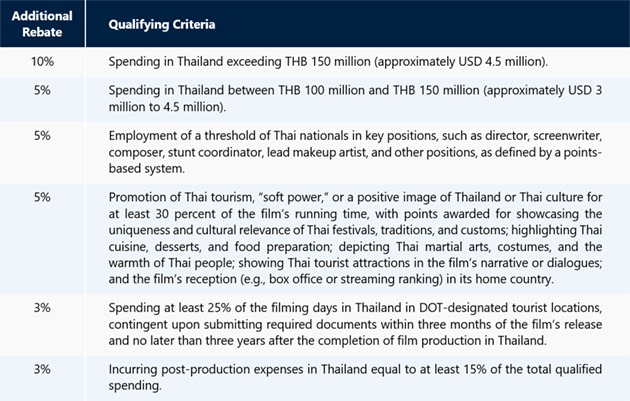
On top of this primary incentive, additional incentives are available; however, the total possible cash rebate is capped at 30 percent, and the additional incentives can only amount to an added 15 percent. Also, the total rebate (including both primary and additional incentives) for films with a budget of less than THB 100 million (approx. USD 3 million) is capped at 25%.

To obtain a higher rebate rate, productions may apply for the following additional incentives:
Compliance Requirements

Foreign production companies seeking to benefit from Thailand’s enhanced film incentives must navigate a structured application and compliance process. The 2024 announcement establishes different processing periods for applications based on spending thresholds. Noncompliance with these procedural requirements could jeopardize eligibility for the rebates, regardless of the actual amount spent in the country.

One of the key criteria for receiving the incentives is that the filming must not cause or result in environmental damage or harm to natural resources; otherwise, the approved incentives will be revoked.

The timing of this policy is noteworthy, given the recent decision regarding an environmental dispute in which Thailand’s Ministry of Natural Resources and Environment sued a major production company for over THB 100 million (approx. USD 3 million), alleging ecological damage caused during filming. The lawsuit claimed that alterations to a bay landscape and failure to comply with legal requirements and agreements established with the authorities resulted in extensive environmental harm, including deforestation and coral reef destruction. After 20 years of legal proceedings, the Thai Supreme Court ruled in 2022 that the production company must pay THB 10 million (approx. USD 300,000), or 10% of the original claim. This case underscores the risk of noncompliance with legal requirements, which can result in negative publicity, financial liability, and the loss of eligibility for incentives.

Tax Implications and Documentation Requirements

The rebate mechanism interacts with several Thai tax considerations that foreign production companies should carefully evaluate. The 2024 announcement specifies that the rebate itself is subject to 1% withholding tax under the Thai Revenue Code. Additionally, service and rental expenses paid to Thai providers typically attract withholding tax rates of 3% and 5%, respectively, while most goods and services in Thailand are subject to 7% VAT (value-added tax), significantly impacting overall production budgeting. The rebate application process also requires comprehensive financial documentation as specified in the requisition form, with all expenses requiring proper verification according to Thai Revenue Department standards.

Understanding which preproduction, production, and postproduction expenses qualify (particularly the requirement that physical production expenses in Thailand must be at least 50% of total qualified spending) requires careful planning. Professional tax and legal advice can help companies optimize their structure to maximize eligible expenses while ensuring regulatory compliance.

Final Remarks

Thailand’s revised film incentives under the DOT’s 2024 announcement provide lucrative opportunities for foreign film and television productions. By enhancing financial incentives, Thailand aims to attract more international projects, thereby stimulating economic growth and promoting cultural exchange. As the global film industry continues to evolve, Thailand’s proactive approach positions it as a competitive and attractive destination for filmmakers worldwide. Productions planning to capitalize on these incentives are advised to consult local experts to navigate the regulatory landscape effectively.


RELATED INSIGHTS​ 

July 30, 2025
Artificial intelligence (AI) model training and data scraping are essential processes in the development of modern AI systems. AI model training involves using large datasets to teach machine learning algorithms to recognize patterns, make predictions, or generate new content. Data scraping refers to the automated extraction of information from websites or digital sources, often to assemble the vast datasets required for effective AI training. As these practices become more widespread, questions about the legality of using third-party content—especially copyrighted works—have become increasingly important. In Thailand, the legal landscape for AI developers is shaped primarily by the Copyright Act, which presents unique challenges due to the absence of a fair-use exception. This article examines the copyright-related risks and legal uncertainties facing AI developers under Thailand’s current copyright law and practices, offering strategic guidance for navigating this complex environment. Copyright Risks in AI Scraping and Training Thailand’s Copyright Act does not provide a broad fair use or fair dealing exception, unlike some other jurisdictions, such as the United States. This absence has significant consequences for AI developers: No general defense for AI training: Any use of copyrighted material for AI model training is presumed to be infringing unless a specific, narrow statutory exception applies or explicit permission is obtained from the rights holder. There is no general legal basis for using copyrighted works in AI training without authorization. Increased rights clearance burden: Developers must identify and secure licenses for every copyrighted work included in their training datasets. Given the scale and diversity of data required for effective AI models, this process can be both impractical and costly. Legal ambiguity and litigation risk: The lack of clear statutory guidance or case law leaves developers in a legal gray area. There is no established precedent clarifying whether certain uses of copyrighted material for
July 25, 2025
Over the first half of 2025, the government of Vietnam has implemented a comprehensive suite of legislative reforms that significantly impact the country’s intellectual property (IP) framework. These amendments, most of which took effect on 1 July 2025, span the criminal, civil, administrative, and judicial sectors, and are part of a broader initiative to modernize Vietnam’s legal infrastructure, strengthen enforcement mechanisms, and harmonize domestic regulations with international standards. A summary of the key legislative changes and their potential implications for IP protection and enforcement across Vietnam is provided below. Criminal Code: Stricter penalties Under the 2025 amendments to Vietnam’s Criminal Code, penalties for offenses involving the manufacturing and trading of counterfeit goods have been significantly escalated. Individuals convicted of such violations now face fines ranging from VND 200 million to VND 2 billion (approximately USD 7,700 to USD 77,000; up from VND 100 million to VND 1 billion). For corporate entities, the penalties are even more severe, with fines ranging from VND 2 billion to VND 40 billion (roughly USD 77,000 to USD 1.54 million; up from VND 1 billion to VND 20 billion). These heightened penalties reflect the government’s intensified efforts to deter counterfeit-related crimes and protect consumer rights. Law on Handling Administrative Violations: Extended statute of limitations and application of electronic procedure The statute of limitations for addressing administrative violations in the IP sector is still two years. However, in cases where such violations are referred by procedural authorities, this period is extended by one year. The time taken by these authorities to process the case is now included within the overall limitation period. In addition, the Law on Handling Administrative Violations facilitates the use of electronic procedures, provided that the necessary infrastructure, technical systems, and information conditions are in place. Specifically, enforcement authorities are now permitted
July 21, 2025
Distinctiveness is a fundamental requirement for a trademark’s registration and protection under Thai law. The Thai courts typically assess distinctiveness based on a mark’s inherent characteristics rather than its use, as proving acquired distinctiveness through use requires substantial evidence, including the duration of use, extent of distribution and promotional efforts. However, the Intellectual Property and International Trade Court (IP & IT Court) has recently ruled that the figurative mark WEPLAY had acquired distinctiveness through use – an uncommon ruling under Thai trademark law. Subsequently, the Court of Appeal for Specialised Cases affirmed the mark’s inherent distinctiveness based on a holistic assessment of its components. This article discusses the criteria for proving both inherent and acquired distinctiveness, offering examples from both courts to provide valuable insights into case preparation and understanding of how the courts assess distinctiveness. Background In 2017 the plaintiff filed a trademark application for the mark depicted below for goods in Class 28, including toy building blocks: The registrar rejected the application on the grounds of non-distinctiveness under Section 7 of the Trademark Act. The plaintiff appealed to the Board of Trademarks, which considered that, when the term ‘weplay’ is used for goods in Class 28, it is descriptive of the nature of the goods applied for as “playthings”. Therefore, ‘weplay’ was deemed nondistinctive under Section 7, Paragraph 2(2) of the Trademark Act. IP & IT Court decision In 2024 the IP & IT Court ruled that the term ‘weplay’ is not a coined or invented word; instead, it is a combination of ‘we’ and ‘play’, conveying the meaning of ‘we play’. When the term is used for goods in Class 28, it describes the nature of the goods as “playthings”. Consequently, the mark was deemed non-distinctive. However, the court considered the evidence presented by the plaintiff,
July 14, 2025
Life sciences specialists from Tilleke & Gibbins have updated the firm’s guide to pharmaceutical data exclusivity regulations and practices in Southeast Asia. This guide contains quick-reference information on the availability of data exclusivity protections and limitations in Cambodia, Indonesia, Laos, Malaysia, Myanmar, Thailand, and Vietnam. Developing and launching a new drug on a commercial scale requires an enormous amount of time and investment in research and development (R&D), including pre-clinical testing and clinical trials. When considering the aggregate amount of drug development costs, it is important to recognize that this includes not only the investment in developing new drugs that get approved by a government food and drug regulator and are successfully brought to market, but also the R&D expenditures on a large number of potential pharmaceutical compounds and products that never actually make it to market. In particular, considerable investment is required in order to conduct and produce clinical trial data—to prove safety, efficacy and effectiveness of a new drug—that would warrant marketing approval by the regulatory authority. Such data is proprietary in nature and highly valuable for a research-based pharmaceutical company that develops an original drug. On the other hand, patent law typically confers generic drug manufacturers with the ability to engage in various preparatory activities with a view to obtaining marketing approval for a generic product before the patent for the original drug expires (commonly known as a “Bolar provision”). Since a generic drug maker may submit an application for marketing approval of a generic product before the relevant patent expires, the extent to which the drug originator’s data submitted to the regulatory authority is protected—or in other words, the extent to which the generic company may rely on the drug originator’s previously filed data, which underpins the safety and efficacy of the drug, to support