
You are using an outdated browser and your browsing experience will not be optimal. Please update to the latest version of Microsoft Edge, Google Chrome or Mozilla Firefox. Install Microsoft Edge

March 12, 2025

Updates on Thailand’s Film Incentive Measures

In November 2024, Thai Prime Minister Paethongtarn Shinawatra unveiled ambitious plans to enhance tax incentives for foreign film productions during a networking reception in Los Angeles, coinciding with her visit to the APEC Economic Leaders’ Meeting in Lima, Peru. This event, attended by Motion Picture Association executives and leaders from top US film companies, marked a significant commitment to boosting foreign investment in Thailand’s film industry.

Thailand’s Department of Tourism (DOT) prioritized the initiative by updating the Announcement on Guidelines, Procedures, and Conditions for Applying for Benefits Under the Incentive Measures for Foreign Film Production in Thailand in December 2024 to further position Thailand as a destination for large-scale international film and television productions.

Key Amendments to Film Incentives under the 2024 Announcement

The 2024 announcement introduced major changes, including (1) removal of the rebate cap, previously set at THB 150 million (approx. USD 4.5 million) per project, enabling rebates based on total qualified spending, and (2) an increase in cash rebate rates. The maximum allowable cash rebate rate was increased to 30 percent from the previous cap of 20 percent. The base rate of 15 percent remains unchanged.

The primary incentive available under the 2024 announcement is a 15 percent cash rebate on qualified spending in Thailand of at least THB 50 million (approx. USD 1.5 million).

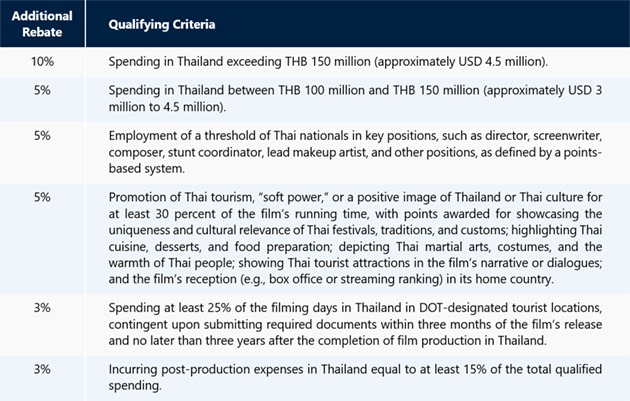
On top of this primary incentive, additional incentives are available; however, the total possible cash rebate is capped at 30 percent, and the additional incentives can only amount to an added 15 percent. Also, the total rebate (including both primary and additional incentives) for films with a budget of less than THB 100 million (approx. USD 3 million) is capped at 25%.

To obtain a higher rebate rate, productions may apply for the following additional incentives:
Compliance Requirements

Foreign production companies seeking to benefit from Thailand’s enhanced film incentives must navigate a structured application and compliance process. The 2024 announcement establishes different processing periods for applications based on spending thresholds. Noncompliance with these procedural requirements could jeopardize eligibility for the rebates, regardless of the actual amount spent in the country.

One of the key criteria for receiving the incentives is that the filming must not cause or result in environmental damage or harm to natural resources; otherwise, the approved incentives will be revoked.

The timing of this policy is noteworthy, given the recent decision regarding an environmental dispute in which Thailand’s Ministry of Natural Resources and Environment sued a major production company for over THB 100 million (approx. USD 3 million), alleging ecological damage caused during filming. The lawsuit claimed that alterations to a bay landscape and failure to comply with legal requirements and agreements established with the authorities resulted in extensive environmental harm, including deforestation and coral reef destruction. After 20 years of legal proceedings, the Thai Supreme Court ruled in 2022 that the production company must pay THB 10 million (approx. USD 300,000), or 10% of the original claim. This case underscores the risk of noncompliance with legal requirements, which can result in negative publicity, financial liability, and the loss of eligibility for incentives.

Tax Implications and Documentation Requirements

The rebate mechanism interacts with several Thai tax considerations that foreign production companies should carefully evaluate. The 2024 announcement specifies that the rebate itself is subject to 1% withholding tax under the Thai Revenue Code. Additionally, service and rental expenses paid to Thai providers typically attract withholding tax rates of 3% and 5%, respectively, while most goods and services in Thailand are subject to 7% VAT (value-added tax), significantly impacting overall production budgeting. The rebate application process also requires comprehensive financial documentation as specified in the requisition form, with all expenses requiring proper verification according to Thai Revenue Department standards.

Understanding which preproduction, production, and postproduction expenses qualify (particularly the requirement that physical production expenses in Thailand must be at least 50% of total qualified spending) requires careful planning. Professional tax and legal advice can help companies optimize their structure to maximize eligible expenses while ensuring regulatory compliance.

Final Remarks

Thailand’s revised film incentives under the DOT’s 2024 announcement provide lucrative opportunities for foreign film and television productions. By enhancing financial incentives, Thailand aims to attract more international projects, thereby stimulating economic growth and promoting cultural exchange. As the global film industry continues to evolve, Thailand’s proactive approach positions it as a competitive and attractive destination for filmmakers worldwide. Productions planning to capitalize on these incentives are advised to consult local experts to navigate the regulatory landscape effectively.


RELATED INSIGHTS​ 

October 3, 2025
In Thailand, the rise in online intellectual property infringement has prompted authorities to strengthen enforcement efforts, including the use of website-blocking orders under Section 20(3) of the Computer Crime Act B.E. 2560 (2017) (CCA). This provision authorizes the Ministry of Digital Economy and Society (MDES), with court approval, to block or remove computer data that constitutes a criminal offence under IP law. Since its implementation, the procedure has undergone several developments, which is an encouraging sign of progress. Website-blocking procedure In practice, website-blocking orders under Section 20(3) of the CCA are primarily used for copyright and trademark infringement. While such orders are legally applicable to patent infringement, their use remains challenging due to the difficulty of proving infringement through administrative procedures. The website-blocking procedure begins when an IP owner identifies online infringing content. For copyright infringement, which is considered a compoundable offence, the IP owner is required to first file a police report with the specialized police unit known as the Economic Crime Suppression Division (ECD) prior to filing the website-blocking application with the Department of Intellectual Property (DIP). For trademark infringement cases, the application can be filed directly with the DIP without a prior police report. The DIP reviews the evidence and, if infringement is confirmed, forwards it to the MDES for further consideration. If the case is deemed valid, the MDES requests a court order to block the infringing website. Once granted, the MDES notifies the internet service providers (ISPs) to block access to the specified website. Website blocking procedure in Thailand Recent advancements in website-blocking actions Seamless collaboration through digital integration. Thailand has made significant progress in digitizing its website-blocking procedures to improve efficiency and transparency. At present, all website-blocking applications and supporting evidence must be submitted in electronic format. These systems have significantly reduced processing
September 24, 2025
Online shopping in Thailand is more accessible than ever, with global platforms, local social media shops, and entertainment-driven social commerce enabling instant purchases. However, this convenience comes with rising concerns over digital intellectual property (IP) infringement, including counterfeit goods, pirated content, and unauthorized brand usage. At first glance, online platforms appear to offer quick solutions. Most major e-commerce sites, social media channels, and social commerce platforms provide “notice and takedown” systems, where IP owners can file complaints and request the removal of listings that infringe IP rights, such as trademarks and copyrights. These tools are certainly useful, as seeing a fake product vanish from a platform feels like progress. But the reality is less reassuring. The counterfeit goods themselves remain in warehouses, markets, or shops, ready to be resold. Sellers whose accounts are taken down often return within days under new names or accounts. In other words, a takedown is like cutting weeds without pulling out the roots: they always grow back. While notice and takedown tools are widely available and can be managed internally by most IP owners, their impact is often short-lived. IP owners seeking more effective, lasting protection need to take a more strategic and multilayered approach. The same applies to online piracy. Unauthorized streaming websites that offer free access to movies, TV shows, or sports broadcasts have become widespread in Thailand. To combat this, rightsholders can request website blocking under the Computer Crime Act, through the Ministry of Digital Economy and Society and the courts. Once requests are approved, internet service providers are ordered to block access to infringing sites. Blocking orders can be effective in disrupting large-scale piracy operations, but they also face limitations—pirate sites frequently reappear under new domains. Strategic Protection Whether the infringing material is physical counterfeit goods or intangible streaming content,
September 17, 2025
Thailand’s Ministry of Finance has introduced a five-year personal income tax exemption on capital gains from the disposal of cryptocurrency or digital tokens. The Ministerial Regulation No. 399, published in the Government Gazette on September 5, 2025, offers the personal income tax exemption for transfers occurring between January 1, 2025, and December 31, 2029. The ministerial regulation was enacted to promote Thailand as a global financial center and digital asset business hub while encouraging increased domestic investment in digital assets. Key Conditions The exemption, which covers capital gains from cryptocurrency and digital token disposals during the specified five-year period, applies only to individuals. Companies that trade in digital assets are not eligible for this tax exemption. With the tax holiday set to expire in 2029 (unless extended), individual traders should plan ahead for postexemption taxation to ensure full compliance with Thailand’s personal income tax requirements. Proper documentation of digital asset transactions during the exemption period will be essential for future tax compliance. For more details on this tax exemption, or on any aspect of Thailand’s tax law and regulations, please contact Saravut Krailadsiri at [email protected] or Papavarin Sarawongsuth at [email protected].
September 4, 2025
On June 6, 2025, the Superior People’s Court in Hanoi overturned a non-use cancellation decision by the Intellectual Property Office of Vietnam, a rare and impactful occurrence. In a ruling that may help clarify the enforcement of Vietnam’s IP Law, the court held that valid trademark use can be established through commercial arrangements where the brand owner maintains actual control over the use of the mark, and is not confined to relationships governed by a so-called “formal license agreement. Background: Cross-Border Use, Local Challenge A Singapore company owns a well-known brand of consumer products that has gained recognition across Southeast Asia. In recent years, the brand has been targeted by several unauthorized trademark filings in Vietnam. In one such instance, a local Vietnamese trading company—previously linked to the production and export of counterfeit goods to neighboring countries—filed a non-use cancellation against the Singapore company’s mark and sought to register it under its own name. If the cancellation had been upheld, it would have enabled a complete hijacking of the brand. The IP holder operates in Vietnam through a structured cross-border supply chain. Under an agreement between two related foreign entities, one of which managed regional operations, production orders were placed through a designated Vietnamese company. While the Vietnamese manufacturer was not a party to the agreement, its role in using the mark was recognized and governed by internal and commercial documentation. The Vietnamese manufacturer lawfully obtained the necessary permits, regulatory approvals, and customs clearances for producing the goods in Vietnam. These activities were supported by banking records and internal communications, evidencing active, continuous use of the mark in Vietnam. However, the IP Office concluded that this use did not meet the statutory criteria because the Vietnamese manufacturer did not have a direct license agreement with the brand owner, as