
You are using an outdated browser and your browsing experience will not be optimal. Please update to the latest version of Microsoft Edge, Google Chrome or Mozilla Firefox. Install Microsoft Edge

March 12, 2025

Updates on Thailand’s Film Incentive Measures

In November 2024, Thai Prime Minister Paethongtarn Shinawatra unveiled ambitious plans to enhance tax incentives for foreign film productions during a networking reception in Los Angeles, coinciding with her visit to the APEC Economic Leaders’ Meeting in Lima, Peru. This event, attended by Motion Picture Association executives and leaders from top US film companies, marked a significant commitment to boosting foreign investment in Thailand’s film industry.

Thailand’s Department of Tourism (DOT) prioritized the initiative by updating the Announcement on Guidelines, Procedures, and Conditions for Applying for Benefits Under the Incentive Measures for Foreign Film Production in Thailand in December 2024 to further position Thailand as a destination for large-scale international film and television productions.

Key Amendments to Film Incentives under the 2024 Announcement

The 2024 announcement introduced major changes, including (1) removal of the rebate cap, previously set at THB 150 million (approx. USD 4.5 million) per project, enabling rebates based on total qualified spending, and (2) an increase in cash rebate rates. The maximum allowable cash rebate rate was increased to 30 percent from the previous cap of 20 percent. The base rate of 15 percent remains unchanged.

The primary incentive available under the 2024 announcement is a 15 percent cash rebate on qualified spending in Thailand of at least THB 50 million (approx. USD 1.5 million).

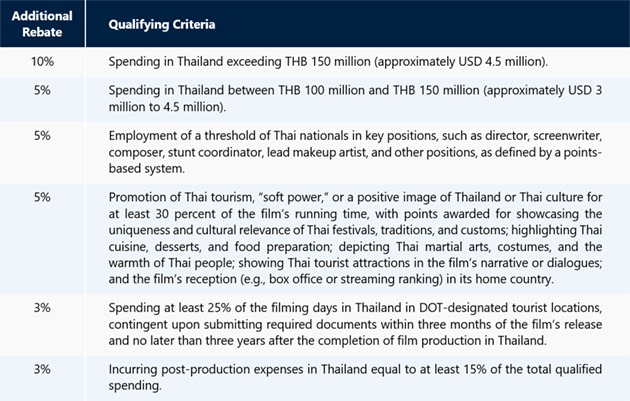
On top of this primary incentive, additional incentives are available; however, the total possible cash rebate is capped at 30 percent, and the additional incentives can only amount to an added 15 percent. Also, the total rebate (including both primary and additional incentives) for films with a budget of less than THB 100 million (approx. USD 3 million) is capped at 25%.

To obtain a higher rebate rate, productions may apply for the following additional incentives:
Compliance Requirements

Foreign production companies seeking to benefit from Thailand’s enhanced film incentives must navigate a structured application and compliance process. The 2024 announcement establishes different processing periods for applications based on spending thresholds. Noncompliance with these procedural requirements could jeopardize eligibility for the rebates, regardless of the actual amount spent in the country.

One of the key criteria for receiving the incentives is that the filming must not cause or result in environmental damage or harm to natural resources; otherwise, the approved incentives will be revoked.

The timing of this policy is noteworthy, given the recent decision regarding an environmental dispute in which Thailand’s Ministry of Natural Resources and Environment sued a major production company for over THB 100 million (approx. USD 3 million), alleging ecological damage caused during filming. The lawsuit claimed that alterations to a bay landscape and failure to comply with legal requirements and agreements established with the authorities resulted in extensive environmental harm, including deforestation and coral reef destruction. After 20 years of legal proceedings, the Thai Supreme Court ruled in 2022 that the production company must pay THB 10 million (approx. USD 300,000), or 10% of the original claim. This case underscores the risk of noncompliance with legal requirements, which can result in negative publicity, financial liability, and the loss of eligibility for incentives.

Tax Implications and Documentation Requirements

The rebate mechanism interacts with several Thai tax considerations that foreign production companies should carefully evaluate. The 2024 announcement specifies that the rebate itself is subject to 1% withholding tax under the Thai Revenue Code. Additionally, service and rental expenses paid to Thai providers typically attract withholding tax rates of 3% and 5%, respectively, while most goods and services in Thailand are subject to 7% VAT (value-added tax), significantly impacting overall production budgeting. The rebate application process also requires comprehensive financial documentation as specified in the requisition form, with all expenses requiring proper verification according to Thai Revenue Department standards.

Understanding which preproduction, production, and postproduction expenses qualify (particularly the requirement that physical production expenses in Thailand must be at least 50% of total qualified spending) requires careful planning. Professional tax and legal advice can help companies optimize their structure to maximize eligible expenses while ensuring regulatory compliance.

Final Remarks

Thailand’s revised film incentives under the DOT’s 2024 announcement provide lucrative opportunities for foreign film and television productions. By enhancing financial incentives, Thailand aims to attract more international projects, thereby stimulating economic growth and promoting cultural exchange. As the global film industry continues to evolve, Thailand’s proactive approach positions it as a competitive and attractive destination for filmmakers worldwide. Productions planning to capitalize on these incentives are advised to consult local experts to navigate the regulatory landscape effectively.


RELATED INSIGHTS​ 

October 30, 2025
Thailand has introduced a comprehensive overhaul of its tax litigation procedures that will significantly impact how tax disputes are handled. The Regulations for Tax Cases B.E. 2568 (2025) take effect on November 24, 2025, and repeal the prior B.E. 2544 (2001) regulations in full. These regulations support the implementation of the Act on the Establishment of the Tax Court and Tax Case Procedure (No. 3) B.E. 2568 (2025), which expands the Tax Court’s jurisdiction to certain criminal tax matters. Published in the Government Gazette on October 14, 2025, the regulations have been reorganized into three parts covering civil cases, criminal cases, and forms, and are designed to accelerate proceedings, tighten evidentiary discipline, and modernize court operations. Structural Reform and Scope The prior regime governed only civil tax disputes. Under the new framework, the regulations introduce a dedicated chapter for criminal cases alongside updated civil procedures, as the Tax Court now has express authority to adjudicate specified criminal tax offenses. Select mechanisms applied in civil case proceedings, such as electronic communication, recording testimony, and appointing experts, also apply to criminal proceedings mutatis mutandis where they do not conflict with criminal procedure. Civil Cases: Evidence Submission, Deadlines, and Scheduling Parties must submit, together with the witness list, originals of all documentary evidence, media, or electronic data (such as files, USB drives, or CDs), and all physical evidence in the party’s possession. Failure to submit any original within the deadline (see below) results in a loss of the right to adduce that item at trial, subject only to narrow exceptions where submission is impossible due to force majeure or where receipt of the evidence is indispensable to the interests of justice. The practical impact is that parties are now obligated to assemble and verify all original documents and data at the very
October 26, 2025
AI-generated songs are now making waves in Vietnam on platforms like TikTok, with tracks such as “Say mot doi vi em” quickly gaining popularity and sparking widespread attention. This phenomenon raises a host of legal and ethical questions: Who is the author of these songs? Can they be protected by copyright? Who is responsible if there is an infringement? These questions are becoming increasingly urgent as AI music becomes more mainstream in Vietnam. Copyright Protection for AI-Generated Music in Vietnam Under current Vietnamese law, copyright protection is reserved for works that bear the mark of human creativity. The 2022 amendments to Vietnam’s Intellectual Property Law reaffirm that only works created by humans are eligible for copyright. In practice, if a human meaningfully contributes to the creative process—by providing prompts, making selections, editing, or arranging—their contribution may be protected. However, if a song is generated entirely by AI without significant human input, it is unlikely to qualify for copyright protection. When an AI-generated song does not qualify for copyright protection, the question arises as to whether the person who writes the prompts, edits, or compiles the work can still be considered the owner of an asset under the Vietnamese Civil Code. According to Article 105 of the Civil Code 2015, assets include objects, money, valuable papers, and property rights. While AI-generated music that is not protected by copyright is not considered money or valuable papers, it may be regarded as an object (in the form of a digital file or recording) or as a property right if it can be possessed, used, transferred, or exploited for value. Use of AI-Generated Works Without Copyright Protection If a song is not protected by copyright, does that mean anyone can use it freely? Not necessarily. The absence of copyright does not mean the
October 24, 2025
Thailand currently lacks a specific franchise act. Consequently, the legality of any franchise agreement is determined by its compliance with various existing laws, such as the Civil and Commercial Code, the Trademark Act B.E. 2534 (1991) (as amended), and the Unfair Contract Terms Act B.E. 2530 (1997). Thailand is a freedom-to-contract jurisdiction. This allows for a high degree of flexibility and autonomy in contractual arrangements, provided that the terms do not violate any laws or public policy and do not fall under the scope of unfair contract terms. Given this, the requirement for fairness in franchise agreement terms often leads to uncertainty, but decisions from the Trade Competition Commission of Thailand (TCCT) can provide guidance on whether specific contentious terms are in fact fair.  One issue worth examining in this light is the inclusion of terms on nonrefundable franchise fees and strict purchasing conditions. Franchise Fee: Unfair to Refuse Refund? Nonrefundable franchise fees represent a significant upfront investment for franchisees, often becoming a point of contention if the franchise relationship deteriorates or the franchisor ceases operations. Their fairness and enforceability are frequently scrutinized by regulatory bodies like the TCCT, highlighting the critical balance between contractual freedom and franchisee protection. Faced with one such case, the TCCT considered whether it was unfair for the franchisor to refuse to refund the franchise fee after the franchisor ceased operations.  The franchisee had entered into a service agreement on August 2, 2021, and begun operating on October 9, 2021. However, by November 21, 2023, the franchisee was notified that the system would be shut down for maintenance, and by December 26, 2023, the franchisor announced the cessation of operations due to financial losses. The franchisee then requested a refund of the franchise fee. Unfortunately for the franchisee, the TCCT found that the franchisor’s
October 23, 2025
Myanmar’s customs authorities have introduced new procedures allowing copyright holders to protect their intellectual property from infringing goods at the border. The Ministry of Finance and Revenue issued Notification No. 107/2025 on September 11, 2025, establishing rules and requirements for customs recordation under the Copyright Law of 2019. The notification includes eight official forms for copyright-related customs matters—three for applicants and five for the Customs Department. This was followed by Customs Department Announcement No. 1/2025, dated September 29, 2025, which details the security required for suspended goods. Customs recordation provides a proactive mechanism for rights holders to prevent importation of pirated works. By registering their works with the Customs Department, rights holders gain access to enhanced border enforcement measures, empowering customs officials to identify and intercept pirated goods before they enter the market. While copyright protection in Myanmar arises automatically under the Copyright Law of 2019, a registration certificate for copyright or related rights is required to apply for customs recordation. Customs Recordation Registered copyright and related rights holders can apply directly or through authorized legal representatives for customs recordation to prevent cross-border trade in pirated works. Applications must use the prescribed form and include all supporting documentary evidence specified in the form. The Customs Department will notify applicants within 15 days of receiving their application. Each recordation remains valid for two years from the date of acceptance and may be renewed for successive two-year periods by submitting a renewal application at least 30 days before expiration. Rights holders whose works are recorded must notify the Customs Department within five days of any amendment or withdrawal of information at the Intellectual Property Department. Suspension Orders Registered copyright and related rights holders can request a suspension order to prevent release of pirated goods into free circulation, regardless of whether they