You are using an outdated browser and your browsing experience will not be optimal. Please update to the latest version of Microsoft Edge, Google Chrome or Mozilla Firefox. Install Microsoft Edge

April 30, 2021

Updated Regulations on Filing Patents and Petty Patents in Laos

Laos’ Department of Intellectual Property (DIP) published its Decision on Patents and Petty Patents No. 1714/MOST, dated December 15, 2020, in the Official Gazette on December 23, 2020. The decision is a replacement for and comprehensive revision of a similarly named 2012 decision, and it is the latest step in the country’s steady efforts to strengthen its patent regime. The new decision clarifies and simplifies many key points, the most significant of which are detailed below.

  • Priority date. Applications filed under the Patent Cooperation Treaty have a 31-month time limit for entering the national phase, counting from the priority date. This improves on the 2012 decision, which set the time limit at 30 months.
  • Submission of original documents. If the pre-filled, unsigned form for the power of attorney and deed of assignment is submitted, scanned copies of the notarized power of attorney and deed of assignment must be submitted within 15 days (down from 60 days under the 2012 decision). However, the original documents still must be submitted within 60 days.
  • International classification. Applicants can ask the Department of Intellectual Property (DIP) to indicate the international class of patent and petty patent applications. If there are amendments to the class, applicants can file an amendment form with the DIP free of charge. International classification was not mentioned in the 2012 decision.
  • Publication timeline. Applications for patents or petty patents will be published in the 19th month after the application filing or priority date. The 2012 decision, in contrast, did not mention the publication timeline.
  • Opposition. The procedures for an opposition to a patent or petty patent application are clear and concise under the new decision, whereas opposition was not mentioned in the 2012 decision.
  • Examination request period. While the 2012 decision gave only a broad description of examination, the new decision provides clear guidelines on procedures, requirements, and timeline of this phase. The applicant must request substantive examination within 24 months after the filing date for patents and six months for petty patents. International substantive examination results can be filed within three months of their receipt.
  • Claims. An excess fee will apply to each independent claim in excess of 3 and each dependent claim in excess of 15.
  • Error correction. The decision permits the correction of errors found in the publication of a patent after it has been granted. Correction requests must be made within 60 days of the date of publication.
  • Cancellation and withdrawal. Third parties can file cancellation applications with the DIP within five years after the relevant publication date in the Official Gazette. If more than five years has elapsed since the relevant patent’s publication date, the application should be filed with the People’s The 2012 decision had only addressed this issue in broad terms.
  • Annuity payments. There is a six-month grace period for renewal and annuity payments.

While securing patents in Laos has not been a priority for many companies operating in the jurisdiction, some of the ambiguity that surrounded the practice has been cleared up by this decision. Consequently, it is more worthwhile then ever for intellectual asset owners to incorporate a patent filing strategy into their business plans in Laos.

Filing Process for Patents and Petty Patents

This new decision on patents and petty patents was the main topic for a roundtable discussion between Tilleke & Gibbins and the Lao DIP on March 31, 2021. In preparation for the meeting, IP specialists at Tilleke & Gibbins developed a flowchart of the patent-filing process in Laos, emphasizing the key points of the new decision and providing a touchstone for the dialogue, allowing for practical and fruitful discussions of each step of the process. It also acts as a helpful guide to the process for those unfamiliar with it, and we are pleased to provide it below for reference.
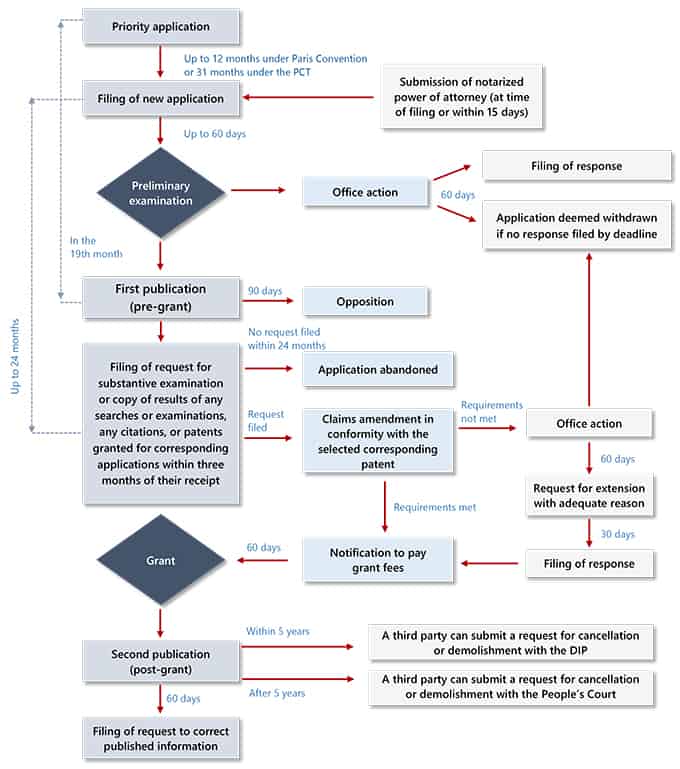
The DIP representatives found the flowchart to be a useful and practice overview, and provided helpful insights on best practices for obtaining a patent in Laos. They also expressed their optimism that the issues of prolonged pendency for patent registration in Laos may finally be improved, with the DIP aiming to decrease the backlog of pending patent applications in the coming few years. The successful realization of this improvement would be positive news for Laos, as it would allow the registration of these crucial rights to be completed in a timely manner, thereby attracting more incoming investment in technology from companies that would be able to rely on legal protections for their patented inventions.


RELATED INSIGHTS​ 

March 6, 2026
Myanmar’s Trademark Law 2019 introduced a modern framework for the registration, enforcement, and protection of trademarks. However, due to the high volume of applications filed during the soft-opening period of the Intellectual Property Department (IPD), marks submitted from 2022 onward remain pending as the IPD works its way through the applications filed in 2021, which it has been publishing on a monthly basis since May 1, 2024. During this period, businesses should adopt proactive strategies to protect their brands, monitor conflicting marks, and ensure a smooth registration process. Practical Steps for Safeguarding Pending Marks While a pending application does not confer full trademark rights, brand owners can take several practical steps to strengthen their position: Monitor IPD publications. Businesses should regularly review the IPD’s monthly gazette to identify any identical or confusingly similar marks at an early stage and prepare timely oppositions in accordance with the Trademark Law’s provisions allowing “any interested party” to file an objection to a trademark application. Monitor market activity. Early detection of potential infringement enables swift action, such as cease-and-desist letters and opposition proceedings. Businesses should monitor competitors, distributors, and retailers for unauthorized use of their marks. Collect evidence of use. Maintaining evidence of use strengthens claims of distinctiveness and supports enforcement efforts. Businesses should keep records of commercial activities, distribution, brand promotion and development, marketing communications, product packaging and labeling, and sales demonstrating brand recognition in Myanmar and internationally, particularly in Southeast Asian markets. Although the Trademark Law 2019 establishes a first-to-file system, evidence of use provides considerable practical support for distinctiveness claims and enforcement actions. Pursue Interim Enforcement Options. A pending trademark application can be relied upon to oppose or refuse other marks on absolute and/or relative grounds of refusal. In addition, marks with established reputations may be protected under passing-off principles
February 27, 2026
On January 26, 2026, Vietnam’s Ministry of Finance issued Circular No. 06/2026/TT-BTC (Circular 06), amending and supplementing Circular No. 13/2015/TT-BTC, which provides guidance on dossiers and procedures for customs recordal and customs supervision in relation to intellectual property rights (IPR). Circular 06 has an effective date of March 1, 2026. Some notable points of Circular 06 include the following: Simplified Documentation for Customs Recordal Applications Circular 06 reduces some documentary requirements for IPR owners: A power of attorney is no longer required to be legalized. Applicants are no longer required to submit title or registration certificates if such documents are issued in digital form. In such cases, it is sufficient to declare comprehensive information on the relevant IPR, enabling customs authorities to verify the information through publicly accessible databases. In practice, this amendment is particularly beneficial for international trademark registrations designating Vietnam. IPR owners may no longer need to obtain a confirmation letter from the Intellectual Property Office of Vietnam regarding the validity of a trademark registration in Vietnam. Instead, they may rely on registration status information available from the World Intellectual Property Organization (WIPO) database, reflecting that the international registration has been granted protection in Vietnam. Clearer Mechanism for Ex Officio Suspension of Suspected Infringing Goods Although ex officio suspension has been referenced in earlier regulations, Circular 06 provides clearer guidance on the circumstances and procedures under which customs may proactively suspend customs procedures for consignments suspected of being counterfeit or pirated goods. Accordingly, customs authorities may initiate the suspension of clearance without waiting for a formal request from IPR owners. Enhanced Supervision of Imported/Exported Goods in E-Commerce Circular 06 also supplements provisions on the inspection of imported and exported goods transacted through e-commerce channels. Customs authorities may apply risk management measures to assess goods traded via e-commerce
February 26, 2026
Thailand is preparing to offer new tools for intellectual property enforcement as the Electronic Transactions Development Agency (ETDA) recently released for public consultation a draft notification requiring social media platforms to verify user identities and conduct know-your-customer (KYC) checks on advertisers. The draft Notification of the Electronic Transactions Commission on Measures to Prevent Technological Crimes for Social Media Service Providers, which is to be issued under the Emergency Decree on Measures for the Prevention and Suppression of Technological Crimes B.E. 2566 (2023), as amended in 2025, primarily aims to combat online fraud and technology-related crimes. However, its new obligations also provide IP owners with valuable tools to identify anonymous infringers. Key Regulatory Mandates The draft notification imposes several verification requirements on social media platforms operating in Thailand. These requirements also strengthen IP rights holders’ ability to identify anonymous infringers, as platforms must: Verify user identities through registered phone numbers and link all accounts to verifiable identities. Conduct KYC checks on advertisers, including individuals, companies, and any third-party payers. Perform heightened identity checks for high-risk or repeat offenders before publishing advertisements. Promptly remove content flagged by the Anti-Technology Crime Division and prescreen advertisements for prohibited or high-risk content. How IP Owners Can Use This Notification for Enforcement The phone number–based verification requirement enables IP owners to work more effectively with enforcement authorities in tracing individuals or entities responsible for infringing content. The comprehensive advertiser KYC obligations, including mandatory disclosure of third-party payment sources, create a clear audit trail even when bad actors attempt to obscure their identity through intermediaries or shell accounts. This traceability is essential for pursuing damages and dismantling organized counterfeit operations. The ETDA is now considering adjustments to the draft notification after receiving comments during the public consultation period, which ended on February 2, 2026. Following finalization
February 25, 2026
Tilleke & Gibbins has updated the Vietnam chapter in the newly released Licensing 2026 guide, published by Lexology Panoramic. The comparative guide provides companies and other interested readers with information on licensing law and practice in various countries around the world. Licensing 2026 provides detailed information on the following topics: Restrictions, laws and licensing arrangements Intellectual property issues: Paris Convention for the Protection of Industrial Property, contesting the validity of licensor’s IP rights, invalidity and expiry of IP rights, security interests, proceedings against third parties, sublicensing, jointly owned IP, first to file, scope of patent protection, trade secrets, copyright Software licensing: Perpetual licensing, legal requirements, user restrictions Royalties and payments, currency conversion, and taxes: Relevant legislation, restrictions, taxation of foreign licensors Competition law issues: Restrictions on trade, legal restrictions, and IP-related court rulings Indemnification, disclaimers, and damages: Prevalence and enforceability of indemnity provisions and contractual waivers of damages Termination: Right to terminate, impact of termination Bankruptcy: Impact of licensee or licensor bankruptcy Dispute resolution: Governing law, arbitration, enforceability, injunctive relief, contractual waivers The Vietnam chapter is available below as a PDF. Readers can gain 30 days of complementary access to the full Licensing 2026 guide and the rest of Lexology Panoramic’s varied offerings through this link.