You are using an outdated browser and your browsing experience will not be optimal. Please update to the latest version of Microsoft Edge, Google Chrome or Mozilla Firefox. Install Microsoft Edge

April 30, 2021

Updated Regulations on Filing Patents and Petty Patents in Laos

Laos’ Department of Intellectual Property (DIP) published its Decision on Patents and Petty Patents No. 1714/MOST, dated December 15, 2020, in the Official Gazette on December 23, 2020. The decision is a replacement for and comprehensive revision of a similarly named 2012 decision, and it is the latest step in the country’s steady efforts to strengthen its patent regime. The new decision clarifies and simplifies many key points, the most significant of which are detailed below.

  • Priority date. Applications filed under the Patent Cooperation Treaty have a 31-month time limit for entering the national phase, counting from the priority date. This improves on the 2012 decision, which set the time limit at 30 months.
  • Submission of original documents. If the pre-filled, unsigned form for the power of attorney and deed of assignment is submitted, scanned copies of the notarized power of attorney and deed of assignment must be submitted within 15 days (down from 60 days under the 2012 decision). However, the original documents still must be submitted within 60 days.
  • International classification. Applicants can ask the Department of Intellectual Property (DIP) to indicate the international class of patent and petty patent applications. If there are amendments to the class, applicants can file an amendment form with the DIP free of charge. International classification was not mentioned in the 2012 decision.
  • Publication timeline. Applications for patents or petty patents will be published in the 19th month after the application filing or priority date. The 2012 decision, in contrast, did not mention the publication timeline.
  • Opposition. The procedures for an opposition to a patent or petty patent application are clear and concise under the new decision, whereas opposition was not mentioned in the 2012 decision.
  • Examination request period. While the 2012 decision gave only a broad description of examination, the new decision provides clear guidelines on procedures, requirements, and timeline of this phase. The applicant must request substantive examination within 24 months after the filing date for patents and six months for petty patents. International substantive examination results can be filed within three months of their receipt.
  • Claims. An excess fee will apply to each independent claim in excess of 3 and each dependent claim in excess of 15.
  • Error correction. The decision permits the correction of errors found in the publication of a patent after it has been granted. Correction requests must be made within 60 days of the date of publication.
  • Cancellation and withdrawal. Third parties can file cancellation applications with the DIP within five years after the relevant publication date in the Official Gazette. If more than five years has elapsed since the relevant patent’s publication date, the application should be filed with the People’s The 2012 decision had only addressed this issue in broad terms.
  • Annuity payments. There is a six-month grace period for renewal and annuity payments.

While securing patents in Laos has not been a priority for many companies operating in the jurisdiction, some of the ambiguity that surrounded the practice has been cleared up by this decision. Consequently, it is more worthwhile then ever for intellectual asset owners to incorporate a patent filing strategy into their business plans in Laos.

Filing Process for Patents and Petty Patents

This new decision on patents and petty patents was the main topic for a roundtable discussion between Tilleke & Gibbins and the Lao DIP on March 31, 2021. In preparation for the meeting, IP specialists at Tilleke & Gibbins developed a flowchart of the patent-filing process in Laos, emphasizing the key points of the new decision and providing a touchstone for the dialogue, allowing for practical and fruitful discussions of each step of the process. It also acts as a helpful guide to the process for those unfamiliar with it, and we are pleased to provide it below for reference.
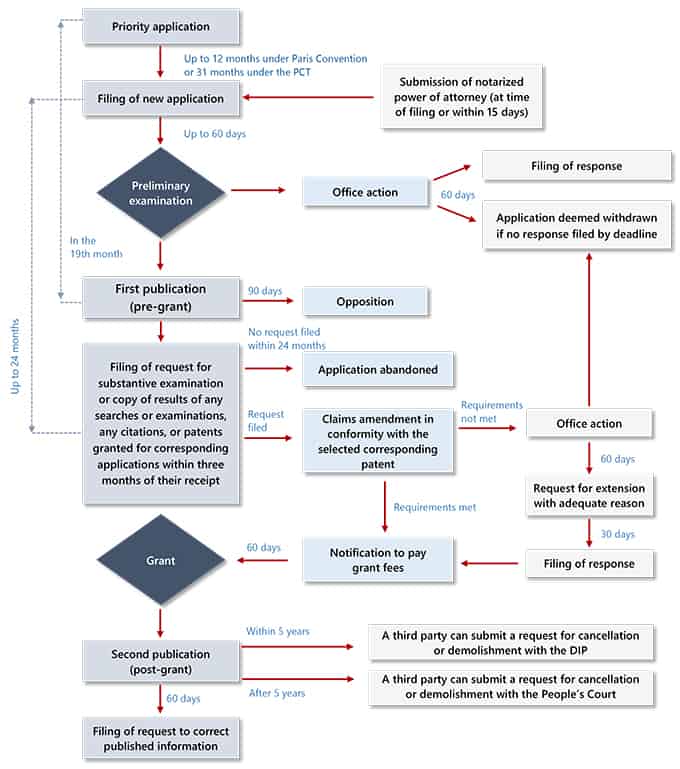
The DIP representatives found the flowchart to be a useful and practice overview, and provided helpful insights on best practices for obtaining a patent in Laos. They also expressed their optimism that the issues of prolonged pendency for patent registration in Laos may finally be improved, with the DIP aiming to decrease the backlog of pending patent applications in the coming few years. The successful realization of this improvement would be positive news for Laos, as it would allow the registration of these crucial rights to be completed in a timely manner, thereby attracting more incoming investment in technology from companies that would be able to rely on legal protections for their patented inventions.


RELATED INSIGHTS​ 

May 22, 2026
Intellectual property specialists from Tilleke & Gibbins in Vietnam have contributed an updated Intellectual Property Transactions in Vietnam overview for Thomson Reuters Practical Law, an online publication that provides comprehensive legal guides for jurisdictions worldwide. The Vietnam overview was authored by Linh Thi Mai Nguyen, Thanh Phuong Vu, Chi Lan Dang, Son Thai Hoang, and Duc Anh Tran. The chapter provides a high-level examination of key aspects of IP transactions law in Vietnam, including IP assignment and licensing, research and development collaborations, IP in mergers and acquisitions (M&A), lending and taking security over intellectual property rights, settlement agreements, employee- and consultant-created IP, competition law, taxation, and non-tariff trade barriers. Key topics covered in the chapter include: IP assignment: Basis and formalities for assignments of patents, utility models, trade marks, copyright, design rights, trade secrets, confidential information, and domain names in Vietnam. IP licensing: Scope, formalities, and recordal requirements for licensing patents, trade marks, copyright, design rights, and trade secrets. Research and development collaborations: Treatment of improvements, derivatives, and joint ownership of IP, including exploitation and enforcement issues. IP aspects of M&A and security: Due diligence, warranties, transfer formalities, and taking security over intellectual property rights. Practical Law, a legal reference resource from Thomson Reuters, publishes a range of guides for hundreds of jurisdictions and practice areas. The Intellectual Property Transactions Global Guide is a valuable resource for legal practitioners seeking comparative insight into transactional IP issues across multiple jurisdictions. To view the latest version of the Intellectual Property Transactions in Vietnam overview, please visit the Practical Law website and enroll in the free Practical Law trial to gain full access.
May 13, 2026
Laos has significantly broadened its industrial property administrative review framework, most notably by extending it to cover copyright and related rights for the first time. Decision No. 0306/IC on the Administrative Resolution of Disputes Concerning Industrial Property Registration, New Plant Variety Registration, and Copyright and Related Rights Recordation took effect on April 24, 2026, replacing the previous rules from 2023, which had covered only industrial property and new plant variety matters. Decision No. 0306/IC governs how Laos’ Department of Intellectual Property (DIP) and provincial offices handle formal challenges to industrial property registrations and applications. The proceedings covered include oppositions to pending applications, appeals of refused applications, requests for cancellation of existing registrations, and—newly—disputes concerning the recordation and interpretation of copyright and related rights. These administrative proceedings within the DIP are heard by a government-appointed Administrative Dispute Resolution Committee, which functions similarly to the opposition and review boards found in other jurisdictions. Key Changes Decision No. 0306/IC covers four categories of administrative proceedings: Oppositions: Third-party challenges to a pending industrial property application before it is granted. Refusal appeals: Challenges to the DIP’s decision to refuse their application. Cancellation or deletion requests: Applications to invalidate an existing registered right on the grounds that it should not have been granted. Copyright and related rights disputes: Challenges to or interpretations of copyright and related rights recordations, including determinations of whether a work qualifies for copyright protection under Lao law. The most significant development is the committee’s new jurisdiction over copyright matters. The committee is now empowered to resolve disputes concerning copyright and related rights recordation—this includes the authority to determine whether a work qualifies for copyright protection and to interpret the scope of an existing recordation. Parties who believe a competitor has improperly recorded copyright over a work, or who wish to contest
April 30, 2026
Vietnam’s Decree No. 134/2026/ND‑CP, which took effect on 9 April 2026, plays an important role in detailing and implementing Vietnam’s Intellectual Property (IP) Law in the context of rapid digital transformation and the growing application of artificial intelligence (AI). The new decree provides comprehensive guidance on the application of copyright and related‑rights regulations, addressing key issues such as authorship, ownership, statutory exceptions and limitations, registration procedures, and enforcement mechanisms. Through these measures, Decree 134 seeks to achieve an appropriate balance between safeguarding the legitimate interests of rightsholders and fostering innovation, research, and technological advancement, thereby strengthening the state’s framework for the effective management, protection, and exploitation of intellectual property in the digital and AI‑driven environment. Some notable aspects of Decree 134 are discussed below. Copyright for AI-Created Works Decree 134 provides important guidance on the determination of copyright and related rights in works created with the assistance of AI. Article 5a reaffirms the principle that human creativity remains central to copyright protection, clarifying that copyright or related rights arise only where a human makes a substantial and decisive intellectual contribution, exercises effective control over the creative outcome, and assumes responsibility for the content and its legality. At the same time, the provision confirms that AI is regarded solely as a technological tool rather than a rights‑holding subject, thus ensuring consistency with the fundamental concepts of authorship and ownership under the IP Law. By introducing requirements on transparency, proof of human contribution, and compliance with AI‑specific labelling and technical marking obligations, Decree 134 establishes a clear and enforceable legal framework for the responsible use of AI in creative activities. Lawful Use of Copyrighted Texts and Data Article 37a of Decree 134 sets out the specific conditions under which copyrighted texts and data may be lawfully used for scientific research, experimentation,
April 29, 2026
Across the region, local brands have become key drivers of economic growth, cultural identity, and innovation, and Myanmar is no exception. From traditional products and creative industries to modern startups and small and medium‑sized enterprises (SMEs), Myanmar’s local brands are increasingly shaping domestic markets. However, as local brands grow, they also face higher risks of imitation, misuse, and unfair competition. In this context, protecting brand identity, creativity, and innovation through proper intellectual property (IP) strategies is essential to ensure that Myanmar’s homegrown businesses can grow sustainably, compete confidently, and retain the value of what they create. The Key IP Laws for Local Brands In 2019, Myanmar enacted a comprehensive suite of four IP laws, aligning the nation’s IP enforcement framework with international standards. Trademark Law 2019: This law introduced the “first-to-file” system into the country, with trademark rights primarily obtained through registration with the Intellectual Property Department (IPD). Trademarks protect brand names, logos, and other signs that distinguish goods or services. Registration grants the exclusive rights to use the mark and to prevent others from using identical or confusingly similar marks. Each registration lasts for 10 years from the filing date and can be renewed for subsequent 10-year periods. Copyright Law 2019: Copyright, which arises automatically upon creation, protects literary, artistic, musical, and audiovisual works, including software, advertisements, artwork, and social media content. While registration with the IPD is not mandatory under this law, it can be helpful for establishing evidence and supporting any future enforcement. The terms of protection for economic rights associated with copyrights vary depending on the type of work involved. In contrast, the protection for moral rights lasts indefinitely—continuing even after the author’s death. Industrial Design Law 2019: Under this law, any industrial design that is new and independently created can be filed with the