You are using an outdated browser and your browsing experience will not be optimal. Please update to the latest version of Microsoft Edge, Google Chrome or Mozilla Firefox. Install Microsoft Edge

April 30, 2021

Updated Regulations on Filing Patents and Petty Patents in Laos

Laos’ Department of Intellectual Property (DIP) published its Decision on Patents and Petty Patents No. 1714/MOST, dated December 15, 2020, in the Official Gazette on December 23, 2020. The decision is a replacement for and comprehensive revision of a similarly named 2012 decision, and it is the latest step in the country’s steady efforts to strengthen its patent regime. The new decision clarifies and simplifies many key points, the most significant of which are detailed below.

  • Priority date. Applications filed under the Patent Cooperation Treaty have a 31-month time limit for entering the national phase, counting from the priority date. This improves on the 2012 decision, which set the time limit at 30 months.
  • Submission of original documents. If the pre-filled, unsigned form for the power of attorney and deed of assignment is submitted, scanned copies of the notarized power of attorney and deed of assignment must be submitted within 15 days (down from 60 days under the 2012 decision). However, the original documents still must be submitted within 60 days.
  • International classification. Applicants can ask the Department of Intellectual Property (DIP) to indicate the international class of patent and petty patent applications. If there are amendments to the class, applicants can file an amendment form with the DIP free of charge. International classification was not mentioned in the 2012 decision.
  • Publication timeline. Applications for patents or petty patents will be published in the 19th month after the application filing or priority date. The 2012 decision, in contrast, did not mention the publication timeline.
  • Opposition. The procedures for an opposition to a patent or petty patent application are clear and concise under the new decision, whereas opposition was not mentioned in the 2012 decision.
  • Examination request period. While the 2012 decision gave only a broad description of examination, the new decision provides clear guidelines on procedures, requirements, and timeline of this phase. The applicant must request substantive examination within 24 months after the filing date for patents and six months for petty patents. International substantive examination results can be filed within three months of their receipt.
  • Claims. An excess fee will apply to each independent claim in excess of 3 and each dependent claim in excess of 15.
  • Error correction. The decision permits the correction of errors found in the publication of a patent after it has been granted. Correction requests must be made within 60 days of the date of publication.
  • Cancellation and withdrawal. Third parties can file cancellation applications with the DIP within five years after the relevant publication date in the Official Gazette. If more than five years has elapsed since the relevant patent’s publication date, the application should be filed with the People’s The 2012 decision had only addressed this issue in broad terms.
  • Annuity payments. There is a six-month grace period for renewal and annuity payments.

While securing patents in Laos has not been a priority for many companies operating in the jurisdiction, some of the ambiguity that surrounded the practice has been cleared up by this decision. Consequently, it is more worthwhile then ever for intellectual asset owners to incorporate a patent filing strategy into their business plans in Laos.

Filing Process for Patents and Petty Patents

This new decision on patents and petty patents was the main topic for a roundtable discussion between Tilleke & Gibbins and the Lao DIP on March 31, 2021. In preparation for the meeting, IP specialists at Tilleke & Gibbins developed a flowchart of the patent-filing process in Laos, emphasizing the key points of the new decision and providing a touchstone for the dialogue, allowing for practical and fruitful discussions of each step of the process. It also acts as a helpful guide to the process for those unfamiliar with it, and we are pleased to provide it below for reference.
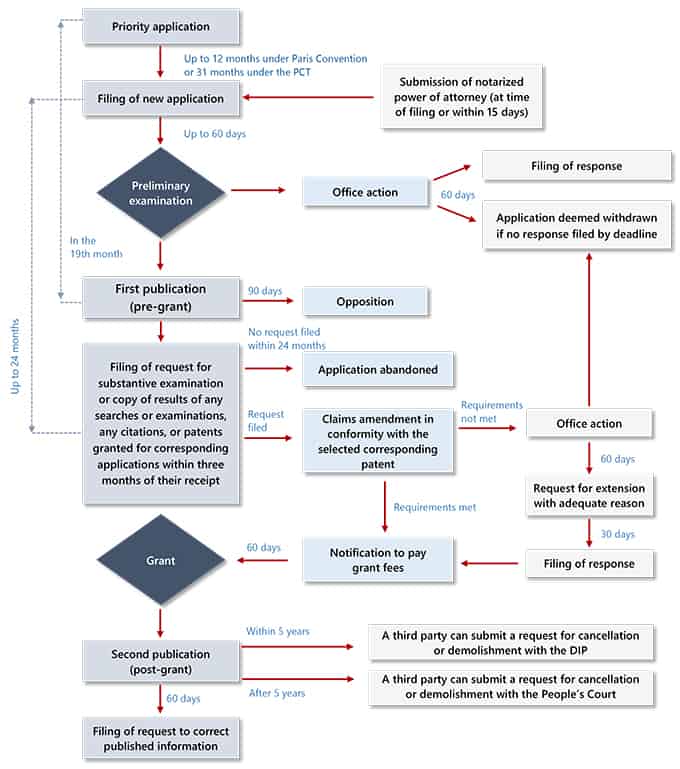
The DIP representatives found the flowchart to be a useful and practice overview, and provided helpful insights on best practices for obtaining a patent in Laos. They also expressed their optimism that the issues of prolonged pendency for patent registration in Laos may finally be improved, with the DIP aiming to decrease the backlog of pending patent applications in the coming few years. The successful realization of this improvement would be positive news for Laos, as it would allow the registration of these crucial rights to be completed in a timely manner, thereby attracting more incoming investment in technology from companies that would be able to rely on legal protections for their patented inventions.


RELATED INSIGHTS​ 

July 9, 2026
Recycling, upcycling, and refill-packaging models are now widely promoted as ways to reduce waste, lower carbon emissions, and respond to consumer demand for sustainable products. However, complications arise when these environmentally driven trends intersect with intellectual property law—particularly where reused or altered packaging continues to display third parties’ registered trademarks. Adding to this complexity, Thailand’s draft Sustainable Packaging Management Act aims to introduce new environmental compliance obligations that businesses must navigate alongside existing trademark concerns. Recycling and upcycling packaging may infringe trademark rights, especially in cases not protected by the first-sale doctrine—the principle that a trademark owner’s rights over a particular mark-bearing product end once the owner first sells it. Furthermore, even refill packaging carries legal risk due to specific statutory prohibitions under Thai law. Compounding these challenges, the draft Sustainable Packaging Management Act will impose extended producer responsibility (EPR) obligations on manufacturers and brand owners, requiring them to manage packaging throughout its lifecycle. These overlapping legal frameworks could deter manufacturers from pursuing ESG-aligned business models unless businesses understand how to navigate both trademark and environmental requirements. Under Thai law, this issue remains uncertain because the Trademark Act does not expressly codify the first sale doctrine, also known as the exhaustion of trademark rights. Generally, this doctrine provides that once a trademark owner has lawfully sold goods bearing its trademark, the owner’s right to control further resale of those particular goods is exhausted. The rationale is that the owner has already received commercial benefit from the first authorized sale; therefore, the purchaser should be free to resell or otherwise dispose of the goods. Although the doctrine is not expressly codified in the Trademark Act, Thai courts have recognized it in relation to genuine goods and parallel imports, as seen in a Supreme Court Judgment No. 2817/2543 in which the
July 6, 2026
Indonesia’s regulation on reporting online intellectual property (IP) infringement provides comprehensive procedural guidance for IP rights holders and their licensees in reporting online infringement complaints. Issued in December 2025 by the Ministry of Law as Regulation No. 47 of 2025 regarding Handling of Intellectual Property Infringement Reports in Electronic Systems, this regulation covers all types of IP rights. It also specifies documentation when reporting infringement, and lays out the procedures for examination, verification, and enforcement actions. Submission of Complaints Complainants may submit reports through the online system of the Directorate General of Intellectual Property (DGIP) or in person at the DGIP office. Complaints may also be filed through an authorized proxy. Under the regulation, complainants are required to provide the following information and documents: Personal details of the complainant; Brief description of the protected work or subject matter (i.e., type of IP and name or address of the infringing website, portal, account, or application, or a link to the location of the infringing content); Complete description of the alleged infringement; Certificate of registration or recordal of the relevant IP; Recordal of IP license agreement, if any; and Other supporting evidence. Verification and Examination Process Upon receiving a complaint, the responsible formality officer may request clarification or additional supporting documents. In the latter case, the complainant must then submit the necessary administrative documents within 14 days of the notification date. Once the documentation is deemed complete and sufficient, the case will be formally registered. Subsequently, the DGIP will establish a verification team to handle online IP violations, which will include the Civil Servant Investigator (PPNS), the Ministry of Communication and Digital Affairs, experts with relevant expertise in IP, and representatives from related associations such as AVISI (Indonesian Video Streaming Association). After examining the report, the team will prepare the Minutes
June 30, 2026
Customs recordation is an enforcement mechanism in Myanmar that enables intellectual property (IP) rights holders to seek prevention of the cross-border movement of infringing goods. The enactment of Myanmar’s IP laws in 2019 has enabled customs recordation for registered marks and copyrights under the Trademark Law 2019 and the Copyright Law 2019. By contrast, the Patent Law 2019 and the Industrial Design Law 2019 do not provide a practical framework for customs recordation, and accordingly such rights are not subject to the customs recordation regime. Under the Trademark Law 2019, rights holders may apply for customs recordation and may also ask the Customs Department to suspend the release of goods suspected of bearing counterfeit marks. Likewise, the Copyright Law 2019 allows for customs intervention in relation to pirated works. These provisions reflect Myanmar’s gradual alignment with international standards on border measures, although the implementation framework remains at a relatively early stage of development. Customs Recordation Pursuant to the Trademark Law 2019 and the Copyright Law 2019, the relevant authorities have issued customs rules concerning the protection of registered marks and copyrights. In practice, the process generally begins with the submission of an application to the Customs Department together with supporting documentation. This typically includes proof of registration in Myanmar; details of the rights holder, applicant, and any authorized representative; and a comprehensive description of the genuine goods. Product identification materials—such as photographs, packaging samples, and distinguishing features—are particularly important in helping customs officers identify suspected infringing goods. A recordation remains valid for two years from the date of approval. It may be renewed for additional two-year terms, provided that the renewal application is filed within the thirty days prior to expiry for marks and up to thirty days in advance of the expiry date for copyrights, in accordance with
June 24, 2026
Patent enablement requirements are provided under Article 102 of Vietnam’s Law on Intellectual Property (IP Law). In particular, a patent specification must “fully and clearly disclose the nature of the invention to such an extent that, based on the specification, a person having ordinary skill in the relevant art can implement the invention.” In pharmaceutical and biotechnology patents, this requirement is more complicated and subject to more rigorous assessment. The Patent Examination Guidelines (Guidelines) of the Intellectual Property Office of Vietnam (IP Office) were amended in March 2026 to introduce Annexes III and IV for the pharmaceutical and biotechnology sectors, in which Annex III provides detailed guidelines on the assessment of specification requirements. These amendments were made under a project for strengthening capacity in industrial property examination between the Japan International Cooperation Agency (JICA) and the IP Office. Annex III provides detailed instructions on how examiners assess enablement in a pharmaceutical or biotechnology application, and offers examples of acceptable and unacceptable descriptions with regard to the enablement aspect. Enablement Requirements in Pharma and Biotech Patents Article 12.7 of Circular 10/2026/TT-BKHCN (Circular 10) adds to the requirements of Article 102 of the IP Law that the description must demonstrate the novelty, inventive step, and industrial applicability of the technical solution. For pharmaceutical composition subject matters, Article 12.9 of Circular 10 sets out that the description must present the results of clinical trials and/or the pharmacological effects of the claimed pharmaceutical composition, and must include at least the following information: Substance/mixture used. Testing method (system) employed. Information on the test results. Correlation between the pharmacological effects obtained from the tests and the application of the pharmaceutical product in the prevention, diagnosis, and treatment of diseases. The Guidelines note that pharmacological study results should be presented in a quantified manner, and pharmacological