You are using an outdated browser and your browsing experience will not be optimal. Please update to the latest version of Microsoft Edge, Google Chrome or Mozilla Firefox. Install Microsoft Edge

April 30, 2021

Updated Regulations on Filing Patents and Petty Patents in Laos

Laos’ Department of Intellectual Property (DIP) published its Decision on Patents and Petty Patents No. 1714/MOST, dated December 15, 2020, in the Official Gazette on December 23, 2020. The decision is a replacement for and comprehensive revision of a similarly named 2012 decision, and it is the latest step in the country’s steady efforts to strengthen its patent regime. The new decision clarifies and simplifies many key points, the most significant of which are detailed below.

  • Priority date. Applications filed under the Patent Cooperation Treaty have a 31-month time limit for entering the national phase, counting from the priority date. This improves on the 2012 decision, which set the time limit at 30 months.
  • Submission of original documents. If the pre-filled, unsigned form for the power of attorney and deed of assignment is submitted, scanned copies of the notarized power of attorney and deed of assignment must be submitted within 15 days (down from 60 days under the 2012 decision). However, the original documents still must be submitted within 60 days.
  • International classification. Applicants can ask the Department of Intellectual Property (DIP) to indicate the international class of patent and petty patent applications. If there are amendments to the class, applicants can file an amendment form with the DIP free of charge. International classification was not mentioned in the 2012 decision.
  • Publication timeline. Applications for patents or petty patents will be published in the 19th month after the application filing or priority date. The 2012 decision, in contrast, did not mention the publication timeline.
  • Opposition. The procedures for an opposition to a patent or petty patent application are clear and concise under the new decision, whereas opposition was not mentioned in the 2012 decision.
  • Examination request period. While the 2012 decision gave only a broad description of examination, the new decision provides clear guidelines on procedures, requirements, and timeline of this phase. The applicant must request substantive examination within 24 months after the filing date for patents and six months for petty patents. International substantive examination results can be filed within three months of their receipt.
  • Claims. An excess fee will apply to each independent claim in excess of 3 and each dependent claim in excess of 15.
  • Error correction. The decision permits the correction of errors found in the publication of a patent after it has been granted. Correction requests must be made within 60 days of the date of publication.
  • Cancellation and withdrawal. Third parties can file cancellation applications with the DIP within five years after the relevant publication date in the Official Gazette. If more than five years has elapsed since the relevant patent’s publication date, the application should be filed with the People’s The 2012 decision had only addressed this issue in broad terms.
  • Annuity payments. There is a six-month grace period for renewal and annuity payments.

While securing patents in Laos has not been a priority for many companies operating in the jurisdiction, some of the ambiguity that surrounded the practice has been cleared up by this decision. Consequently, it is more worthwhile then ever for intellectual asset owners to incorporate a patent filing strategy into their business plans in Laos.

Filing Process for Patents and Petty Patents

This new decision on patents and petty patents was the main topic for a roundtable discussion between Tilleke & Gibbins and the Lao DIP on March 31, 2021. In preparation for the meeting, IP specialists at Tilleke & Gibbins developed a flowchart of the patent-filing process in Laos, emphasizing the key points of the new decision and providing a touchstone for the dialogue, allowing for practical and fruitful discussions of each step of the process. It also acts as a helpful guide to the process for those unfamiliar with it, and we are pleased to provide it below for reference.
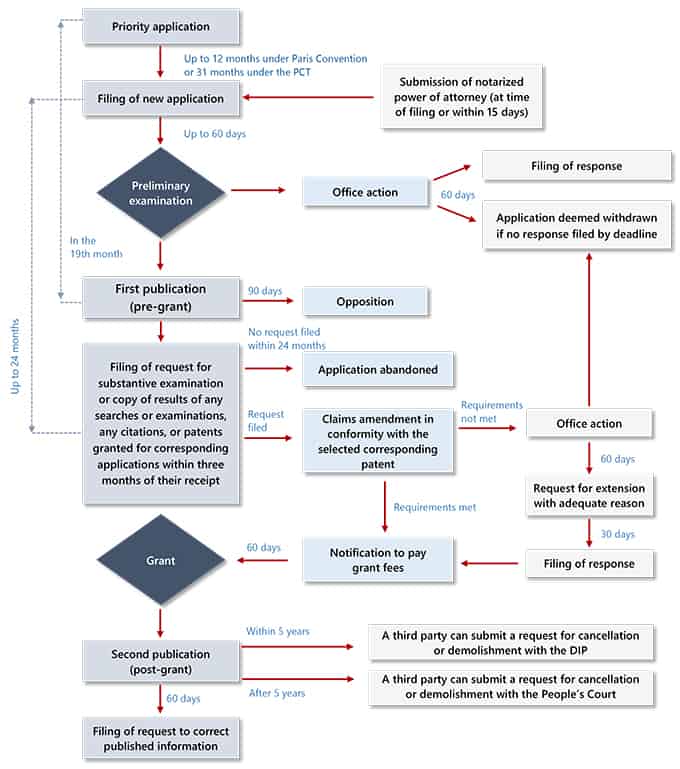
The DIP representatives found the flowchart to be a useful and practice overview, and provided helpful insights on best practices for obtaining a patent in Laos. They also expressed their optimism that the issues of prolonged pendency for patent registration in Laos may finally be improved, with the DIP aiming to decrease the backlog of pending patent applications in the coming few years. The successful realization of this improvement would be positive news for Laos, as it would allow the registration of these crucial rights to be completed in a timely manner, thereby attracting more incoming investment in technology from companies that would be able to rely on legal protections for their patented inventions.


RELATED INSIGHTS​ 

July 27, 2026
Vietnam’s new E-Commerce Law, which took effect on 1 July 2026 along with its implementing Decree No. 248/2026/ND-CP (Decree 248), marks a significant development in the country’s approach to online intellectual property (IP) enforcement, reflecting a clear shift from a reactive model of intermediary liability to one that expects platforms to play a more active role in preventing infringement. From notice-and-takedown to platform responsibility The most significant change introduced by the E-Commerce Law is the transformation of the legal role of e-commerce platforms. The existing safe harbor provisions under the IP Law and the copyright notice-and-takedown regime established by Decree 17/2023/ND-CP (Decree 17) largely required intermediaries to act only after receiving notice of infringement. Once infringing content had been removed, the platform’s legal obligation was generally considered fulfilled. The new legislation adopts a fundamentally different approach. Article 17 of the E-Commerce Law requires intermediary platforms to screen information relating to goods and services before publication in order to prevent listings involving counterfeit or IP-infringing goods, and goods of unknown origin. Rather than relying exclusively on complaints from rights holders, platforms are now expected to implement preventive measures before infringing listings become publicly available. Decree 248 further requires platforms to update keyword filters based on recommendations issued by competent authorities. These filtering mechanisms are intended to prevent prohibited listings from appearing on the platform and represent a further move away from a purely complaint-driven enforcement model. The legislation also introduces Vietnam’s first statutory stay-down obligation. Under the E-Commerce Law and Decree 248, major digital platforms must maintain automated systems capable of reviewing, warning against, and removing unlawful listings while also implementing measures to prevent repeat violations, defined under Decree 248 as conduct that has previously been identified and handled by the platform, but continues to recur. This obligation addresses one
July 27, 2026
Tilleke & Gibbins’ intellectual property specialists have authored the Thailand chapter of Trade Secrets 2026 from Chambers and Partners. This global guide examines the legal frameworks governing trade secret protection, enforcement, and litigation across jurisdictions worldwide. The Thailand chapter provides a comprehensive overview of the country’s legal regime for protecting confidential business information, covering the legal framework, trade secret misappropriation, litigation procedures, remedies, and dispute resolution. Some topics covered include: Protectable trade secrets Reasonable measures to maintain secrecy Employee confidentiality Trade secret licensing Civil and criminal remedies Litigation procedures and injunctions Damages and other remedies Mediation and arbitration The guide also examines practical issues relating to safeguarding trade secrets, defending against allegations of misappropriation, and managing trade secret disputes in Thailand. Chambers and Partners’ Global Practice Guides provide in-house counsel with authoritative commentary on practical legal issues affecting business, enabling readers to compare legislation and procedures across multiple jurisdictions. The Thailand chapter of Trade Secrets 2026 is available as a PDF through the button below. The full guide can be accessed for free on the Chambers and Partners website.
July 27, 2026
In March 2025, Thailand’s Central Intellectual Property and International Trade Court (IP&IT Court) issued a landmark judgment in favor of Luckin Coffee, China’s leading retail coffee chain. The judgment marked a significant turnaround following earlier trademark litigation involving Luckin Coffee from 2021 to 2023 that had generated widespread public attention and raised questions about the protection available to legitimate foreign brand owners in Thailand. In a significant subsequent development, Thailand’s Court of Appeal for Specialized Cases has now affirmed the IP&IT Court’s judgment in its entirety. The appellate decision brings clarity to one of Thailand’s most closely watched trademark disputes. Significantly, this is the first case in Thailand to formally recognize the trademark squatting principle. The Court of Appeal confirmed that Luckin Coffee has a better right to the disputed mark and ordered cancellation of the defendants’ trademark registration—a key application of the “better right” doctrine. The court also upheld the substantial damages awarded at first instance, providing important guidance on assessing harm from systematic trademark squatting. Award-Winning Judgment Affirmed in Its Entirety The significance of the first-instance judgment extended beyond the outcome for Luckin Coffee. The IP&IT Court judgment was subsequently recognized in the IP&IT Court’s Distinguished Judgment Awards in 2025, reflecting the complexity, novelty, and legal significance of the issues considered in the case. The defendants nevertheless appealed the judgment, challenging several key aspects of the IP&IT Court’s decision. Luckin Coffee continued to entrust Tilleke & Gibbins as their sole attorney to pursue the case at the appellate level. After considering the defendants’ appeal and Luckin Coffee’s submissions in response, the Court of Appeal affirmed the first-instance judgment in its entirety. The judgment was announced on July 8, 2026. Better Right to the Marks The Court of Appeal confirmed Luckin Coffee’s superior rights. The orders include cancellation
July 24, 2026
As food innovation continues to accelerate, manufacturers are increasingly introducing ingredients derived from new sources, produced using novel technologies, or lacking a significant history of human consumption. While these innovations create new opportunities for the food industry, they also raise important questions regarding consumer safety. For this reason, many jurisdictions, including Thailand, the European Union, Australia and New Zealand, Canada, and Singapore, require a premarket safety assessment for novel food ingredients before they can be placed on the market. The objective of this assessment is to ensure that each ingredient is safe for its intended use and level of consumption, does not present toxicological, allergenic, microbiological, or nutritional concerns, and will not mislead consumers. Scientific authorities typically evaluate the ingredient’s identity, manufacturing process, composition, specifications, anticipated dietary exposure, toxicological information, nutritional impact, and history of use before determining whether it can be marketed. Against this background, the Thai Food and Drug Administration (FDA) recently took an important step toward improving regulatory transparency by publishing, for the first time, a consolidated public list of substances that have successfully completed the Thai FDA’s safety assessment process, including substances determined to be novel foods and those determined not to fall within the novel food category. The list identifies the approved substances, the corresponding manufacturers or importers, approval dates, and the approved conditions of use. Although the publication does not change the existing legal framework governing novel food approvals, it provides businesses with greater visibility into the Thai FDA’s regulatory precedents and the types of substances that have previously been accepted through the safety assessment process. The full announcement is available on the Thai FDA’s website. As the list is now publicly available, it also provides useful insight into the types of substances that have successfully completed the Thai FDA’s safety assessment process.